Pickles!

pickles1 Folks, I'm finding it hard to contain my excitement about NDP's second-ever guest post. Guess who wrote it? MY MOM!

That's right: in the post below, NDP Ima tells you all about easy-to-make, hard-to-stop-eating pickles. You'll see from her intro paragraph where I got my taste buds. These pickles are salty, tangy, and really bright from the addition of fresh dill. So read up -- then go make some pickles!
pickles2

I am really not a salt lover. I don’t use much when I cook, and in restaurants great food that’s well-seasoned is often too salty for my taste. I don’t care for chips or french fries, and I prefer nuts spicy or au naturel. Nonetheless, I do love briny salty things – olives, capers, and sour pickles. So when I was leaving town for a long weekend and had a lot of small cucumbers that wouldn’t last until my return, I decided to try my hand at some pickles. I wanted spicy, garlicky, dill pickles that would make themselves in the refrigerator while I was gone. I remembered the ones a family friend used to make with cucumbers from his garden and my dad’s. He didn’t use shortcuts, though – he put his pickles in huge crocks of brine and alum in the basement for weeks.

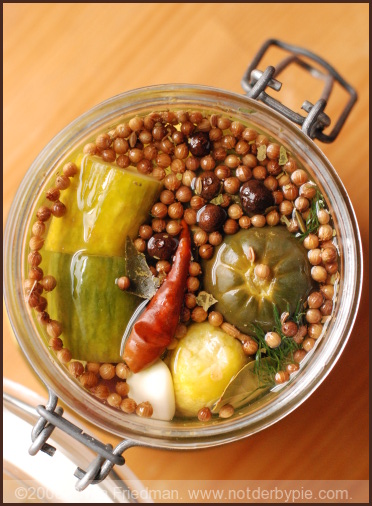
I cut the cukes into thick, chunky slices and placed them in a quart jar with pickling spices and garlic. I didn’t have any fresh dill, so my first batch just had dill seed from the pickling spice, but it still tasted authentic. I prepared the vinegar brine and filled the jar, leaving it upside down on the counter overnight. The next morning, before rushing to the airport, I put the jar in the frig. When I returned four nights later, the pickles were done to perfection! pickles3
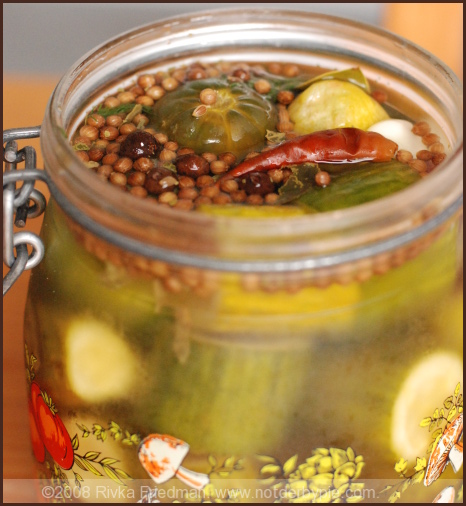
The recipe below is really more of a method – you can vary the ingredients, and the size of your jars and your cucumbers will determine your quantities. As long as you maintain the proportions of ¾ cup of vinegar and ¼ cup of kosher salt per quart of boiled and cooled water, your brine will work and you’ll have great pickles in a matter of days. Try this with green tomatoes if you have them in your garden, with blanched cauliflower, small sweet peppers, or blanched pearl onions. Add onions or hot peppers for extra kick. I used just one hot pepper to enhance the spicy flavor. I made a second batch with fresh dill sprigs, blanched carrots, and a few kalamata olives in addition to the cukes. They’re not quite finished as a I write this, but they look so good I can’t wait to sample them!

If you like sweet pickles instead of sour, substitute sweet pickling spices, cloves, and allspice, use cider vinegar instead of white vinegar, and add sugar (1/2 cup to ¾ cup) to your brine.

Your pickles will keep about four months in the refrigerator. If you seal your finished pickle jars with a canning process, they will keep on the shelf indefinitely. Open jars should be refrigerated.
pickles4

Refrigerator Dill Pickles

1 dozen or more pickling cucumbers or small English cucumbers

4-8 cloves garlic, peeled and cut in half

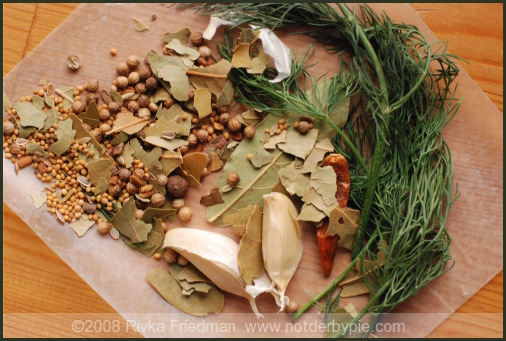
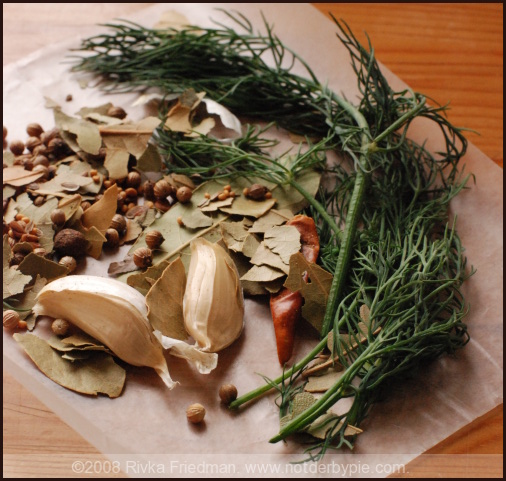
2-3 tablespoons pickling spice (the brand I used had dill seed, mustard seed, celery seed, coriander, ginger, black peppercorns, bay leaves, and red pepper)

A few sprigs of fresh dill

1 small dried hot pepper, or a fresh hot pepper cut in half and seeds removed (optional)

1 quart water boiled and cooled

¾ cup white vinegar

¼ cup salt (kosher salt works well, but sea salt or table salt are also fine)

A pinch of sugar (if desired – I omitted)

Use one or two quart jars or a gallon jar, depending on how your cucumbers fit into the jar. The amounts of spices are for one gallon jar or two quart jars, but you can modify this according to taste and the quantity of pickles you want to make. Place one tablespoon of pickling spice, half the dill and half the garlic in the bottom of the jar. If using slender or English cucumbers, you can cut them into thick chunks/slices and they will be ready in less time. If you use larger cucumbers, you can pickle them whole and cut them into lengthwise quarters when you serve them. Pack the cucumbers tightly into the jar(s). When you have added most of the cucumbers, add half of the remaining spices and garlic. When all the pickles are in the jar, add the last of the spices. If using the pepper, place it in the middle layer.

When the jar is full of cucumbers and spices, stir the salt into the vinegar. Pour the mixture into the boiled water and stir to finish dissolving the salt. The water does not have to reach room temperature, since it will continue to cool as you make the brine. Fill the jar to the brim with brine. Close the jar tightly with its lid. Invert the jar into a bowl and leave it outside the refrigerator. After one day, turn the jar upright. Check to see how pickled the cucumbers are. If you used the smaller, slender cukes, it is probably time to refrigerate the pickles. They will be completely done in another three or four days. If you used larger cucumbers, leave them out for another day or two. Check for doneness according to your preferences – if you prefer half-sour, they should be edible after just one-two days.

When the pickles are as done as you like them, you can pour out half the brine, leaving as many spices in the jar as possible. Replace the removed liquid with a mixture of plain boiled water and vinegar. For each cup of boiled, cooled water, add two tablespoons of white vinegar. Fill the jar to the top again and refrigerate. You can also remove the hot pepper if you don’t want the pickles to get spicier over time.

Not So Potato-y Salad

potato-salad-1 From a vege-mostly-tarian’s perspective, spring and summer are the seasons to beat. Fresh fruit and vegetables are available in abundance, and the variety, especially in summer, is simply unmatched. I make at least one salad a day; using anything from the usual lettuce and Israeli cucumbers to radishes to carrots to tomatoes and nectarines, mushrooms and garlic scapes and beets and even raw kale (my newest addition), I rarely repeat ingredients two days in a row.

It’s in this light that barbeque food confuses the hell out of me; why, when there are so many beautiful fruits and vegetables available, do we resort to coleslaws and potato salads that are literally choking on my gloppy, quivering, nemesis, the devil named Mayo? Those thick, white dressings are a “no, thanks” for me, but if we’re going to use them, why not when we’re on our 20th batch of kale and need to get creative about masking the taste of winter? I simply don’t get the desire to coat delicious summer vegetables in all that goop. …And the Mayo gripes resume.

While I almost always serve a leafy green salad with meals these days, I did buy some really beautiful tiny tomatoes at the Foggy Bottom market last week, which gave me an occasion to reconsider the merits of potato salad. I’m not a huge potato person, but I get the appeal of having a side dish that’s got some starch and substance but isn’t the same old rice or other grain. However, instead of putting the potatoes front and center, I decided to make room for other vegetables to share the limelight. Happily, the market provided many options. I settled on some pattypan, small summer squash that are shaped somewhat like a flying saucer, as well as some nice-looking green beans.

potato-salad-2

After boiling, shocking, and slicing the potatoes, I sliced and blanched the zucchini. I left the green beans raw, for crunch, and I'm glad I did -- they provided a much-needed contrast to the softer vegetables. I coated the salad in a light, tangy, slightly spicy shallot-mustard vinaigrette, which complemented the slight bitterness of the zucchini and gave otherwise boring potatoes some real character. All in all, this is the type of potato salad I'd actually go for: it highlights summer produce instead of masking it, and its tangy flavors will make a great addition to any barbeque.

Not So Potato-y Salad

1 pound small (like, really small) red and yellow potatoes 2 long summer squash (yellow or green), sliced into 1/2-inch slices 1 pound green beans, halved 2 shallots, diced finely 2 teaspoons coarse dijon mustard 1 teaspoon honey 1/4 cup sherry or white wine vinegar 1/8 cup olive oil 1 teaspoon walnut oil, optional salt and pepper

Boil potatoes in 4 cups water until soft but not mushy, about 10 minutes. Using a slotted spoon, remove potatoes and transfer to serving bowl. Let cool 15 minutes.

Meanwhile, blanch squash slices in potato water about 2 minutes, just until soft. Drain and run under cold water for a couple seconds to stop cooking. Transfer to serving bowl.

Slice potatoes into rounds, and transfer to serving bowl. Add green beans and toss to mix.

In a small bowl or dressing jar, combine all remaining ingredients except oil. Pour oil in a slow stream, whisking to combine. If using jar, shake vigorously to emulsify. Add dressing to salad and toss about 10 minutes before serving. Serve at room temperature.

Tamarind-Cherry Meatballs

Short post today, but I wanted to offer a recipe that puts the tamarind puree I recently posted to good use. These meatballs are really a cinch to make; they're studded with rich, nutty pine nuts, and the sweet-tart sauce, with fresh and dried sour cherries and plenty of tamarind, is downright addictive. The recipe is a combination/adaptation of two recipes, both from Aromas of Aleppo, that beautiful Syrian Jewish cookbook I mentioned in my post on tamarind puree. Sour cherries are done for the season here in DC; if they're over in your area as well, you can substitute frozen sour cherries, available at some grocery stores, or replace the fresh ones with more dried cherries, and add a bit of extra apple cider or wine or even water to compensate for smaller amount of cherry juice.

I served these with saffron rice, which provided both flavor and color contrast to the meatballs. The combination was perfect, and I highly recommend it.

Sour Cherry Meatballs adapted from Aromas of Aleppo

1 pounds ground beef, preferably NOT lean (if lean, add a couple Tbsp. olive oil) 1/2 cup chopped pinenuts a couple sprigs of parsley, leaves removed and chopped 1 1/2 teaspoons allspice, divided 3 onions, diced 1 pound sour cherries or 2 cans/jars pitted cherries, including liquid (NOT pie filling!) 3 tablespoons tamarind puree juice of 1 lemon 1 tablespoon sugar 1 cup red wine 1/2 cup crushed tomatoes 3 tablespoons vegetable or olive oil, divided

Combine beef, pine nuts, parsley, and 1/2 teaspoon allspice in a medium mixing bowl. Using a fork and a light hand, break up ground beef and incorporate other ingredients; do not overmix or press too hard, as you want beef to stay light and airy.

In a medium saucepan, saute meatballs in 2 tablespoons olive or vegetable oil over medium heat, until lightly browned, turning gently to brown on all sides. Remove meatballs and set aside.

Using the same saucepan, saute the onions in the remaining tablespoon oil over medium heat until translucent, about 5 minutes. Add liquid from cherries (if fresh, use 1/2 cup water or apple cider instead), lemon juice, tamarind puree, red wine, 1 teaspoon allspice, and crushed tomatoes. Stir to combine; bring to a boil. Add meatballs and cherries back into the pan. Cover, reduce heat to low, and simmer for 1 hour, or until sauce has thickened.

Serve hot, either over pita or over saffron rice.

Spinach and Roasted Red Pepper Gratin

This rich, flavorful gratin dish makes a fantastic light supper or lunch main course. It also happens to be gluten-free and kosher for passover -- go figure. Spinach and Roasted Red Pepper Gratin adapted from Epicurious

4 10-ounce bags fresh spinach leaves 3 red bell peppers 1 1/2 tablespoons butter 1 1/2 tablespoons olive oil 3 medium leeks (white and pale green parts only), thinly sliced (about 3 cups) 1 large shallot, chopped (about 1/4 cup) 3 garlic cloves, minced 1 cup whipping cream 4 large eggs 1 cup part-skim ricotta cheese 1/2 cup grated Swiss cheese 1/4 cup grated Parmesan cheese 1 1/2 teaspoons salt 1/2 teaspoon ground black pepper

Heat large deep nonstick skillet over medium-high heat. Working in batches (about 10 cups at a time), sauté fresh spinach in dry skillet until bright green and wilted, about 2 minutes per batch. Transfer spinach to strainer. Squeeze spinach dry; roll in kitchen towel to remove excess water.

Char peppers directly over gas flame or in broiler until blackened on all sides. Enclose in paper bag; let stand 10 minutes. Peel, seed, and slice peppers into 1/4-inch-wide strips.

Melt butter with oil in heavy large skillet over medium heat. Add leeks, shallot, and garlic; cook until soft, about 5 minutes. Remove from heat. Whisk cream and eggs in large bowl to blend. Whisk in all cheeses, salt, and pepper. Stir in spinach, leek mixture, and 2/3 of roasted red peppers (reserve 1/3 of peppers for topping). (Can be prepared 1 day ahead. Cover and refrigerate.)

Preheat oven to 350°F. Generously butter 13x9x2-inch baking dish. Transfer spinach mixture to prepared dish. Bake gratin until knife inserted into center comes out clean, about 50 minutes. Arrange remaining red pepper strips decoratively atop gratin and serve.