Curried Kohlrabi and Apple Slaw

Every year, sometime in late November, we turn on our heat, move the sweaters to the top drawer, dig up our tights and fleece-lined slippers, ...and stop eating salads.

It's silly, really. Once the cold sets in, and my cravings for fresh, red tomatoes are a faint mystery, all I can think about is stew and soup, tea and cider. Might a salad go perfectly with my black bean chili? Why yes, yes it would. Do I make one? No, no I don't. The chill kills my appetite for fresh leaves, replaces it with a deep-belly hunger for soy-marinated kale and spicy, savory pasta dishes like this one. But I'm right on cue. Around December, I suddenly remember winter vegetable slaw, and everything changes.

That's the beauty of slaws: they're a year-round staple. Bring'em to a barbeque in the summer, make one with the best of what produce you've got in winter. Use cabbage of any kind, but also broccoli, fennel, cucumbers, carrots, pretty much whatever you've got. Go Asian, Mexican, Singaporean, or fusion. The possibilities are limited only by your imagination.

Case in point: when two kohlrabis were included in this week's CSA along with a grab-bag of apples, the wheels started turning. I thought of the brand new jar of Madras curry powder, the unsulphered apple cider vinegar, and a wonderful slaw I'd devoured at an otherwise terrible restaurant (which I'd vowed to recreate, in part so I'd never have to dine there again. A fellow blogger describes the place as "what it'd look like if Epcot Center threw up Cuba." She's spot-on.) But I digress. The curry, the apple cider vinegar, the kohlrabi, the apples: they'd go really well together, it dawned on me.

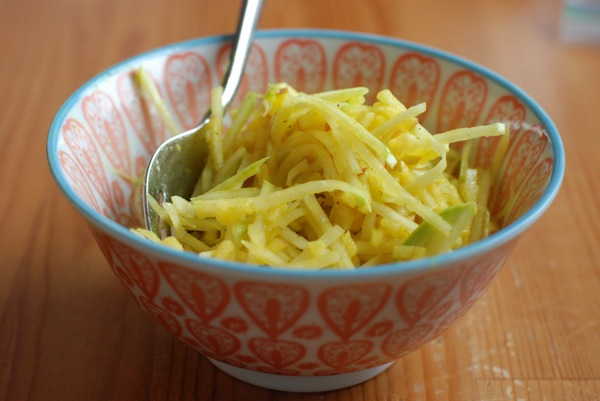
And so they did. The curry powder turned the slaw an electric orange-yellow, which was pretty awesome. I've never gone Indian with slaw before, but after this successful experiment, I'll be doing it again for sure.

Curried Kohlrabi and Apple Slaw serves 4

1/4 cup peanut or canola oil 1 teaspoon high-quality curry powder 2 kohlrabis, peeled 1 crunchy, crispy apple (I used Cortlandt; Granny Smith, or any other crispy, not-too-sweet apple, would also be great), unpeeled 1/8 cup apple cider vinegar 2 teaspoons grainy mustard 3/4 teaspoon salt, to taste freshly cracked pepper

Heat oil in a small saucepan over medium heat. When oil shimmers, add curry powder. Heat for about 30-45 seconds, until curry starts to sizzle and faintly starts to darken in color. If it hasn't darkened after 45 seconds, don't wait: remove pan from heat, transfer flavored oil to a jar with a lid, and let cool to room temperature, about 10 minutes.

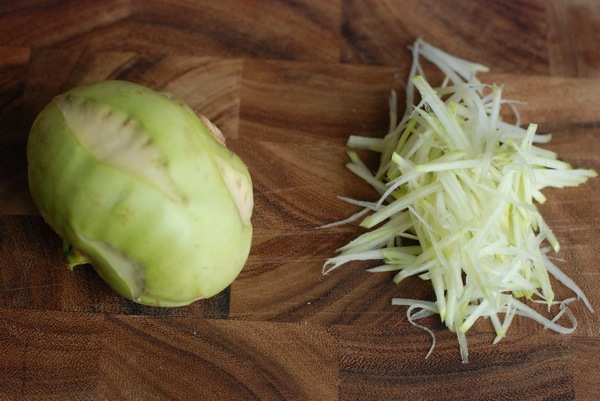
Meanwhile, using the julienne slicer, slice peeled kohlrabi and apples (unpeeled, for color contrast) on 1/4-inch setting. Once kohlrabi and apple have been julienned, toss pieces to separate from each other (they have a tendency to stick together) and transfer to medium salad bowl.

Add mustard to oil, and shake vigorously to combine. Then add apple cider vinegar, half of salt, and pepper, and continue shaking until dressing is emulsified. Dip your finger into the dressing to taste, and add more salt if desired.

Dress slaw with half the dressing to start; depending on the size of your kohlrabi and apple, you may not need it all. Taste, and add more dressing as desired. Serve.

Coleslaw will keep for several days; the kohlrabi softens, but the texture of the softened slaw is appealing in a totally different way.

Mushroom Conserva

This is part of a series on great side dishes for Thanksgiving and year-round. The first of the series can be found here.

To my mind, there are two foods whose flavor profiles are so diverse, they can taste like just about anything. One is cheese, which can taste sweet or salty, buttery or nutty or mild, grassy or spicy or altogether funky, like hot peppers or red wine, pure raw milk or bay leaves. The other? Mushrooms.

The buttons taste bland, but when you get into chanterelles that taste and smell of butter and honey, oyster mushrooms with briny undertones, and morels that sing of smoke and springtime, you're talking serious flavor diversity. My favorites are honeycap mushrooms, which smell and taste like honey with chocolate undertones. I could literally sit for days with my nose deep in a basket of honeycaps.

The sweet taste of honeycaps comes at a price: $15 a box, to be exact. With few exceptions, I steer clear, making a b-line for the criminis, shiitakes, and maybe some chanterelles. Criminis are pretty plain, shiitakes slightly less so; when I serve these to company, I'm looking to maximize their flavor and increase their shelf life in case there are leftovers. For this, I turn to mushroom conserva. It comes from one of my new favorite cookbooks, Thomas Keller's Ad Hoc at Home.

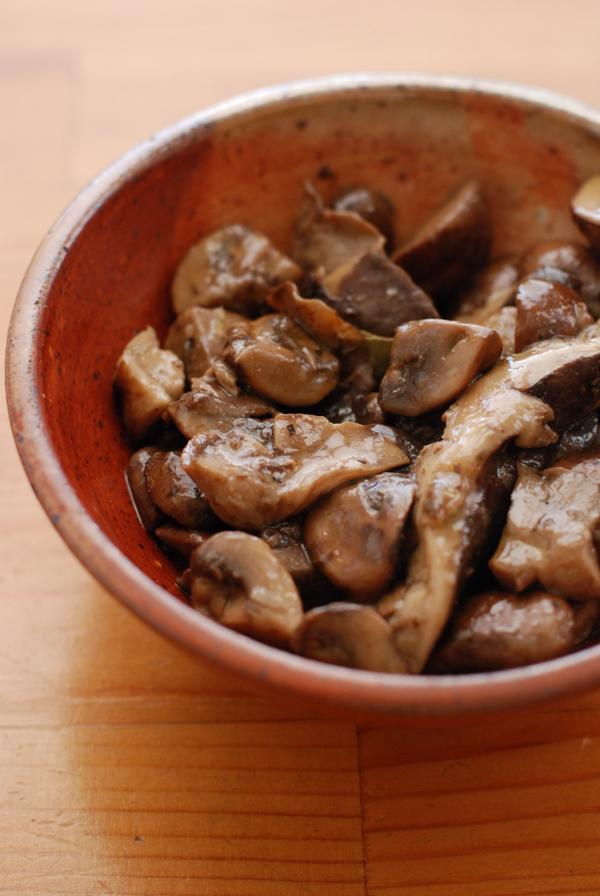
A recipe the likes of which only Thomas Keller could have invented, mushroom conserva is to mushrooms what jam is to fresh raspberries. Keller has you essentially poach the mushrooms in oil perfumed with herbs and spices, splash the mixture with vinegar, and then jar them. Submerged in the oil, the mushrooms keep for upto a month -- much longer than they would otherwise. While the recipe calls for wild mushrooms galore, I've found that peppering a mostly crimini/shiitake mix with smaller portions of wild mushrooms works quite nicely, and is easier on the wallet. As if these weren't enough to motivate, this recipe -- just like the green beans I wrote about earlier this week -- is actually meant to be made in advance. Just trying to make your life easier, folks. Thank me later.

Mushroom Conserva from Thomas Keller's Ad Hoc at Home

note: if you don't have piment d'espelette, feel free to use a different paprika. I used smoked paprika one time I made this, and thought it was lovely.

2 pounds assorted wild mushrooms such as small shiitakes, morels, chanterelles, small porcini, hen-of-the-woods, trumpet and oyster; if you can't get these or enough of them, feel free to substitute some criminis, 2 cups extra virgin olive oil 2 bay leaves 4 sprigs thyme 1 sprig rosemary (6 inches) 1 teaspoon piment d'espelette (if you don't have this, feel free to use a different paprika) 3 tablespoons sherry wine vinegar kosher salt fresh cracked black pepper

Just before cooking, rinse the mushrooms as necessary to remove any dirt. Remove any stems that are tough, such as the stems of shiitake mushrooms and discard or set aside for another use, such as a vegetable stock. Trim the end of other stems as well as any bruised areas.

Cut the mushrooms into pieces. The size and shape will vary with the variety of the mushroom. Small mushrooms can be left whole, larger mushrooms can be cut into chunks or into slices. Some mushrooms with meaty stems such as porcini or trumpet mushrooms, can be cut lengthwise in half.

Use the tip of a paring knife to score the inside of the stem in a crosshatch pattern. This will enable the marinade to penetrate the stem. The pieces of mushroom will shrink as they cook, but the finished pieces should not be larger than one bite. You should have about 1.5 pounds (10 cups) of trimmed mushrooms.

Place the olive oil, bay leaves, thyme sprigs, rosemary and Piment d'Espelette in a large, wide saucepan over medium to medium high heat.

Place a thermometer in the pot and heat until the oil reaches 170 degrees F, stirring the mushrooms in the oil from time to time. It may be necessary to tilt the pot and pool the oil to get a correct reading on the thermometer. Adjust the heat as necessary, to maintain this temperature for 5 minutes.

Add the mushrooms to the pot, and gently turn the mushrooms in the oil.

When the oil reaches 170 degrees F again, maintain the temperature for 5 minutes, gently turning the mushrooms from time to time. The mushrooms will not initially be submerged in the oil, but will wilt as they steep.

After 5 minutes, turn off the heat and stir in the vinegar and salt and pepper to taste. Let the mushrooms steep in the oil for 45 minutes. Place the mushrooms, oil and herbs in a covered storage container. Kept covered in oil the mushrooms will keep for up to 1 month in the refrigerator.

Reheat conserva before serving.