Tamarind-Cherry Meatballs

Short post today, but I wanted to offer a recipe that puts the tamarind puree I recently posted to good use. These meatballs are really a cinch to make; they're studded with rich, nutty pine nuts, and the sweet-tart sauce, with fresh and dried sour cherries and plenty of tamarind, is downright addictive. The recipe is a combination/adaptation of two recipes, both from Aromas of Aleppo, that beautiful Syrian Jewish cookbook I mentioned in my post on tamarind puree. Sour cherries are done for the season here in DC; if they're over in your area as well, you can substitute frozen sour cherries, available at some grocery stores, or replace the fresh ones with more dried cherries, and add a bit of extra apple cider or wine or even water to compensate for smaller amount of cherry juice.

I served these with saffron rice, which provided both flavor and color contrast to the meatballs. The combination was perfect, and I highly recommend it.

Sour Cherry Meatballs adapted from Aromas of Aleppo

1 pounds ground beef, preferably NOT lean (if lean, add a couple Tbsp. olive oil) 1/2 cup chopped pinenuts a couple sprigs of parsley, leaves removed and chopped 1 1/2 teaspoons allspice, divided 3 onions, diced 1 pound sour cherries or 2 cans/jars pitted cherries, including liquid (NOT pie filling!) 3 tablespoons tamarind puree juice of 1 lemon 1 tablespoon sugar 1 cup red wine 1/2 cup crushed tomatoes 3 tablespoons vegetable or olive oil, divided

Combine beef, pine nuts, parsley, and 1/2 teaspoon allspice in a medium mixing bowl. Using a fork and a light hand, break up ground beef and incorporate other ingredients; do not overmix or press too hard, as you want beef to stay light and airy.

In a medium saucepan, saute meatballs in 2 tablespoons olive or vegetable oil over medium heat, until lightly browned, turning gently to brown on all sides. Remove meatballs and set aside.

Using the same saucepan, saute the onions in the remaining tablespoon oil over medium heat until translucent, about 5 minutes. Add liquid from cherries (if fresh, use 1/2 cup water or apple cider instead), lemon juice, tamarind puree, red wine, 1 teaspoon allspice, and crushed tomatoes. Stir to combine; bring to a boil. Add meatballs and cherries back into the pan. Cover, reduce heat to low, and simmer for 1 hour, or until sauce has thickened.

Serve hot, either over pita or over saffron rice.

Feta Phyllo Torte

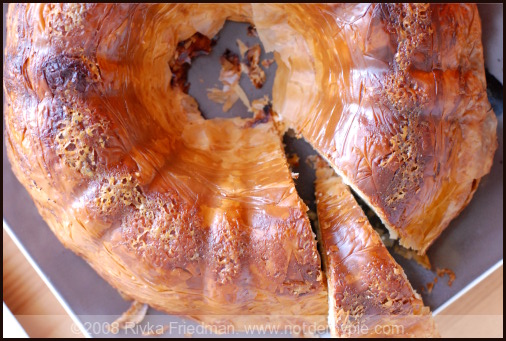
feta-phyllo-1a Feta Phyllo Torte

Of all the incredibly culinary feats out there (and there are plenty), one of which I'm truly in awe is the ability to consistently serve vegetarian food that fees like a main dish. As I've written before, one of the challenges to purely vegetarian cooking is that often, everything on the table looks like a side dish, and there's no one thing that, when brought to the table, elicits the oohs and ahhs of, say, a whole roast chicken. There are a few people who are particularly excellent at this. One is Deborah Madison, author of Vegetarian Cooking for Everyone (one of my favorite cookbooks to read; I often find myself leafing through it while killing time at Barnes and Noble). Madison understands the challenge of creating a "wow factor" when serving vegetarian entrees, and she conquers that challenge seemingly effortlessly. Her books are endless sources of inspiration for meatless entertaining.

feta-phyllo-1

Another, though she may not intend to be (given her well-publicized love of meat) is Melissa Clark, a food columnist for NYT and recipe writer extraordinaire. Reading Melissa's column, I not-infrequently stumble upon a really new idea for a vegetarian entree. One excellent example is her cornbread and broccoli rabe strata, a vegetarian Thanksgiving main that doubles as a side for the turkey eaters. Another, for a phyllo feta torte, was published just a couple weeks ago, and after reading her recipe, I had an undeniable urge to rush into the kitchen and make it, immediately.

feta-phyllo-2

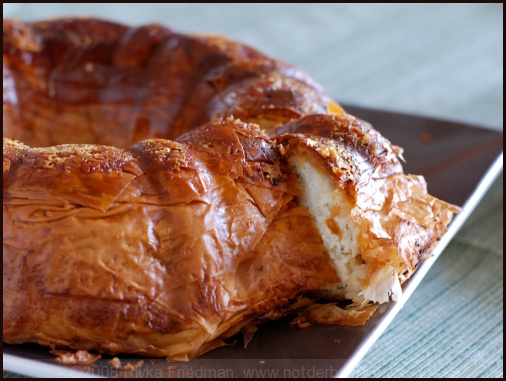
Originally called "No-fear Phyllo Torte," Clark's recipe originates in a dinner party hosted by a lauded French literature professor and his Greek wife, for whom phyllo is second-nature. Clark claims intimidation, but her recipe proves her an equal master of this domain. In the torte, made in a bundt pan for a particularly impressive presentation, thin, crisp layers of butter-soaked phyllo cloak a tender filling of feta, cottage cheese, dill and nutmeg. Sound like a spinachless spanikopita? Think again: the finished product is drizzled with honey before serving, for an irresistible hit of sweet to balance the rich, salty torte. Stop me from drooling.

feta-phyllo-3

Clark was intimidated when she first saw the torte emerge from the oven, and wondered whether she needed to be Greek in order to make it successfully; I had an all-out panic attack when, just before serving the torte, I realized that I had used salted butter in place of the unsalted butter called for in the recipe. It didn't matter; I had used less salty Greek feta in the filling, which offset the extra salt in the crust. Other changes I made to Clark's original recipe include swapping out some of the cottage cheese for extra feta (since cottage cheese generally gives me the creeps, and 3 cups sounded like a lot), upping the level of dill and nutmeg for added kick, and cutting the butter from 3 sticks to 1 (because who needs 3 sticks of butter in anything? and 1 was more than enough to coat the whole torte and make the insides crispy). Other than those changes, I found this recipe absolutely to die for and would make it again in a flash. I actually served it with some homemade rhubarb chutney, which I'll blog in a future post, and I was really pleased with the combination. The tanginess of the rhubarb brought out the acidity in the feta and the chutney provided a nice textural contrast to the torte. An all-out thumbs up from this happy eater -- I recommend you give this a go; your guests will be thankful -- and maybe even intimidated.

feta-phyllo-4

Sonia's Phyllo and Feta Torte with Dill and Nutmeg Time: An hour and a half, plus cooling adapted from Melissa Clark, inspired by her husband's friend's wife Sonya, via The New York Times

Time: An hour and a half, plus cooling

1 1/2 pounds Greek feta cheese, crumbled (I used feta from a local Mediterranean market, but TJ's carries Greek feta that's pretty good) 2 cups cottage cheese 3 large eggs 1/3 cup chopped fresh dill 1/4 cup grated Romano cheese (I used Parmesan, which was what I had on hand) 1 teaspoon freshly grated nutmeg 1/2 teaspoon freshly ground black pepper 1 1-pound box phyllo dough, thawed overnight in refrigerator if possible 1/2 cup (1 stick) unsalted butter, melted

Greek honey, for serving (Clark says this is optional but I say it's a must).

1. Heat oven to 375 degrees. combine feta, cottage cheese, eggs, dill, 2 tablespoons Romano, the nutmeg and pepper in a food processor and pulse just to combine (Clark says you can also use a large bowl and a fork). Clark also says the mixture should be chunky, but I made mine smoother.

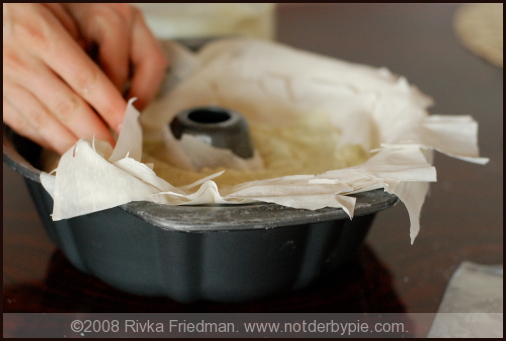
2. Sprinkle remaining 2 tablespoons Romano into a Bundt pan. Drape a sheet of phyllo on top of Bundt pan, poke a hole into phyllo with your finger where center tube is and push phyllo into pan to line it. Do this with another phyllo sheet, but place it perpendicular to first sheet. The first couple of sheets will seem disorderly and may collapse some, but as you start layering them, the process will get easier and the sheets will keep their shape. Continue adding phyllo sheets in alternating directions until all sheets are used. Edges of phyllo should hang over edges of bundt.

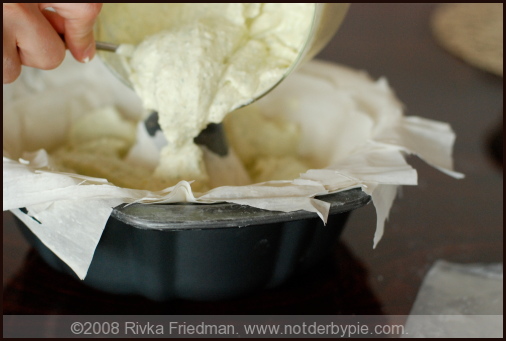
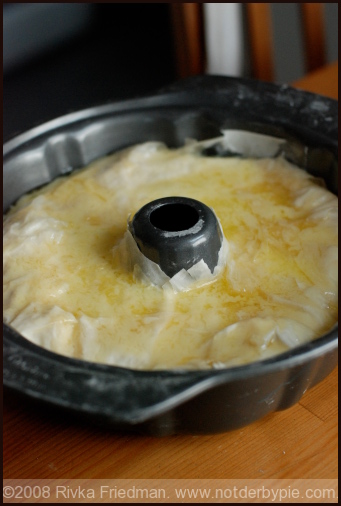
3. Scrape cheese filling into pan, and fold edges of phyllo over filling. Using a sharp knife, poke many holes (at least 20) in dough that reach all the way to bottom of pan. Then pour melted butter over the torte; some will seep into holes, but a fair amount will pool on top of torte, which is fine. I actually poured the butter before poking the holes, and my torte tasted perfectly delicious, so fret not.

4. Place Bundt pan on a baking sheet and bake for about 1 hour 15 minutes, or until torte is puffy and golden brown. Allow torte to cool in pan for 1 to 2 hours before inverting onto a plate and slicing. Serve warm or at room temperature, with honey and/or sweet chutney.

Yield: 10 to 12 servings.

Classic Mac and Cheese

macncheese5 As you all know by now, D's made lots of culinary concessions for the sake of our relationship. In the four-plus years we've been together, she's become someone who appreciates good food far more than I ever thought she would. So this past week, I felt inspired to acknowledge that by taking a couple of steps in her direction and finally trying my hand at macaroni and cheese.

macncheese2

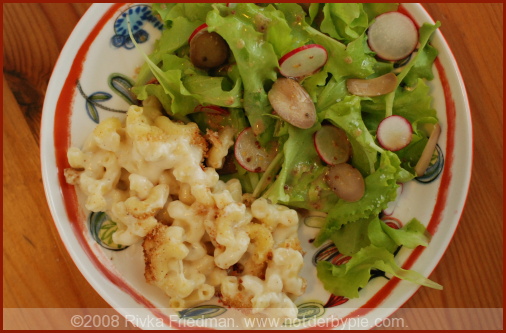
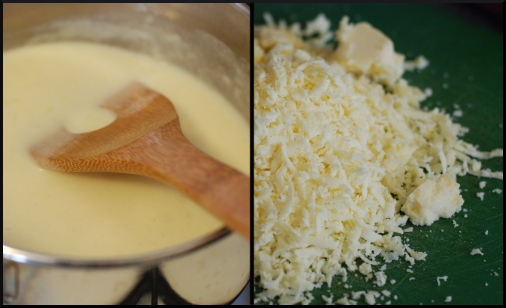
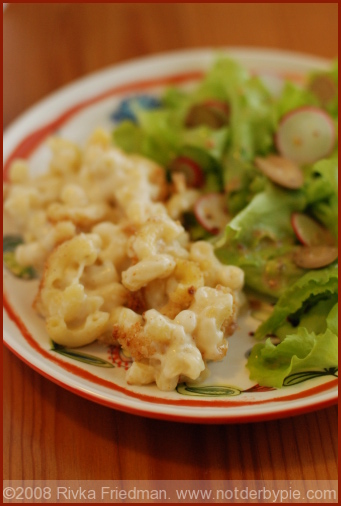
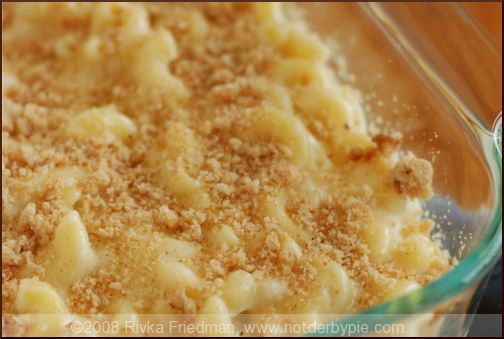
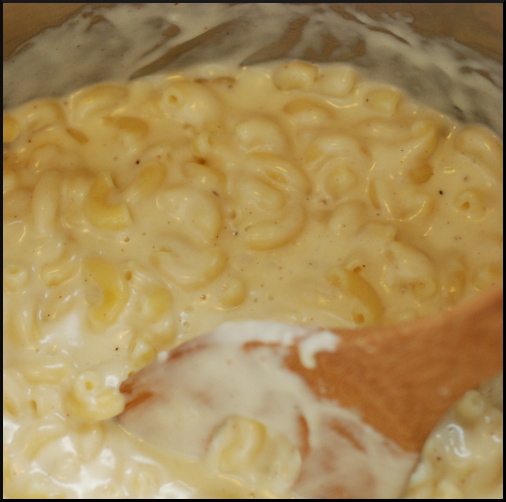
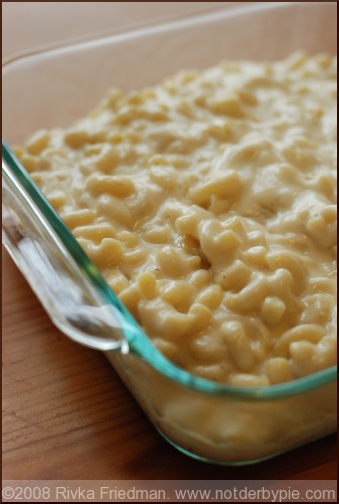
I've been meaning to make mac and cheese for quite some time. After seeing Ina Garten make it several months ago on her FN show, Barefoot Contessa, I knew it wouldn't be difficult to make. Then I saw that show rerun like four or five times (ok, Ina, I get it!) and decided to give it a go. The method is simple: heat flour and butter to make a roux. Add milk and mix to combine, then continue stirring until the milk is thickened. Add lots of cheese, stir until it melts, then incorporate cooked and drained macaroni. Optional step: transfer macaroni to a gratin, add some very optional tomato slices, top with buttered bread crumbs, and broil until bread crumbs are golden and crunchy.

macncheese6

macncheese1

In terms of cheese, the sky's the limit. Ina (she's so congenial, I can't help but feel like we're on a first-name basis) recommends a mix of cheddar and gruyere, which is probably ideal. I didn't have gruyere around so I used just Cabot white cheddar, and I liked the final result -- but the sharpness of gruyere would go very nicely with the hit of nutmeg in Ina's recipe. On one of her shows, Ina uses part gorgonzola or other blue cheese for an added layer of complexity. Me? I like my blue cheese in small portions, so I'd skip, unless blue cheese is really totally your thing.

macncheese3

Though I bet the tomatoes would provide a much-needed hit of juiciness and freshness amid the layers of cheesy pasta, I was making this for a lover of all things traditional and someone who takes her mac and cheese very seriously (she boasts a long repertoire of restaurants whose mac she's tried and critiqued; for those in DC, I think her faves are Napoleon, on Columbia road, where a side will set you back a mere 5 bucks, and Belga Cafe, where the mac is truffled (!) and not too goopy.) In any event, I'd definitely have used the tomatoes otherwise and would blindly recommend that you do the same. In terms of servings, I halved this recipe and baked it in an 8x8, and it served 4+, so make adjustments accordingly.

macncheese4

Macaroni and Cheese adapted from Ina Garten, via Food Network

Kosher salt 1 pound elbow macaroni or cavatappi 1 quart milk 8 tablespoons (1 stick) unsalted butter, divided 1/2 cup all-purpose flour 12 ounces Gruyere, grated (4 cups), or sub out for cheddar or other melty cheese 8 ounces extra-sharp Cheddar, grated (2 cups) 1/2 teaspoon freshly ground black pepper 1/2 teaspoon ground nutmeg 3/4 pound fresh tomatoes (4 small), optional 1 1/2 cups fresh bread crumbs (5 slices, crusts removed)

Directions Preheat the oven to 375 degrees F.

Drizzle oil into a large pot of boiling salted water. Add the macaroni and cook according to the directions on the package, 6 to 8 minutes. Drain well.

Meanwhile, heat the milk in a small saucepan, but don't boil it. Melt 6 tablespoons of butter in a large (4-quart) pot and add the flour. Cook over low heat for 2 minutes, stirring with a whisk. While whisking, add the hot milk and cook for a minute or two more, until thickened and smooth. Off the heat, add the Gruyere, Cheddar, 1 tablespoon salt, pepper, and nutmeg. Add the cooked macaroni and stir well. Pour into a 3-quart baking dish.

Slice the tomatoes and arrange on top. Melt the remaining 2 tablespoons of butter, combine them with the fresh bread crumbs, and sprinkle on the top. Bake for 30 to 35 minutes, or until the sauce is bubbly and the macaroni is browned on the top.

Pesto Streudel and Panzanella Salad

panzanella1 Now that it's summer, my counters are teeming with beautiful red tomatoes and my fridge is packed with brightly-colored produce of all sorts: radishes, favas, beets, strawberries, you name it. It's a welcome change from the endless supply of potatoes, yams, potatoes, and kale, oh, the kale. Thank goodness I've got some red back in my life!
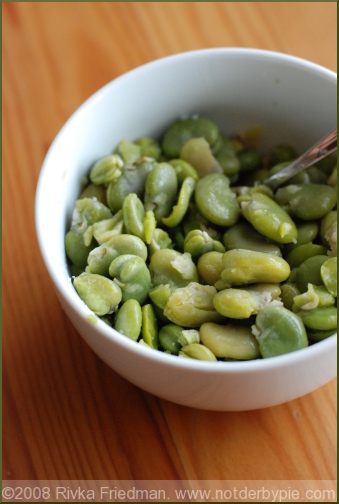
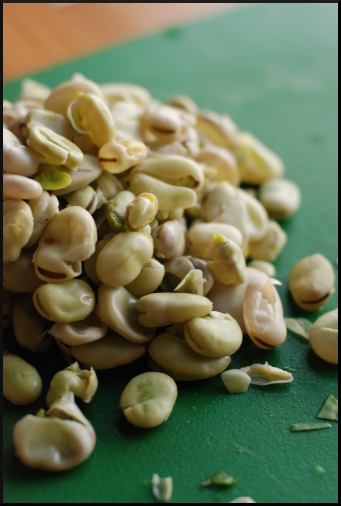
favas

fava-shells

Of course, with beets and radishes come a whole new type of greens -- the kind attached to the stems of the beets and the radishes, of course. Both are too often overlooked -- especially radish greens, for which I've never seen a recipe. Until now.
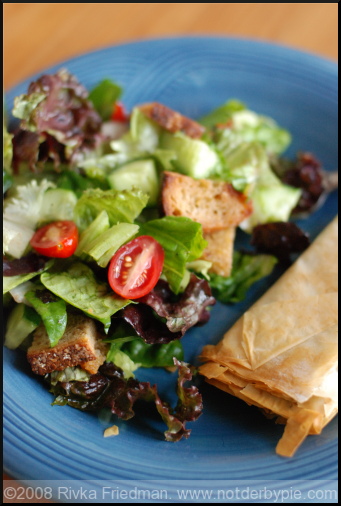
panzanella2

Here's the thing. Pesto? It doesn't just have to be basil in there. Stick in some cilantro and call it chimichurri or -- better yet -- send some radish greens under the knife and start to enjoy what too often ends up in the disposal (or, in my case, the compost bin. Yay!)

Radish greens are best used within a couple days of buying or picking them, so they're a bit more finicky than basil. But they're spicy and a little bitter like arugula, and quite flavorful. They're also almost always attached to the radishes you buy, so why not use them? I've blended them up with walnuts and pinenuts, and they pair beautifully with both. But I've got a lingering curiosity about how they'd play with pecans, so if you try it, lemme know.

Last time I made this, I stuffed it in phyllo dough for a variation on spanikopita. Radish leaves contain a fair amount of water, so I'd recommend putting the ground leaves into a fine mesh strainer to let some of the liquid drain out. After that's done, feel free to add any other things you'd like. I've added Parmesan before, which is quite nice, but since this last time I was going for a Greek theme, I opted with feta cheese and liked it even more. I also added a squeeze or two of lemon, which gives the pesto some tang and has the added benefit of delaying oxidation (when pesto hits the air and turns brownish).

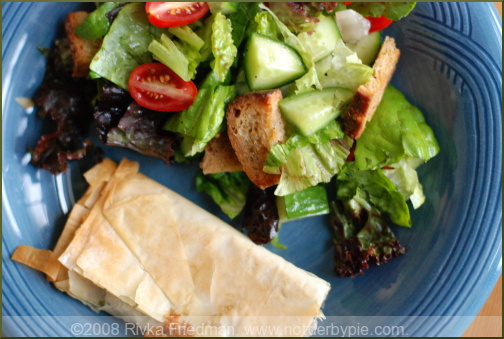
As you can see from the pictures and the post title, we ate this streudel with Panzanella, or bread salad. I can't say I have a recipe; we really just used the vegetables from this week's trip to the farmers' market, and any vegetables will work. The key is to have some good, juicy, ripe tomatoes in there, whose juices will seep into the pieces of bread. Other than that, no rules -- sky's the limit.
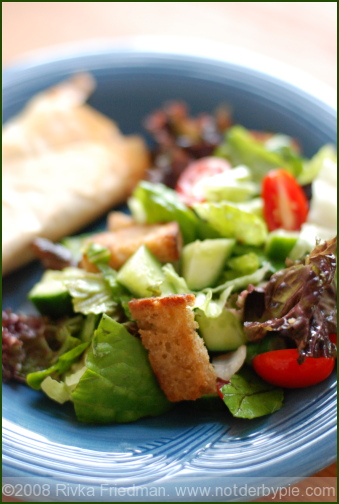
panzanella3

Radish-Beet Pesto Streudel

I know this recipe is really rough and that the measurements are as imprecise as can be -- but this is one of those things that is ever so contingent upon your tastebuds. If you're nervous, start with 3/4 of the greens and 3/ 4 of the nuts, and after you've blended that quantity, start tasting and adjusting until you achieve your preferred balance of greens to nuts.

1 bunch (about 1 1/2 cups) radish leaves, rinsed and dried 1 bunch (about 3 1/2 cups) beet leaves, rinsed, dried, and ripped into large pieces 1 1/2 cups walnuts or pinenuts salt and pepper 1 cup feta cheese, crumbled juice of half a lemon, optional

Preheat oven to 350 degrees. Set phyllo dough out on the counter, in its box, until thawed, at least half an hour.

Chop greens in a food processor. Transfer to a fine mesh strainer set over a bowl, and either leave for an hour to let the liquids drain out, or (much more efficient) press on the greens to expel their liquid. Return to the food processor.

Add nuts and blend until the pesto is your preferred consistency (I like this radish-beet pesto quite smooth with only a few very small chunks, but others like it super chunky -- up to you). Add cheese, and give the processor a couple quick pulses just until the cheese is incorporated. Taste and adjust for salt, and add pepper and lemon if desired.

Remove the plastic covering from the phyllo dough, unroll it, and cover it with a slightly damp towel; this will prevent the sheets from drying out and turning brittle.

On a rimmed baking sheet covered with a piece of parchment paper or tin foil, place one layer of phyllo dough and brush lightly with olive oil. Cover with a second sheet of phyllo dough. Repeat five times, until you have six layers of phyllo dough stacked on top of each other with a thin layer of olive oil in between (if you have five or seven layers, please don't sweat it).

With one of the long ends facing you, spread the pesto horizontally about a third of the way from the edge closest to you, leaving about 1 inch at either end. You'll be rolling the up the streudel along the long edge of the dough. Start rolling the filo away from you, making sure the pesto stays inside the dough as much as possible (if it leaks out a bit, no worries). Pause at the halfway point to tuck the edges into the roll (or be lazy like me and leave it open, though the pesto will seep out during baking). Brush the top with a little olive oil and bake at 350 for about 25 minutes, until the top is golden and whatever filling has seeped out is bubbling.

Panzanella Salad with Fava Beans

Ingredients

Several handfuls of fresh lettuce, whatever is on hand is fine The best tomato (or cherry tomatoes, in my case, though large ones are preferable) you can get your hands on 2 mediterranean little cucumbers or 1 regular cucumber, chopped 1 lb. fava beans, shucked, blanched, and peeled ** 2 slices or 1 big hunk of good, crusty bread that's a couple days old, cut or ripped into squares or small pieces 1/8 cup olive oil 1/8 cup red wine vinegar salt pepper

Mix vegetables, favas, and bread together in a medium salad bowl. In a separate smaller bowl or dressing container, mix oil, vinegar, and salt and pepper to taste. About ten minutes before serving, shake dressing well and drizzle over salad. Toss to combine, and allow to sit for a bit until the bread starts to soak up the dressing. Serve.

**To prepare favas, start by popping open the pods and picking out the beans. The beans are coated in a waxy outer layer that also needs to be removed; to do this, cook fava beans in medium saucepan of boiling salted water until just tender, about 1 1/2 minutes. Drain. Rinse under cold water; drain well. Peel fava beans and set aside. (Can be made 1 day ahead. Cover and refrigerate.)