 I've been thinking a lot about Jonathan Safran Foer's article in the New York Times Magazine's recent Food Issue about why he stopped eating meat. If you haven't read the article, take a look. Safran Foer tells the story of his long-time struggle with vegetarianism and the ways in which fatherhood helped him strengthen his convictions to not eat meat. The question with which he grapples has been posed many times before: how do we reconcile our appetites for meat with the ethical questions of animal cruelty and environmental damage that are part and parcel to the process by which 99% of American meat is produced? While Safran Foer's insights and answers aren't new, not everyone reads The Omnivore's Dilemma and shops at farmers' markets. I imagine that given the wide circulation of NYT, the author's message reached a wider, less "in-the-loop" audience. I'm glad for that.
Still, I struggle with something he said, one sentence in particular:
According to an analysis of U.S.D.A. data by the advocacy group Farm Forward, factory farms now produce more than 99 percent of the animals eaten in this country. And despite labels that suggest otherwise, genuine alternatives — which do exist, and make many of the ethical questions about meat moot — are very difficult for even an educated eater to find. I don’t have the ability to do so with regularity and confidence. (“Free range,” “cage free,” “natural” and “organic” are nearly meaningless when it comes to animal welfare.)"
That sentence about how alternatives to factory-farmed meat are hard for even the most educated eater to find? That's just not true. Now, there certainly aren't enough alternative sources out there to feed Americans' insatiable appetite for meat and poultry, and the price-point of said alternatives may make meat and poultry consumption cost-prohibitive for many families, but alternatives most certainly do exist, and they're as accessible (geographically) as the nearest farmers' market. Yes, they require some research to discover, but they're there. The issue isn't that they're hard to find, it's that people simply aren't looking.
About a year ago, just around the time I got back from our cruise to Alaska, I started looking for those alternative sources. Remember that in addition to the various ethical concerns I had, I also needed the meat to bear a kosher certification; that notwithstanding, I managed to find a source of meat and, eventually, poultry, that was both ethically and technically "kosher." If I didn't keep a kosher home, it would have been as simple as hitting up the Polyface stand at the Dupont Circle farmers' market. Rumor has it their chicken is out of this world.
Admittedly, many have tried to profit by abusing terms like "free range" and "cage free," causing those labels to lose their significance; however, when you buy directly from a farmer, you don't have to worry so much about these terms. Most farmers' markets have policies about who can and cannot sell, meaning there usually is at least a baseline standard for those who sell there. If you're still not convinced, talk to the farmer; are the chickens actually raised in pasture or are they raised in cages with a gate cracked open? Are cows grass-grazing? If not, is their diet vegetarian and hormone/antibiotic free? Ask the questions whose answers will help you decide whether you're comfortable eating that animal or not. These are questions we should be asking.
One more thing. I grew up in a pescatarian house and am fully comfortable with a vegetarian diet; you'll notice that most recipes on this site do not involve meat. However, I have no problem with occasional meat and poultry consumption, so long as it's actually "occasional." I feel very strongly that meat and poultry should be consumed in moderation; not for every meal, or even every five meals, and certainly not in the quantities most are accustomed to eating. As Safran Foer says, the meat and poultry industries have truly deleterious effects on the environment, and do nothing to try to curb the American appetite for chicken and beef, since our appetite is their dollar. In fact, earlier today I read a great piece in the Atlantic about Baltimore Public Schools' Meatless Mondays program, in which the 80,000 public school students in Baltimore eat an ever-changing selection of vegetarian lunch dishes on Mondays, and about the unsurprisingly angry responses of American Meat Institute, along with the Animal Agriculture Alliance, the Missouri Beef Council, and the editors of Pork Magazine (all of which were replete with fallacious information, equally unsurprisingly).
I probably eat meat and poultry once to twice a month, and am pretty repulsed by the regularity with which Americans eat animal products. However, I am not a vegetarian, and I have no intention of being one. If anything, I think it's important to eat meat and poultry that are ethically raised and slaughtered. I'm not convinced that being a vegetarian makes any more of a statement than buying from those farmers who raise their animals well. Plus, there's that whole taste thing. I truly love the taste of chicken, the taste of beef. After all, I'm an omnivore. That's how we evolved, so as long as we don't abuse the animals that become our food supply or the land that we all inhabit, I'm very thankful, and eager, for the occasional roasted chicken.
Which brings me to today's recipe. A good bird deserves only the simplest of preparations, which this is. Judy Rogers has you season the bird with nothing but salt, pepper, and one herb (your choice). By salting the bird overnight and cooking in a piping hot oven in a preheated pan, the skin gets incredibly crispy while the flesh stays tender. The bread salad is one of the best things I've ever eaten. Moist but crispy chunks of tuscan bread are brushed with olive oil and broiled to a golden brown, combined with pine nuts, currants (I used cherries) and arugula (and mizuna, if you're me), and drizzled with a champagne vinaigrette and chicken drippings. What could be better?

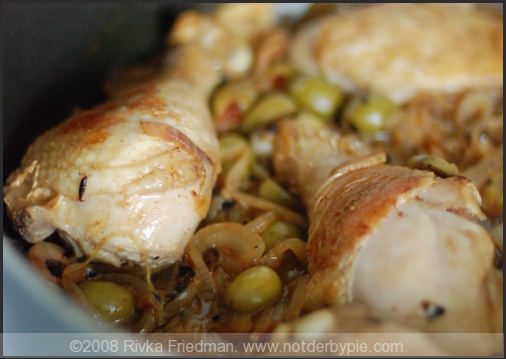
Now don't judge from that picture at the top of the post; my bird got much, much browner after it was shot. I had to photograph before dark, and my bird wasn't quite finished roasting, so I made the ultimate blogger sacrifice and took the half-finished bird out for its glamour shots. As a result, I ended up having to cook the bird for longer than 1 hour to compensate for the internal heat it likely lost during the photo shoot. Truthfully, I don't think the bird suffered at all. The skin on my thigh was crispy as hell, and the folks that ate the white meat frankly don't care much about crispy skin, so all worked out. Seriously, this is one memorable chicken recipe.
Occasional Roasted Chicken with Bread Salad
adapted from the Zuni Cafe
There are two keys to making a roast chicken Zuni-style: the first is to buy a small bird instead of the large ones typically sold as roasters, and the second is to salt it and let it dry out overnight. I had no control over either of these two factors, as my pasture-raised bird was a gift from the fabulous folks at KOL, and being kosher, it had already been salted, thus precluding the need to do it again the Zuni way. Undeterred from my mission to make this recipe, I prepared the bread salad as described in the book, roasted the chicken as instructed, and served what I can assure you was the most flavorful roast chicken dish I've ever made. I don't even like chicken all that much, and I was reaching for seconds. The takeaway? It's just as much about the cooking and side-dishing as it is about the buying and salting. Phew.
I don't want to try to paraphrase Judy Rogers' original recipe. It's written so beautifully, with such expert and detailed descriptions, that there's no way I'd do it justice. It's also three pages long. For the sake of brevity, I've boiled it down into essential steps so that you can recreate this masterpiece at home. For the unedited version, buy The Zuni Cafe Cookbook; you certainly won't be disappointed.
One small, 2 3/4-3 1/2-pound bird
4 sprigs fresh thyme, marjoram, rosemary, or sage
salt
1/4 teaspoon freshly cracked black pepper
a little water
Season the chicken 1-3 days before serving: remove and discard the lump of fat inside the chicken. Rinse the bird and pat very dry, both inside and out. Be thorough, as a wet chicken will end up steaming for much of the cooking time and thus won't brown.
Slide a finger under the skin of each of the breasts, making a small pocket on either side. Now create a similar pocket on the outside of the thickest section of each thigh. Using your finger, insert a sprig of herb into each pocket.
Season chicken liberally with salt and pepper. If using a kosher bird, use the salt sparingly; I used 1/4-1/2 a teaspoon for a 3-pound bird. Season thick sections more than thinner sections, and season the cavity as well. Cover loosely and refrigerate.
Preheat the oven to 475. Preheat a shallow flameproof roasting pan, dish, or skillet about the size of the bird. Wipe the chicken dry and set it breast-side up in the pan. It should sizzle.
Place the pan in the center of the oven and listen for more sizzling, which should happen within 20 minutes. If it doesn't, raise the heat progressively until it does. If you find that the bird begins to char or the fat begins to smoke, lower the heat 25 degrees.
Flip the bird after about 30 minutes. Roast for another 10-20 minutes, depending on size, then flip back over to re-crisp the breast skin, another 5-10 minutes. Total oven time will be 45 minutes to an hour (though mine was longer -- see above.)
Lift the chicken from the roasting pan and set on a plate. Carefully pour off most of the clear fat from the roasting pan, leaving behind all the drippings (i.e. the good stuff). Add a tablespoon of water to the pan and swirl it. I actually used a wooden spoon at this point to loosen all the good brown bits.
Slash the skin between the thigh and breast, then hold the chicken plate over the roasting pan and let the juice drip off. Set the chicken on top of the stove to keep warm, and leave to rest while you assemble the bread salad.
Zuni Cafe Bread Salad
adapted from the Zuni Cafe Cookbook
8 oz. slightly stale open-crumbed, chewy, peasant-style bread
6-8 tablespoons milk olive oil
1.5 tablespoons champagne vinegar or white wine vinegar
salt and pepper
1 tablespoon dried currants (I used dried cherries and heard no complaints)
1 teaspoon red wine vinegar
2 tablespoons pine nuts
2-3 garlic cloves
1/4 cup slivered scallions, including some of the green part
chicken drippings from above recipe
(This part can be done up to several hours in advance)
Cut the bread into a couple large chunks. Brush bread all over with olive oil. Broil very briefly to crisp and lightly color the surface. Turn bread over and repeat. Tear broiled bread into chunks and bits. Pieces should be irregular and not uniformly sized; you're aiming for some big chunks, some big crumbs.
Combine 1/4 cup olive oil and champagne or white wine vinegar and salt and pepper. Toss about 1/4 cup of this vinaigrette with torn bread in a wide salad bowl. bread will be unevenly dressed. Taste and adjust seasoning if necessary.
While chicken is cooking:
Put red wine vinegar and currants or cherries in small bowl to marinate. Toast pine nuts in dry skillet until golden.
Put a spoonful of olive oil in a small skillet, add garlic and scallions, and cook on medium-low heat until softened, stirring constantly. Don't let them color; scrape into bread and fold to combine. Remove plumped cherries or currants and fold in. Dribble chicken drippings in and fold again. Taste and adjust.
Pile bread salad in large baking dish and tent with foil, then set aside. Carve chicken and slice into manageable pieces, reserving drippings as much as possible. When chicken has been sliced, tip bread salad into the salad bowl. Drizzle reserved drippings overtop, then add chicken pieces and serve warm.
 Finally, the next chapter of "Weekday Lunch," where I offer recipes for food that fits in tupperware and warms in the office microwave.
 Today was seriously busy -- fortunately for me, D's stepmom Terri came in a couple days early to help cook, finish up grocery shopping, and see to it that the house was clean. That last bit she takes more seriously than you can imagine; when D and I moved into our apt, in a 100-year old building, the stove was caked with some hard-core black stains that I assumed were there to stay. I tried a couple of times to get them out but made no headway whatsoever, so I just got used to them. Terri doesn't give up so easily; she's got a big back of tricks up her sleeve when it comes to cleaning things, and I could swear she also pulled some sort of voodoo hex thing while I wasn't looking, because folks, my stove is crystal clean. If you only knew the sort of filth I've been cooking with -- it's the sort that builds up over many many years -- I can't believe it's actually all gone. amazing!
 D and I had people over Friday night. As of Thursday, I not only had done no cooking, I hadn't even figured out my menu. Now, I'm not one to plan these things all too far in advance -- but 24 hours is not much time to plan, shop, and make food for a dinner party. Not impossible, but not ideal.