Rigatoni with Radish Pesto and Oven-Roasted Tomatoes

A couple weeks ago, my friend Jeremy told you using the last of the summer bumper crop to make oven-roasted tomatoes. Like the diligent readers you are, several of you went and made your own oven-roasted tomatoes. But then you emailed me later that week asking what to do with the oven-roasted tomatoes you had made. Recognizing that my first-impulse answer, "what can't you do with them?!" wasn't exactly so helpful, I started a list of ways to use these plump little suckers. Toss a couple on pizza; pile them in a heap on baked feta and serve with pita chips; add to roasted broccoli and drizzle vinaigrette over the whole mess; and so forth.

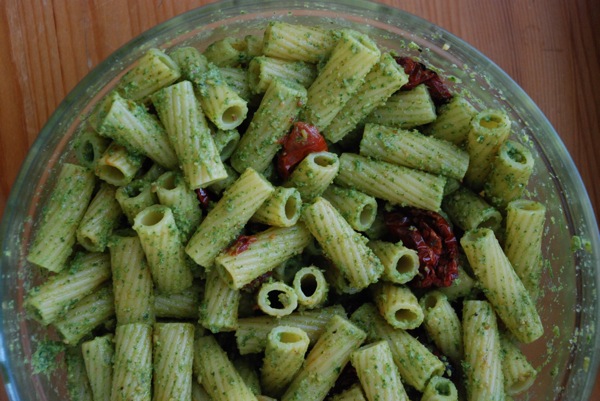
One suggestion I neglected to share, of course, was to toss them with pasta. Ironically, that's my most frequent use for them. I toss them with spaghetti and finish with parmesan, I add them to baked dishes like ziti and lasagna, and -- as you'll see -- I mix them with some rigatoni and coat it all with pesto. In this combination, the tomatoes brighten the pesto-coated pasta, punctuating with sweetness and acid. Once you've got the tomatoes, the dish takes about 25 minutes to make, though the results would suggest otherwise. An added plus: this doubles as weekday lunch. What more could you ask for?
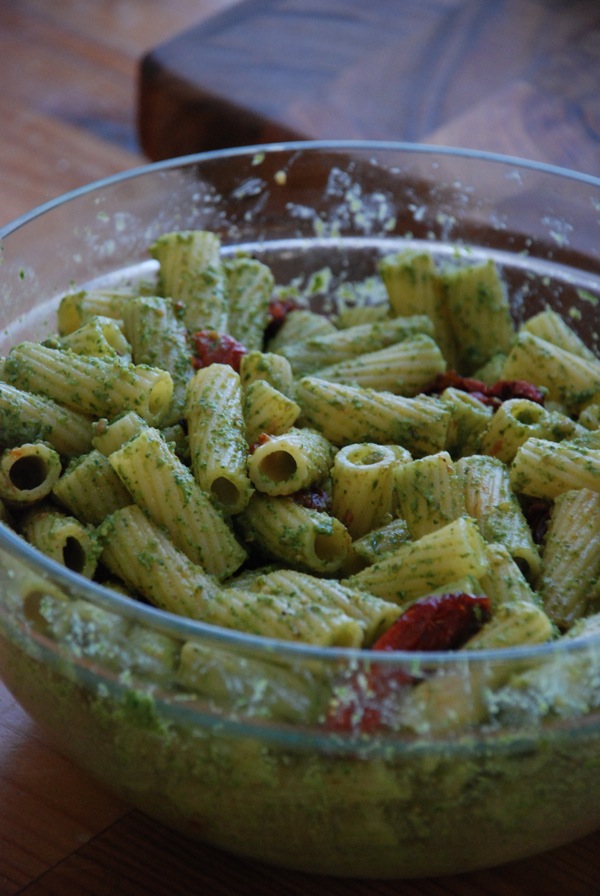
The pesto is delicious -- though "radish pesto" is perhaps a misnomer, since the pesto is made not with the radishes themselves, but with their leaves. After years of buying radishes from the farmers' market and watching the forlorn greens wilt away in the fridge, I discovered this wonderful recipe on Food52 and haven't turned back since. The recipe is by "Oui, Chef," a regular contributor whose recipes are some of the most well-conceived on the site. I've always been one to add acid (lemon juice, lemon zest) to my pesto, and when Oui, Chef did so as well, I knew I had to read on. His pesto recipe combines traditional ingredients (basil, garlic, olive oil) with less traditional ones (feta, marcona almonds, chives -- stay tuned for more about them later this week), and the result is divine.

It's not only the tomatoes that have multiple uses, by the way. This pesto is exceedingly versatile. Shmear some on slices of bread or pieces of baguette, top with feta or ricotta, maybe some chopped tomatoes, and lettuce, and you have a lovely vegetarian lunch. Drop dollops onto pizza dough with a couple thin slices of radish, and some pecorino, and you have yourself a unique and delicious pizza. Add some to a vinaigrette and use it to dress beans (from a can is totally fine) for a nice variation on bean salad. You get the drift. One spread, many uses. Just the way I like it.

Rigatoni with Radish Pesto and Oven-Roasted Tomatoes

1 pound rigatoni or other large tube pasta 1/2 cup oven-dried tomatoes 3/4 cup radish and basil pesto (recipe by Oui,Chef on Food52 -- printed below with my adjustments) Parmigiano Reggiano Cheese

Cook pasta according to package directions. Drain and transfer to large bowl. Mix in pesto and tomatoes, and grate 1/4 cup cheese over top. Mix to incorporate; serve warm or at room temperature.

Radish and Basil Pesto via Food52

1 cup packed fresh radish greens, well washed and dried 1 cup packed basil leaves, well washed and dried 2 cloves garlic 1/4 cup marcona almonds 1/4 cup olive oil Juice of 1/2 lemon 1/4 cup feta cheese, cut or broken into chunks 1/4 cup grated parmesan cheese 3 radishes, finely minced 1 tablespoon finely minced fresh chives Kosher salt and black pepper to taste

Place garlic and almonds in the bowl of a small food processor with a pinch of salt and a few grindings of pepper, and pulse until finely minced.

Add the radish and basil leaves, and process while pouring the olive oil through the feed tube, stopping as needed to scrape down the sides of the bowl. Continue until oil has been incorporated and pesto is smooth.

Add feta and radishes, and pulse just until broken up into small bits -- this is where the pesto gets chunky. If you prefer a completely smooth pesto, process for longer at this stage.

Pour pesto into a medium sized bowl, and mix in the lemon juice, grated parmesan, and chives.

Test for seasoning, adding more salt, pepper or lemon juice as desired. Spoon into an air-tight container just big enough to hold all the pesto, pour a thin layer of olive oil to coat the top, and store in fridge. Pesto will keep for up to 1 week.
Pasta with Fresh Tomato Sauce

Where we live, time is running out to make this sauce. Tomatoes are on their last legs here in the Northeast, and I've been alternating between panic and panicking on and off for the past three weeks about their impending disappearance.

By now, you've seen posts on cream of roasted tomato soup and sundried tomatoes. Everyone's trying to squeeze the last little bit out of summer's tomato bounty, and really, who can blame them? I'll be doing the same -- there are many jars of oven-roasted tomatoes in my future -- but for now, I'm chopping the last of those tomatoes raw into my bowls of pasta and enjoying them in their juicy, fresh state while I still can.

This may not be the first you've heard of fresh tomato sauce: Mark Bittman wrote about it recently for the New York Times. When he did, I breathed a sigh of relief, realizing suddenly that I, like Bittman, have been making this sauce for years, and only now had it occurred to me that it might actually be a recipe worth sharing. Truth be told, that's not 100% accurate. I've actually been taking pictures of bowls of pasta with fresh tomato sauce for two years now -- whether its just the tomatoes, tomatoes with a pillow of ricotta or mozzarella mixed in, or with some other vegetables (zucchini, mushrooms) added in. This dish is a staple of my diet, and I'm appreciative to Bittman for making me realize just how post-able it is.

The beauties of fresh tomato sauce are many. While long-simmered sauce makes an ideal accompaniment to a deep bowl of noodles in January, fresh tomato sauce on a handful of spaghetti reminds you that, yes, there was a summer season and no, it wasn't so long ago. Fall brings a tendency to slip prematurely into hibernation; fresh tomato sauce holds us back.

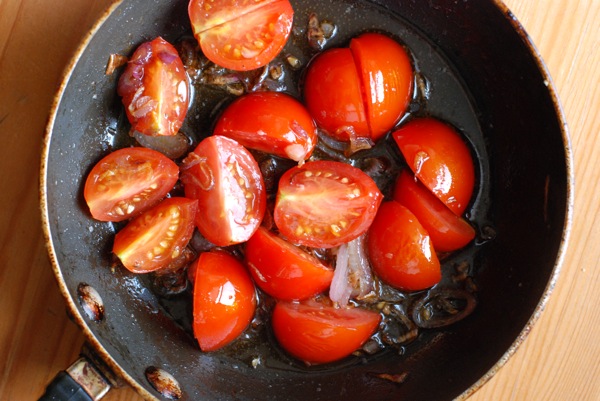
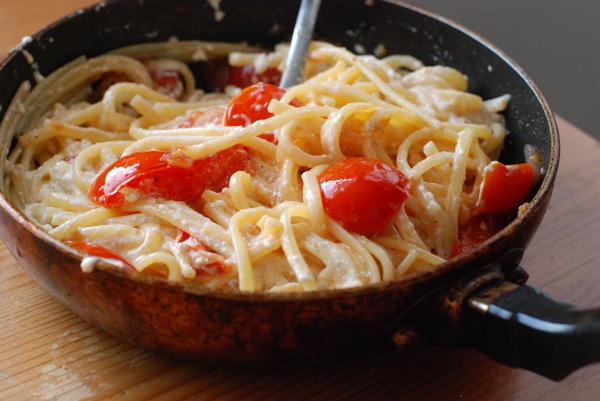
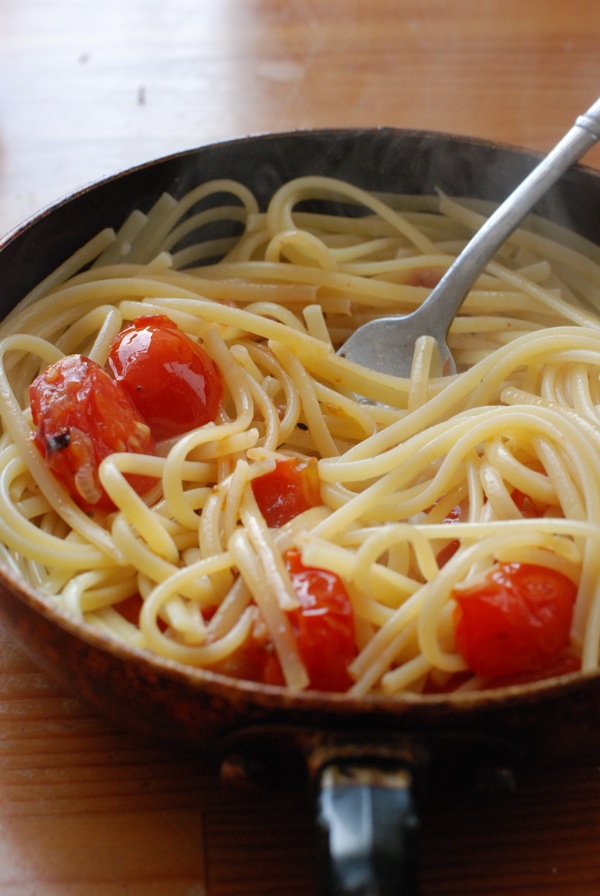
The method couldn't be simpler. A shallot and some butter or olive oil mingle over the heat. Pieces of chopped fresh tomato -- any tomato really, though don't use heirlooms here; I've had success with everything from big red beefstakes to baby yellow cherries -- and are added, along with some salt, and the heat is raised slightly. The pan is shaken enough to get everything distributed, and before you know it, the pasta is just shy of al dente, and it's heading for those tomatoes to finish cooking. The whole mess is topped with either a shower of finely grated parmesan or a spoonful (or several) of fresh ricotta cheese. Mixed. Plated. Consumed.

The recipe I provide below serves 4, but I make this meal most frequently to serve just one. It's the ideal food for those evenings you're alone in the apartment, ready to curl up on the couch and indulge in something comforting. And, in case I wasn't super clear, this is a sauce to be made now. Get cookin'.

Pasta with Fresh Tomato Sauce serves 4

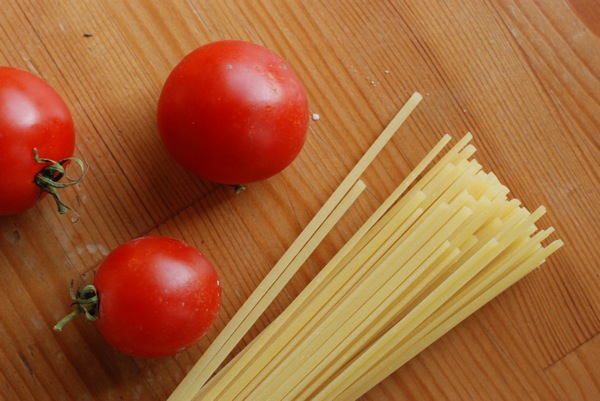
1 pound long pasta: spaghetti, vermicelli, and linguini are all great 1 shallot, chopped 3 tablespoons butter or olive oil 1 1/2 pounds fresh red or yellow tomatoes (no need to use heirlooms here; their nuance will be lost in the sauce) salt and pepper finishing flourishes, including a handful of ripped basil leaves, a generous grating of parmesan, a scoop full of fresh, milky ricotta, or anything else you want

Bring plenty of salted water to a boil in a large pot. When at a rolling boil, add pasta, stir to separate noodles, and return to a boil. Cook until just shy of al dente.

Meanwhile, heat butter or olive oil in a wide shallow pan over medium. When butter foams or oil shimmers, add chopped shallot. Shallot should sizzle. 30 seconds later, add tomatoes. Turn heat to low. Cook 5-7 minutes, until tomatoes have softened and smoothed together somewhat. You're not looking for a completely smooth sauce; you just want the tomatoes to break up, to absorb the butter, and to mix in with the shallots. When this happens, you're golden.

By now, your pasta should be not-quite al dente. Drain, and transfer into pan with sauce. Toss to incorporate, and cook a scant additional minute. Add cheese and/or basil, transfer to platter, and serve.

A Menu for the Jewish New Year

For serious, how has a year passed already? Eek.

The Jewish New Year is upon us. What's a girl to make for a holiday this big and momentous? Answer: a whole lotta food. But at the request of quite a few lovely readers, this year, I'm getting more specific. I'll be posting my Rosh Hashana menu from soup to cake, and -- per your requests -- I'll share my recipe for apple cake. In my humble opinion, it's a perfect recipe, with cinnamon-laced apples and the all-important crust. Let's get to it, shall we?

First things first: my work schedule is such that I'll have one day - one half day, if we're being precise -- to cook. With this in mind, my wonderful stepmother-in-law-to-be, Terri, is bringing a bunch of the staples with her from Detroit. Among the things coming on the plane are soup, 3 chickens, and 2 briskets. Clearly the lady is used to cooking for a crowd, and thank god for that.

Have no fear: just because she's doing brisket doesn't mean I'm not armed with a recipe for ya. It's hard to believe I haven't shared this brisket recipe yet, because it is my absolute favorite, and I rarely make brisket any other way.

But I'm getting ahead of myself. Here's the whole menu:

Day 1:

Homemade challah Various homemade pickles Matza ball soup Salad of arugula and romaine, peaches, raw sweet corn, chives, and mustard vinaigrette Terri's chicken and brisket Moroccan eggplant (recipe to come shortly) Summer squash couscous with sultanas, pistachios, and mint

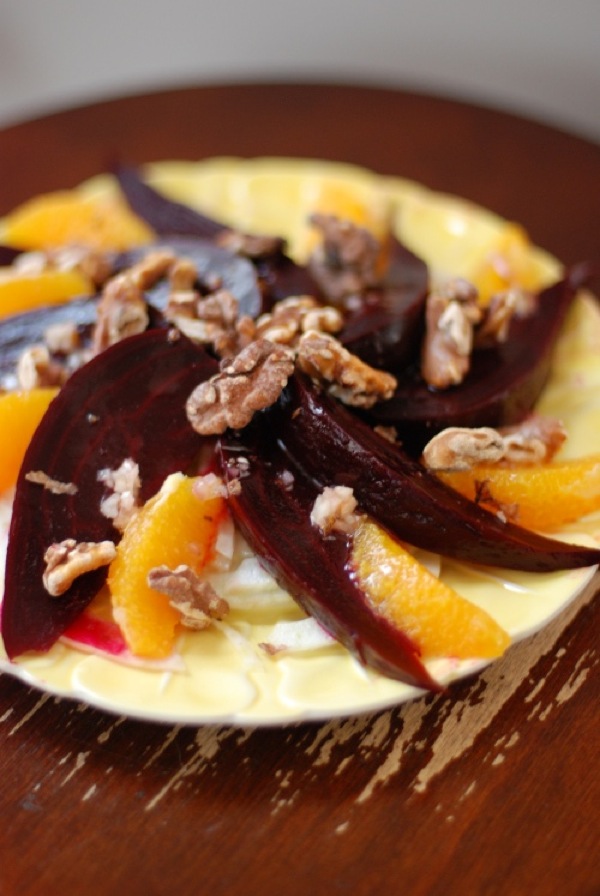
Day 2: Caponata Tomato Soup Fattoush Chicken and brisket Beets with fennel, orange, and walnuts Braised Sweet and Sour Cabbage

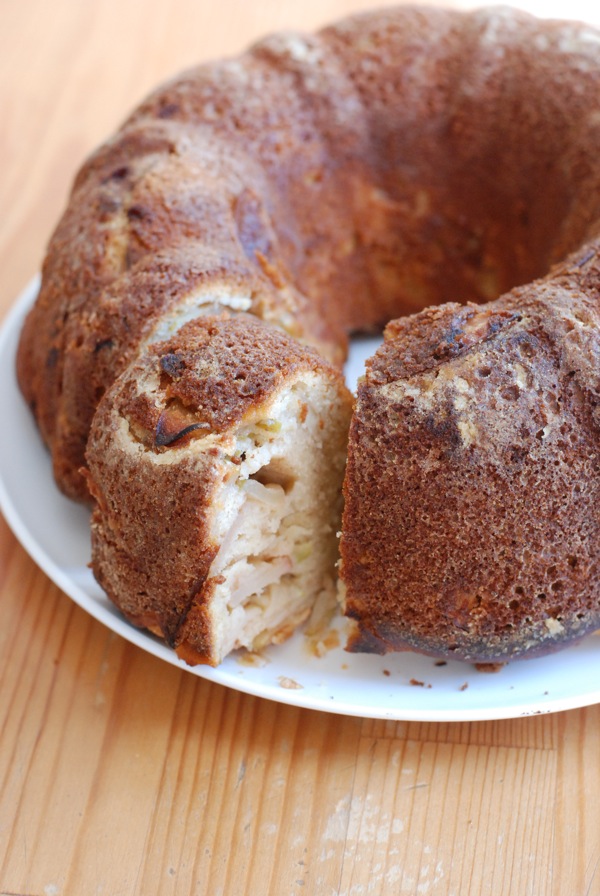
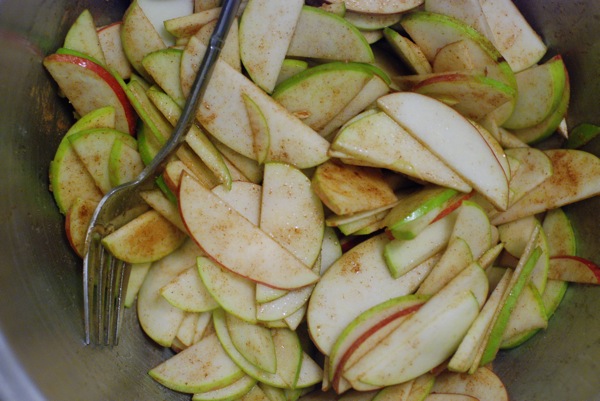
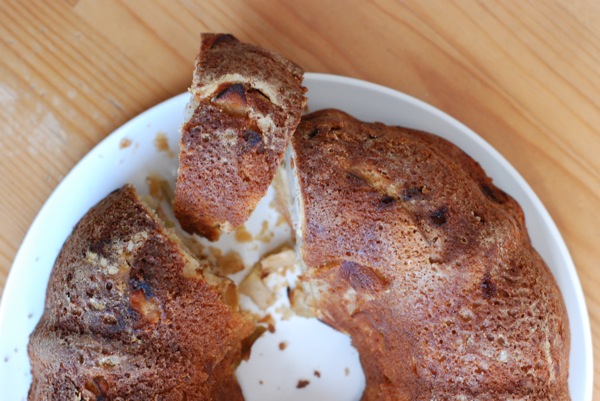
And, for both nights, I'll be making my new favorite Jewish apple cake. It's a not-too-sweet, plenty sturdy batter, laced with thin slices of cinnamon-and-sugar-coated apples. I used Cortland, which become soft but not at all mushy. Granny Smith would be great as well. Pretty much anything but Macintosh and Delicious will work.

Some folks like their apple cake with big chunks of fruit; I love that this cake has the apples in thin slices, woven through the body of the cake. When you're pouring the batter into the pan, it'll feel as though you took a bunch of apple slices, dunked them in batter, and baked them off. I love that. This cake is loaded with apples, but have no fear -- the batter expands in the oven, and the blob of batter-coated apples becomes a phenomenal cake.

We're rounding out 5770 here at NDP, and we're also sneakin' up on the blog's 3-year anniversary. It's hard to believe; I'm not sure what else to say. Blogging in this space, hearing your comments, reading your emails, and sharing my favorite recipes with all of you gives me no small measure of joy. I feel lucky to be a place you visit, and I hope this year brings all of us many, many blessings. Have a happy, healthy new year!

My Favorite Apple Cake

4 firm, tart apples; I like Cortlandt 3 tablespoons cinnamon 1 3/4 cups plus 4 tablespoons sugar, divided juice of half a lemon 3 cups flour 1 tablespoon baking powder 1/2 teaspoon salt 4 eggs 1 tablespoon vanilla 1 cup vegetable or corn oil 1/2 cup apple sauce

Preheat oven to 350º. Butter and flour either a bundt pan (for pretty slices but no real crust), or a 9-inch springform or round pan (more boringtown shape, great crust).

Core apples, slice into 1/2 inch slices, and toss in a medium bowl with cinnamon, 4 tablespoons sugar, and juice of half a lemon. Set aside.

In a small bowl, combine flour, salt, and baking powder. Set aside.

In a large bowl, combine eggs, remaining sugar, and oil. Beat with whisk or whip with electric mixer until frothy and somewhat satiny, about 60 seconds with a whisk or 30 with an electric mixer. Add vanilla and whisk to combine.

Add 1/3 of dry ingredients to egg mixture. Whisk to combine. Add half apple sauce, and whisk again. Repeat with second third of dry ingredients, remaining apple sauce, and finally, the last third of the dry ingredients. When batter is smooth and only a few lumps remain, add apples, with all accumulated liquid, to batter. Fold in to combine.

Pour batter into prepared pan, and bake approximately 60 minutes, maybe 70, until cake is set in the middle and crust is golden. Set pan on rack and allow cake to cool 15 minutes. Then gingerly run knife around perimeter of cake, set plate overtop, and flip pan, inverting cake onto plate. Allow to cool completely. Dust with powdered sugar before serving.

My Best Brisket Recipe

5 pounds first cut brisket, trimmed of any excess fat 3 tablespoons olive oil 2 leeks, cleaned and chopped 2 yellow onions, coarsely chopped 2 carrots, quartered lengthwise and chopped 2 stalks celery, chopped 5 cloves garlic, smashed, skins removed 2 bay leaves 2 tablespoons tomato paste 3-4 sprigs parsley, roughly chopped 2 sprigs thyme 3 tablespoons pomegranate molasses 1 cup pomegranate juice 1 bottle dry red wine minus 1 cup (to drink, of course 1/2 cup beef stock, optional

Preheat oven to 325º.

Pat brisket dry and salt liberally on both sides, If using kosher meat, do not salt.

Put your largest, deepest saute pan (preferably oven safe; a dutch oven is a great one to use) over medium high heat.

Using sturdy kitchen tongs, transfer brisket to pan and sear, undisturbed, for 4-5 minutes, until underside develops brown crust. Turn brisket and cook 3-4 minutes on second side, until similarly seared. If pan is oven-safe, transfer brisket to a plate. If not, transfer brisket to oven-safe pan and set aside.

Pour off any accumulated fat in pan, reserving the fond (the delicious brown bits stuck to the bottom of the pan, which have all the brisket flavor in them). Reduce heat to medium, add olive oil, and swirl to coat. Ad onions, leeks, carrots, and celery, and saute until onions are translucent, 4-5 minutes, stirring regularly. Add garlic and saute 3 minutes more. Add bay leaves and herbs.

Add tomato paste, and use the back of a wooden spoon to break it up and incorporate it into the vegetables. Saute 3 minutes more, and then transfer to plate or pan holding brisket.

Raise heat back to medium-high. Add a splash of wine to the pan, and use a wooden spoon to scrape up the fond from the bottom of the pan. Add the rest of the wine, pomegranate juice, and beef stock, if using. Cook on medium-high heat until reduced by half. Add pomegranate molasses and cook 1 minute more.

Transfer brisket, vegetables, and braising liquid to oven-safe pan (if using a dutch oven, cooking liquid already will be in it, so carefully transfer brisket and seasoning to pan.)

Braise, covered, at 325 for 3 hours, until soft and tender. At the 1 hour mark, taste sauce and correct for salt and seasoning. When 3 hours have passed, remove pan from oven and allow brisket to rest at room temperature approximately 20-30 minutes. To serve, slice against the grain as thickly as desired. Top each slice with a spoonful of sauce.

Sesame-Crusted Tuna on Arugula Salad

Much as I love to serve fish for dinner, I return to my weeks-old whining about the heat. How are we expected to endure an hour of 400-degree air in the kitchen, followed by several hours of still-not-cool temperatures, just to get a piece of protein on the table? We're not, is the answer. We make a salad -- any salad will do, but there are lots of nice ones here -- and call it a night. But we both know that gets old. At a certain point, we start craving something more.

Here, then, is an entree that won't blow the gasket on the delicate balance between the blazing outdoors and the "little engine that could" of an air conditioning system. It requires no braise, no long boil, but a quick flash-sear on a hot stovetop, followed by a rest in the fridge, while you set the table, stick your head in the freezer for a moment, and suck on an ice cube hoping for that sweet, sweet redemption known as fall.

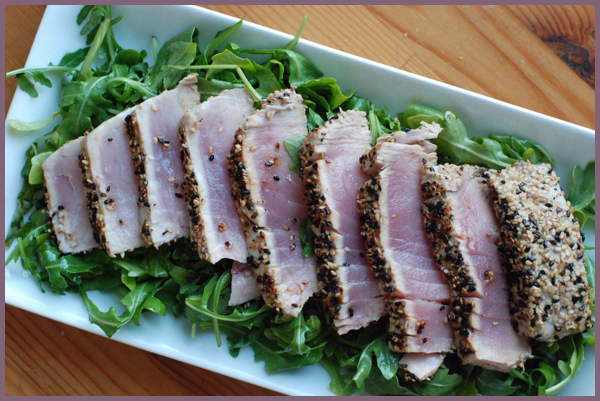
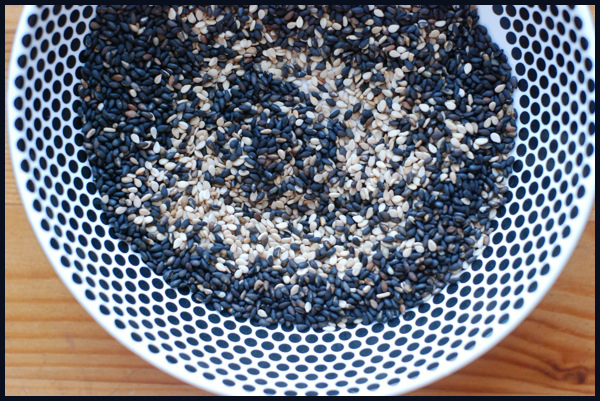
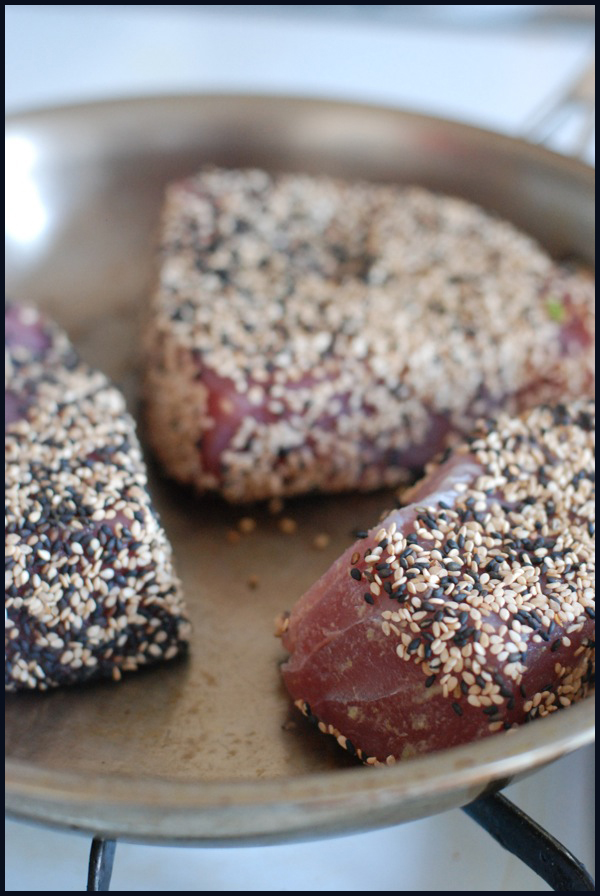
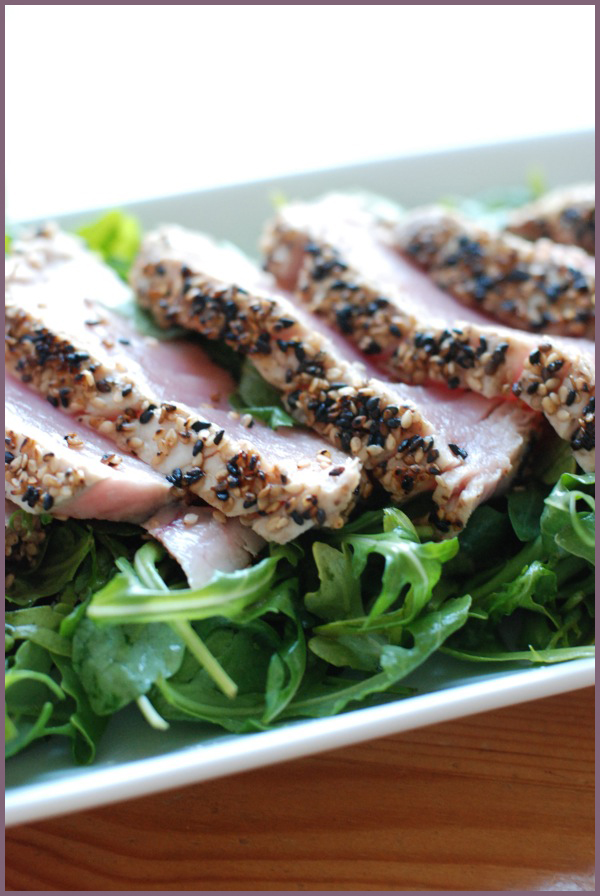
We're talking about tuna, rubbed with wasabi and coated with a mix of black and white sesame seeds, seared until it develops a crust to hide that jewel-pink interior. I'm being totally serious when I say that this tuna would be good on just about anything. I served it on a bed of arugula, dressed in rice wine vinegar, a little soy sauce, and sesame oil. Leftovers were cut into rice and piled onto sourdough toast. If only there'd been more.

To incorporate more of the tasty stuff that redeems this awful season, set the tuna (chunks, slices, whatever) in a salad of butter lettuce, corn, small cucumbers, and chopped red bell pepper. If you have some or none of those vegetables, just make a salad from whatever you've got. Put some of this tuna in, and you've got a simple, substantial summer lunch.

And with this, dear friends, I depart for a much-needed vacation. You'll find me with my nose deep in a glass of zin -- I'm going to San Francisco and wine country, and I couldn't be more excited. Not to worry: I've got a couple posts in the pipeline, so even in my absence, NDP will still have the goods. I'll be back in a couple weeks, with pictures and stories and, hopefully, some good wine in tow. Adieu!

Sesame-Crusted Tuna on Arugula Salad inspired by a recipe from Jaden of Steamy Kitchen and a recipe from Epicurious serves 6

2-3 lbs tuna, about 3 large pieces 1-2 tablespoons wasabi paste 1 cup sesame seeds (I like a mix of black and white) salt and pepper vegetable oil

1/2 lb arugula 1/8 cup rice wine vinegar 2 tablespoons sesame oil 1 teaspoon soy sauce 1 teaspoon honey salt and pepper

Put sesame seeds in wide, shallow bowl. Blot tuna with paper towel until dry. Season with salt and pepper on all sides, then rub wasabi paste evenly over top, bottom, and sides of tuna pieces. Place each piece of tuna in the bowl of sesame seeds, one at a time, and coat all sides with the seeds.

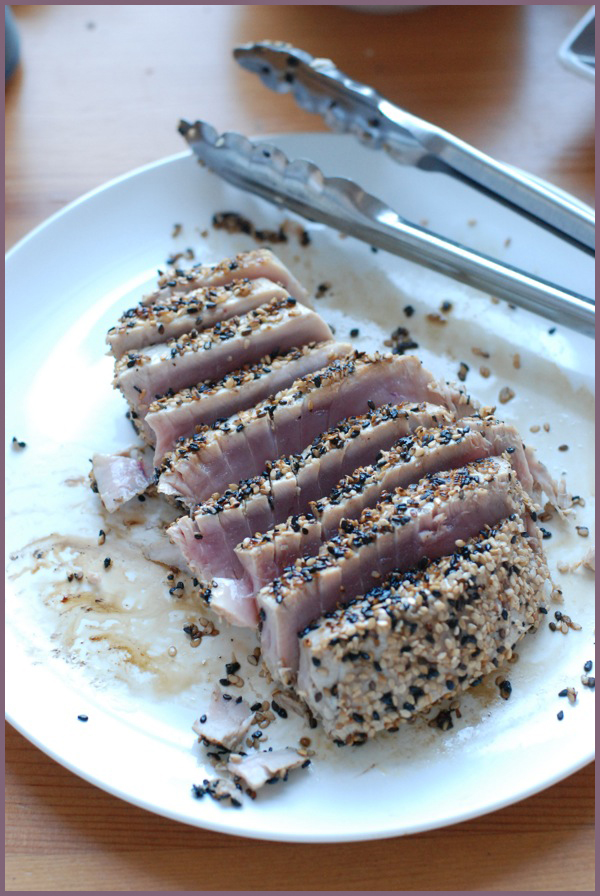
Heat heavy-bottomed pan (not non-stick) over medium-high heat. Add 1 tablespoon vegetable oil. When pan is very hot and oil shimmers, place tuna in pan. It will spatter -- be careful! Cook tuna about 2 minutes on each side; white sesame seeds will have browned, but in testing one of the pieces with a sharp knife, you'll see that it's quite pink in the middle. You want it seared on the outside, rare within; please, don't overdo tuna; it doesn't like to stay on the heat too long. When it's cooked properly, transfer tuna to plate or cutting board to rest.

Combine ingredients for dressing, and drizzle over arugula. Toss to incorporate. Transfer arugula to a serving platter, reserving remaining dressing.

Using a very sharp knife, slice tuna against the grain on a bias into 1/2-inch slices. Keeping the slices of each piece of tuna together, transfer onto arugula, then use a knife or spoon to nudge them into a fan or domino pattern. Drizzle reserved dressing over tuna, and serve immediately. (If not serving promptly, store in fridge until ready to serve.)