The Friday Night Conundrum

You and I know how hard it is to get a meal on the table Friday night (let alone Saturday morning) that's well-cooked but not over-cooked, tasty and colorful, and not entirely dried out after a long tenure on the blech. It's not easy! In honor of these hardships, here's a laundry list of questions from my dear friend Sarah about how, exactly, to coordinate a Friday night dinner service....and my answers.

Sarah: I need some food related advice. I'm making Shabbat dinner for friends on Friday. I have the day off on Friday but have a 3pm doctors appt that will make the afternoon kind of rushed and give me only an hour to cook. I'm making zucchini and pumpkin muffins before hand and roasting squash and potatoes (your recipe!) beforehand too and just reheating. Is that a bad idea?

The main dish is terriyaki salmon. Was just going to Marinate and broil... but then I realized I really dont know hot to broil! How long do you leave it in for and do you leave the door ajar? You rock.. thank you!

-Stumped in Seattle

Rivka: Sarah you rock! Ok... in answer to your qs:

muffins are a perfect idea! The potatoes should also hold up really nicely; you might stick them in the oven just before you leave for the dr, so that by the time you return they'll have been in for a good two-ish hours. If you're using small potatoes, this is more than enough. If you're using large ones, you can leave them in for a bit longer. In any event, the reheating should be fine. Just check their moisture level when you're about to stick them back in the oven; if they're a bit dry, add a splash of olive oil and a splash of water or stock and reheat covered for a few minutes, then finish uncovered; if they're soft, crisp them by reheating without a cover.

Squash will also keep very well. If you're doing delicata, make sure you only par-cook it in advance (say about 15-20 minutes) so that your re-heat won't overcook the squash. Butternut, acorn and other winter squash varieties will withstand a reheat without getting mushy.

Teriyaki salmon -- yum! Broiling can happen two ways: some ovens actually have a broiler, usually found beneath the regular oven. To use this, turn your oven on broil and when it's nice and hot, stick your salmon inside. My broiler has a metal tray with three shelf heights, and I use the second from the top for fish. If your oven doesn't have a broiler, just turn the knob to broil, put your fish on the highest rung in your oven, and yes -- leave the door ajar. This allows the steam to escape so that you achieve the crispy crust of a good broil. Baste the fish at least once in the middle of the broil. Also, a note on reheating -- make sure that you don't overdo it, so that it doesn't dry out when you reheat it. I'd estimate about 10 minutes per inch of fillet. My fillets are usually an inch and a half at their thickest. I'd say broil it for 10-12 minutes, then check for doneness. You don't want it to be raw inside, but if the very center is a bit underdone, you can finish cooking it during the reheat.

I want to be at your Friday night table! :)

Happy cooking and coordinating and chowing...it's a delicate dance, indeed.

Chicken Cholent

I think I officially have enough blog traffic that my Jewish friends aren't the only ones reading! This means that I actually have to explain what cholent is. (This is very exciting.)
Cholent is what Ashkenazi Jews (from Eastern Europe) used to eat every Saturday for lunch. Sephardi Jews ate something similar, but they called it "Hamin" (which means "hot stuff" in Hebrew...funny, no?) We still make this today, and to my knowledge, little has changed in terms of the basic ingredients -- though every cook adds his or her special touch.
The key to cholent is cooking time. Because traditionally, no cooking is allowed on the Sabbath, people start cooking cholent by sundown Friday, and don't touch it until they're ready to eat it on Saturday for lunch. By Saturday afternoon, the watery, murkey pot-o-goodies is an entirely different animal: the barley has soaked up all the water and turned soft and supple; the meat (or, as here, chicken), having been braised for about 18 hours, falls off the bone unprodded. Potatoes have turned dark brown from steeping in chicken stock and whatever else is in the pot -- and the marrow in the bones is creamy, flavorful and delicious. Sound appealing?
Over the years, the basics of cholent have stayed the same (meat, potatoes, barley), but the little things change from chef to chef (and, in my case, from time to time). I find that meat sits in my stomach like a brick when I eat it on Saturday afternoon, so my new thing is subsituting chicken. Sometimes I add apricots and carrots, sometimes prunes or dates. Once I even did a tagine style and included preserved lemons. As for the liquid, I frequently add chili sauce or bbq sauce, which are both pretty common -- but anything will do.
The best part about cholent is that it only improves with age; leftovers are even thicker and more flavorful. I've included a recipe below, but that's really not necessary, for two reasons:
a) cholent is a method, not a recipe. Just throw some protein and carbs in a pot, cover with liquid, and cook forever.
b) my actual cholent recipe is someone else's prized posession, and it was given to me on strict condition that I never write it down, let alone pass it on. I wasn't even allowed to transcribe it as I heard the holy words uttered; I merely had to remember it as best I could, and try to replicate the recipe according to my (very flawed, very human) memory. You may not be surprised to know that he who gave me this recipe actually called it "Torah She-B'al Peh," or "Oral Law."
So that's that.
Cholent
serves lots.
1 whole chicken or many strips of flank steak
several potatoes or any kind, washed and quartered
a few cups of barley
a couple marrow bones, optional
salt and pepper
any or all of the following things and more: carrots, apricots, prunes, dates, raisins, gosh I don't know -- preserved lemons, olives, tomatoes, you name it.
Dump all this in the crock pot.
Cover with water by at least a couple inches or more.
Add any or all of the following sauces, if you wish: bbq, teriyaki, sweet chili sauce, tomato sauce, soy sauce, etc.
Turn on high until boiling, then switch to low and leave it alone until ready to eat!
I should mention one note: some people stick balls of tinfoil between the actual crock pot and the heating device in which it sits, so as to avoid the burnt crust that forms at the bottom of the pot. I like burnt, so I leave well enough alone.
Happy Cholent!

how to temper chocolate

People, I couldn't have said this better myself. Watch this video on Chowhound for thorough and user-friendly instructions on how to achieve that glossy coat of chocolate deliciousness that hugs strawberries, almonds, candybars and more. Then go out and buy yourself a candy thermometer: I did this last week, and it cost me a grand total of...3 bucks. Do it! Precision is key in tempering chocolate, and you can't be precise without a thermometer. The results, which I will post as soon as I temper some chocolate, are well worth the effort.

The easiest cake ever

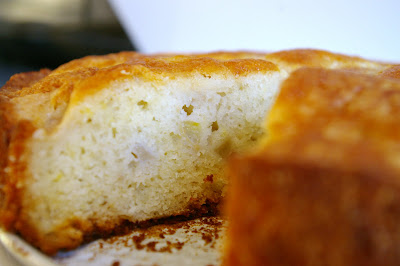
Many thanks to Elena, who gave this recipe to my mom, who practically forced me to make it. This cake is deceiving: its ingredient list and instructions are so short and sweet, you could make it blindfolded. But don't let the ease deceive you; this cake is definitely better than the sum of its parts. Throw the ingredients in a bowl, mix (by hand!), chop the fruit, throw it all into a springform (or regular pan), bake, and voila, a perfect dessert is yours.

Make sure your fruit are ripe; this will really add to the overall flavor and moistness of the cake. Also, as this recipe is so darn basic, feel free to improvise! Here are my favorite variations:
-pears, lots and lots of pears
-plums and peaches
-blueberries and pears
-raspberries
-raspberries and peaches

You get the drift -- do whatever you like. One last note: I tend to arrange sliced fruit on the bottom of the springform, so that when I turn the cooled cake onto a serving platter, the bottom (now the top) looks pretty. This is entirely optional. In fact, I didn't do it this time because my pears were very ripe, and too delicate to mess around with. If you're using a regular, non-springform pan, you can do as my mother does, and arrange fruit on top of the batter. They will sink in a little as the cake bakes, but you'll still be able to see them.


The Easiest Cake Ever
serves 8-12.

1 cup flour
3/4 cup sugar
2 eggs
1/2 cup canola oil
1 tspoon baking powder
1 tspoon vanilla
zest of 1 lemon
3 cups of fruit, any variety, but soft and juicy!

Combine all the above ingredients, reserving 1 cup of the sliced fruit.

Grease and flour a 9" round or rectangular baking pan or springform pan.

At this point, EITHER:
1) pour in batter and add the last cup of fruit on top OR
2) arrange the remaining sliced fruit in spiral design in the springform, and pour batter overtop.

I sometimes sprinkle a bit of sugar ontop for a crunchy crust.

Bake at 350 degrees for 1 hour.

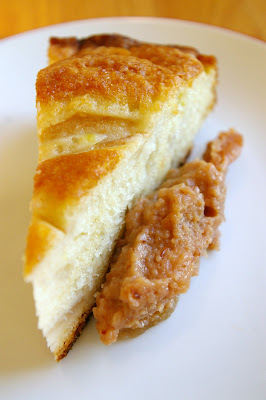
I often serve this cake with a fruit sauce or reduction; it's pictured here with quince sauce, and I'll post that recipe soon.