Rugelach

rugelach4.jpg I rarely buy cookbooks. That probably comes as a surprise, considering how much I love to cook, and how pretty cookbooks can be -- but I just don't buy them that often. That's partly because I tend to browse for recipes online, and partly because, not being able to help myself, I take all the pretty ones of the shelf at Barnes and Noble and before I know it, I've already looked at every pretty picture and no longer have any interest in buying the darn things.
rugelach1.jpg

On the rare occasion that I actually shell out the cash for one, the self control and patience I've been cultivating for years run out in a matter of seconds. I plop down on the couch, open the thing up, and soak up every last picture. Yes folks, that's why they call it food porn. rugelach2.jpg
Regarding the fillers between the pictures: sometimes I read those. Recipes, I think they're called.
rugelach3.jpg

Right of the bat, a couple recipes will jump out at me. They're the ones I know I'll be making -- things like Katherine Hepburn Brownies; Nibbly Buckwheat Butter Cookies; World Peace Cookies; and the like. Other recipes don't exactly leap off the pages. Too many steps, seemingly ordinary ingredients, tedious preparatory chores like splitting 8 eggs, and other things make me hesitate. Imagine my surprise, then, when I find said "ordinary" recipes to be utterly transcendent.
rugelach5.jpg

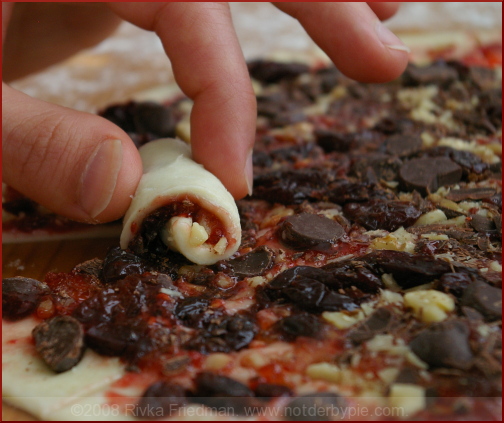
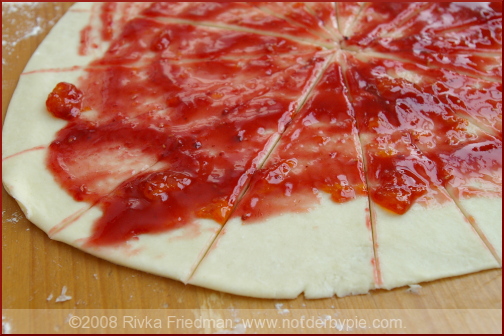
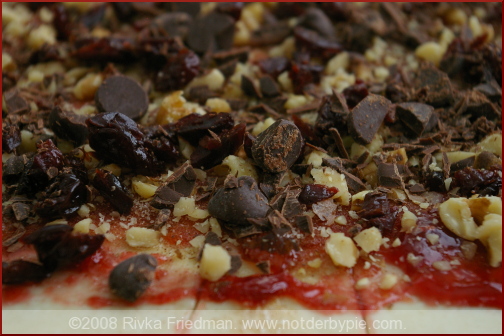
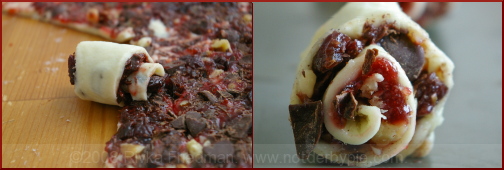
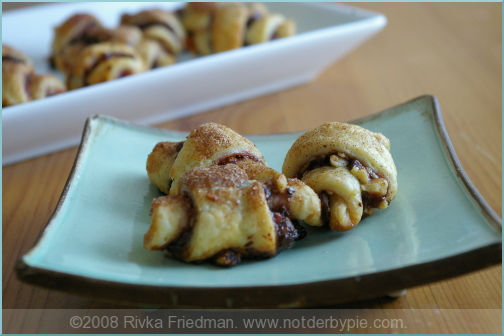
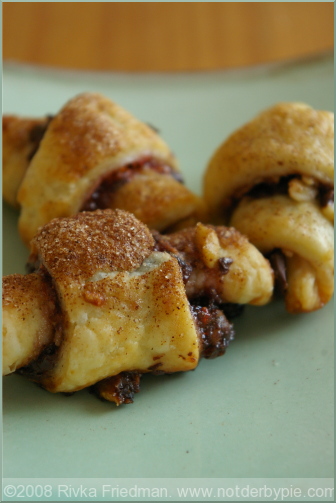
Long story short: Rugelach seem ordinary, and they have a few annoying steps involved, but oh, they are so very worth the extra effort. A delightfully flaky, unsweetened crust sandwiches raspberry and/or apricot jam, chopped nuts, chocolate bits, and cinnamon sugar -- at once sweet, tangy, and crispy. So when you're shmearing melted raspberry jam, carefully slicing 16 equally-sized pieces, or rolling each piece up and gingerly placing it on the baking tray, remember: reward is near.
rugelach6.jpg

I used Dorie Greenspan's rugelach recipe, because she's just that fabulous (and because she happens to have authored two of my very few cookbooks). I altered the recipe slightly, subbing chopped dried cherries for the dried currants and chopped big chocolate chips for the mini chips. I also used a mix of raspberry and apricot jams because I'm bold. And I recommend the blending, because it tasted fantastic.
rugelach7.jpg

Rugelach from Dorie Greenspan

  • 4 oz. cold cream cheese, cut into 4 pieces
  • 1 stick cold unsalted butter, cut into 4 pieces
  • 1 cup flour
  • 1/4 tsp. salt
  • 2/3 cup raspberry jam, apricot jam or marmalade
  • 2 Tbsp. sugar
  • 1/2 tsp. cinnamon
  • 1/4 cup chopped nuts (pecans, walnuts or almonds)
  • 1/4 cup dried currants or chopped dried cherries
  • 4 oz. bittersweet chocolate, finely chopped, or mini chocolate chips (or chopped regular chips)
  • 1 large egg
  • 1 tsp. cold water
  • 2 Tbsp. sugar, preferably coarse
  1. Make the dough: Put flour and salt in a food processor, and scatter the cream cheese and butter chunks overtop. Pulse the machine 6-10 times, then process, scraping down the sides as necessary. Stop when the dough forms large curds.
  2. Turn the dough out, gather it into a ball, divide it in two, and refrigerate each half in plastic wrap for at least two hours and up to one day.
  3. Make the filling: heat the jam in a saucepan over low heat until it liquefies. Mix the cinnamon and sugar together and set aside. Line two baking sheets with parchment or silicone.
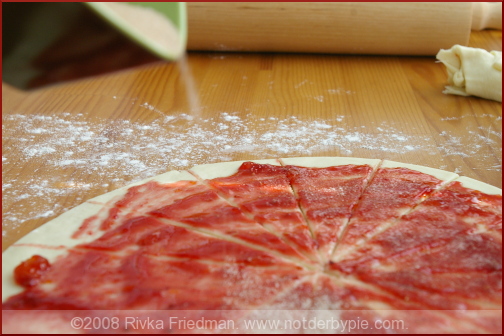
  4. Shape the cookies: Pull one packet of dough from the refrigerator. If it's too easy to roll, leave it out for ten minutes. On a lightly floured surface, roll the dough into an 11-12 inch circle. Spoon a thin gloss of jam overtop, and sprinkle half the cinnamon sugar. Scatter over half of the chopped stuff (nuts etc), and use a piece of wax paper to press the ingredients into the dough. Set aside the paper for the second batch of dough.
  5. Using a pizza wheel or sharp knife, slice the dough into quarters, and slice each of the quarters into four long, narrow triangles. Starting at the outside rim of each triangle (the base), roll each triangle up so that it becomes a little crescent. Make sure points are tucked under the cookie, and arrange on a baking sheet. Repeat with the second packet of dough. Refrigerate rugelach for at least 30 minutes before baking.
  6. Position racks to divide oven into thirds, and preheat to 350 degrees. Stir the egg and water together, and brush a bit of this glaze over the rugelach. Sprinkle each with coarse sugar. (I didn't have any, so I used more cinnamon sugar.) Bake for 20-25 minutes, rotating sheets from top to bottom and front to back half way through. Jam will likely have leaked out, so it's best to scoop underneath each cookie within a minute of removing them from the oven, so that they don't stick to the tray.
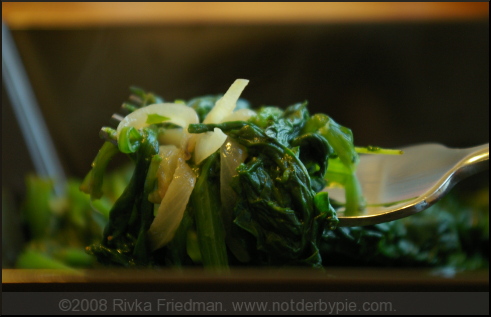
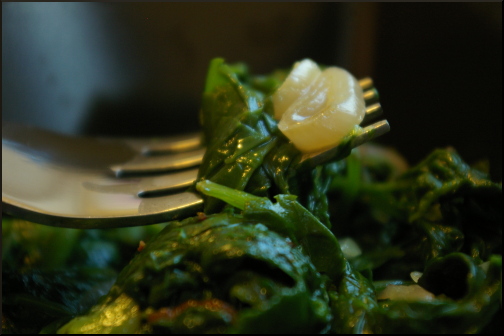
Greens? mouthwatering. Pictures? Not so much.

(After a long, long hiatus -- nearly 2 weeks! -- I've finally got a recipe for you. I recently started a new job, which, in contrast to the old one, actually necessitates my doing work. It's been tough to adjust to a full -- often overflowing -- workday and still make time to blog, but I'm coming around. Thanks for continuing to read, and I promise, more great recipes are in the wings!) spinach1.jpg

Honestly, I don't think I've ever posted such ugly pictures (save some of my early shots, which are pretty embarrassing). My apologies if looking at them makes you lose your appetite. I didn't even bother to put the watermark on that second one -- let's face it; no one's going to claim to have taken that ugly pic.

But the spinach, people, the spinach. It's absolutely delicious, and I insist that after staring for way too long at these ugly pictures, you go bother to make the spinach that's in them. I happened to have spinach in the fridge, and stumbled upon this recipe in The New Best Recipe (aka my New Best Cookbook). It's not my usual tune to make creamed spinach. I'm more drawn to raw salads and quick-sautees with Asian flavors than I am to heavy, Southern-style greens. However, I will certainly be making frequent exception to that rule from now on. TNBR's creamed spinach recipe yielded a perfectly delicate green, sweet from the cream and a pinch of sugar, slightly salty, a bit spicy from the freshly-grated nutmeg, and buttery from a sauteed shallot and, well, butter. I guess it's not hard to see how anything can be made tasty if you add sugar, salt, cream, butter, and shallots. But anyway, this spinach was pretty much a home run. I actually cut the cream in half, and it was still delicious, so if you'd be inclined, do the same.

spinach2.jpg

Assertive Greens with Shallots and Cream makes 2 cups

  • 2 Tbsp butter
  • 2 shallots, chopped fine
  • 1 recipe Blanched Assertive Greens (below)
  • 1/4 cup heavy cream
  • 1/2 tsp. sugar
  • 1/2 tsp. minced fresh thyme leaves
  • 1.4 tsp. freshly-grated nutmeg
  • salt and pepper
  1. Melt the butter in a large saute pan over medium heat. When the foaming subsides, add the shallots and cook, stiring frequently, until golden brown, 3-4 minutes.
  2. Add the greens and stir to coat them with the butter. Stir in the cream, sugar, thyme, and nutmeg.
  3. Cover and cook until the greens are heated through, about 2 minutes. If any excess liquid remains, remove the lid and continue to simmer until the cream has thickened slightly, about 1 minute.
  4. Season with salt and pepper to taste, and serve immediately.

    Assertive Greens:

    • 1 1/2 tsp. salt
    • 2 pounds assertive greens, such as kale, mustard greens, collard greens, etc.

    Bring 2 quarts of water to a boil in a Dutch oven or a large, deep saute pan. Add the salt and the greens, and stir until wilted. Cover and cook until just tender, 7 minutes. Drain into a colander. Rinse the pan, then refill with cold water, and put the greens into the cold water to stop the cooking. Gather greens by the hand, and squeeze dry.

The thing about recipes

When we cook, we use ingredients and we employ techniques. There is an abundance of information about these ingredients and techniques; some of it we know, some we could really stand to learn. When does an ingredient perform best? How does it behave in different combinations and conditions? When is a given technique best employed? Which steps are absolutely necessary and which can be skipped in a pinch?

We know much of this information already. To give a few examples:

  1. Eggs make dishes lighter. Whipping the egg whites? Even more so.
  2. Onions and garlic contain a lot of natural sugar that will caramelize and mellow when heated.
  3. Applesauce and yogurt are viable alternatives to the fatty liquids in baked goods.

There's a lot of other information we could really stand to learn. Here are some things I'm thankful to have learned from cookbooks, food articles, and plain old trial-and-error:

  1. a good dish balances the five dimensions of taste: sweet, sour, salty, hot, and umami (i.e. glutamate, which rounds out the other flavors)
  2. baking powder contains its own acidic agent; baking soda needs some sort of acid to be activated.
  3. Lots of time, little yeast, and no kneading can produce one of the best loaves of bread ever invented.

So you see, there's a lot of knowledge floating around out there about what we eat and how we make it. Recipes can be useful in providing bite-sized chunks of information in digestible form (no more food metaphors). But here's the thing about recipes: they transmit that information so absolutely, so authoritatively, that the cook feels reluctant, even scared, to change anything. Recipes are what make you stand by the oven, wiping your brow, because your quiche didn't cook in the half-hour promised. They're what make you think twice about even making a quiche, if you don't have the requisite amount of mushrooms for the mushroom one, cheddar for the cheddar one, etc. You could run to the grocery store at the last minute and buy exactly 2 1/2 cups of mushrooms, a mix of button, cremini and portabello as called for. Alternatively, you could save yourself the headache and improvise.

Improvisation: friend, not foe.

I treat recipes not as rules, but as inspiration. This is how I was raised. With the exception of my dad's Sunday-morning fannie farmer pancakes, my mom's linzer torte and a couple other unchanged family staples, almost everything I ate growing up was a product of cookbook and creativity.

Take Thanksgiving as an example of how we operate. My mom and I wrote up a menu skeleton -- brothy soup, cornbread, "main" or some sort, two chutneys/sauces, squash with something, interesting stuffing, vegetable, three pies -- and then looked at about 30 recipes online for inspiration. What we gathered from our reading was as follows:

  • the NYT dining section had a great recipe for broccoli rabe strata that we'd riff on for our main dish.
  • lots of cranberry chutney recipes call for chilies, so we'd include some in our sauce.
  • mushroom soup is flavorful without being heavy, so it's the perfect start to a big meal.
  • a rice recipe calling for cranberries and apple cider would be perfect with bread as stuffing.

We used this to draft our shopping list. Once we had all the ingredients, making the food was a processes of taste-and-adjust. I admit that it takes a lot of practice to get good at this. The more food you make, the better your palate becomes.

People have written countless posts, articles, even books, about the ease (and importance!) of adjusting recipes. Chief among them is this, my favorite quote from chef Michael Ruhlman's newest book, The Elements of Cooking, which I read cover-to-cover in a Barnes & Noble one afternoon. Modeled after Strunk and White's The Elements of Style, it's practically a dictionary of the actual elements of cooking (heat, etc), the terms used in foreign (mostly French) kitchens, as well as basic ingredients. Here's what he has to say about recipes:

Recipes are not assembly manuals. You can’t use them the way you use instructions to put together your grill or the rec room Ping-Pong table. Recipes are guides and suggestions for a process that is infinitely nuanced. Recipes are sheet music. A Bach cello suite can be performed at a beginner’s level or given extraordinary interpretation by Yo-Yo Ma—same notes/ingredients, vastly different outcomes.

How to use a good recipe: First read it and think about it. Cook it in your mind. Envision what it will look like when you serve it. Try to know the outcome before you begin. Read a recipe all the way through not only to understand it generally, but to make your work more efficient and to avoid making errors or taking unnecessary steps. Perhaps a dough needs to chill for an hour in the middle of a preparation, perhaps meat needs to be salted for twenty-four hours, or a liquid must be simmered, then cooled. The recipe suggests adding the flour, baking powder, and salt one at a time, but perhaps you can combine all the dry ingredients ahead of time while you’re waiting for the butter to get to room temperature so you can cream it with the eggs. Taking a few minutes to read a recipe, acting out each step in your mind as you do, will save you time and prevent errors.

Measure out or prep all your ingredients before you begin. Don’t mince your onion just before you need to put it in the pan, have it minced and in a container ready to go, have that cup of milk and half cup of sugar set out before you. Good mise en place makes the process easier and more pleasurable and the result tastier than preparing a recipe with no mise en place.

If you’re unsure about an instruction, use your common sense. You’ve already imagined in your head what the goal is. Work toward that goal using all your senses.

How to perfect a good recipe: Do it over again. And again. Pay attention. Do it again. That’s what chefs do. Often great cooking is simply the result of having done it over and over and over while paying attention. Great cooking is as much about sheer repetition as it is about natural skill or culinary knowledge. - Michael Ruhlman, The Elements of Cooking: Translating the Chef's Craft for Every Kitchen

If that's not clear, recipes are blueprints, not rulebooks. Play around a bit in the kitchen, and as always, trust your gut. Unless you think you're a horrible cook; in that case, you can always trust my gut. :)

I'd love to hear feedback from you lovely readers out there in cyberspace: how do you consult recipes? Are there steps you chronically skip or mess up? What are your sources for inspiration when it comes to adapting recipes? Please -- do share!

Ramps in shallot butter

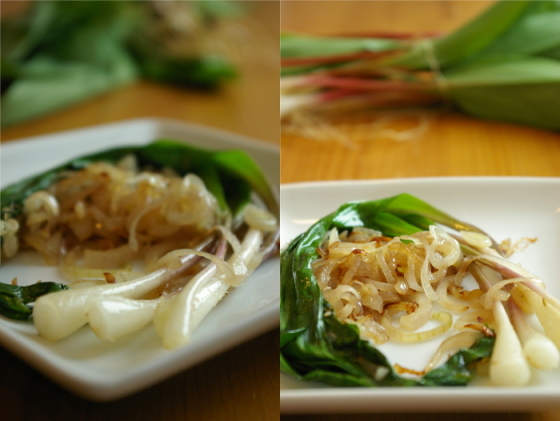
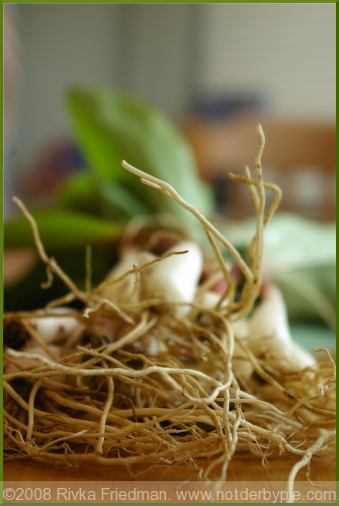
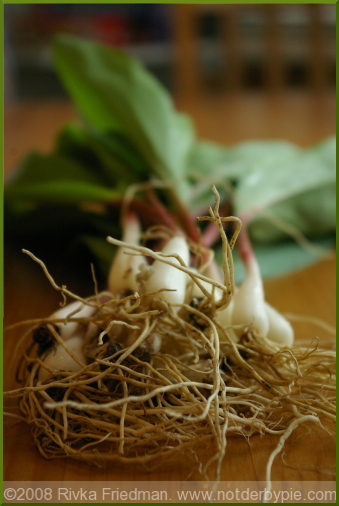
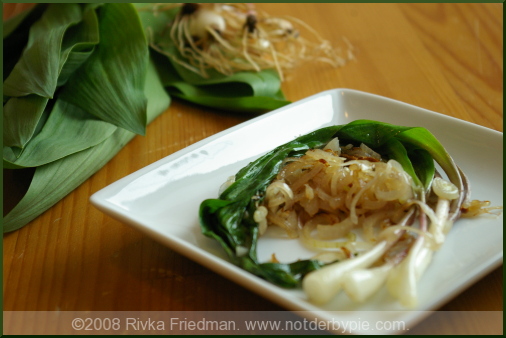
ramps11.jpg Nothing announces the end of gloomy winter and the coming of bright, bloomy Spring like ramps. Ramps resemble baby leeks, and taste like a cross between garlic and onion, only less pungent, more delicate green. Unlike leeks, ramps' green stalks are soft and can should be eaten. They're certainly Spring's hot item among chefs and gourmandes, and the most ramp-obsessed folks have been known to shell out as much as 20 bucks a pound for 'em. Now, you won't find me telling you they're worth that much -- after all, they were once mistaken as weeds and people spent time trying to rid their gardens of them -- but they are mighty tasty, and quite versatile. However, as they're expensive, I'd use them wisely.

ramps2.jpg

This May weekend was sadly wet, and we spent quite a bit of time indoors hoping for sun. Every so often the yellow showed its face for a fleeting moment, only to hide again behind the clouds. When taking an afternoon walk was pretty much out of the question, I decided to play with my ramps instead. I've been told they're great with asparagus in olive oil, or by themselves, but I don't have enough restraint to cook them plain. I knew I wanted to use butter, because let's face it -- nothing is worse for some butta in the pan. I did notice a pile of shallots in our potato/onion basket, and there's no combo like shallots and butter -- so I figured, as some ramps to the mix, and you might have some serious yum at your fingertips.

ramps3.jpg

Next time I'd serve the whole thing atop a slice of toasted baguette. While the dish was incredibly tasty, it may have been heavy on the onion/garlic flavor without something else to balance it out. It'd also be delicious over fish or chicken, or in roasted potatoes. As with sauteed onions, there are endless possibilities for how to use the ramp-shallot mixture. Just don't drown its flavor in a tomato sauce or anything, ok?

Ramps in Shallot Butter

1 shallot, 1 bunch of ramps, 2 Tbsp. butter, fleur de sel or sea salt

Slice off the roots from the ramps. Slice shallot thinly; saute in 1 Tbsp butter. Add second Tbsp butter and ramps, unsliced. Toss in pan so that butter coats vegetables. Saute about 1-2 minutes, until stalks are soft. Add fleur de sel or salt to taste.

ramps41.jpg