This post by another name? Best Cake Ever. Hazelnut, Brown Butter, Cake. Do you hear me yet? Brown butter, aka liquid gold. Hazelnuts, the best nuts on the planet. Cake. Yea. It's that good.
Read MoreMeringues (Finally)
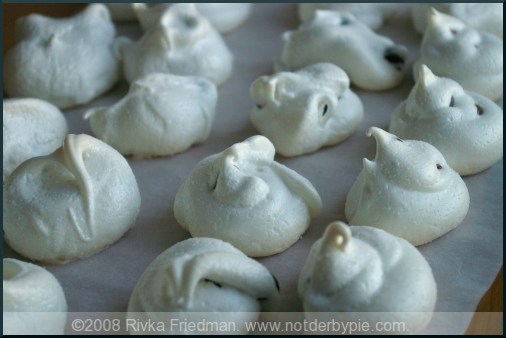 For all those anticipating Passover, these meringues are the perfect Passover dessert. They require no flour or leavening, but actually taste good. I simply can't go the week without them.
I was looking through my archived photos today and discovered something utterly shocking: I've had a website for...how long now? a year and a half?...and somehow escaped until today without posting a recipe for one of my most reliable, fool-proof, standby, can't-live-without desserts. I make them all all all the time, especially when I have leftover egg whites. On top of being nearly effortless to make, they achieve one of the rare feat of being both non-dairy and delicious. Like I said, rare.
Meringues, my friends, meringues. They are a fundamental part of my dessert repertoire, and the basis for many other desserts (including, among others, this crazy buche de noel, and the ultimate meringue-based dessert, Macarons.
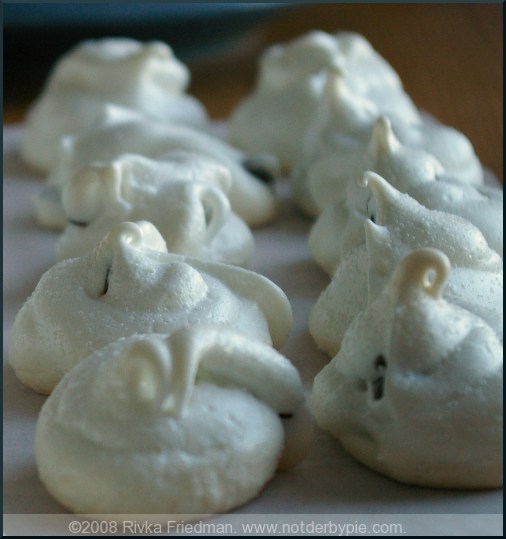 Before I get knee-deep in apologizing, I'll be out with the recipe. As I said, they're great on their own, or with any number of additions, including extracts (vanilla, almond if that's your thing), spices (cinnamon, cocoa, etc) and other add-ins (nuts or chocolate chips, pictured).
A few tips on making good meringue:
- Make sure your mixing bowl is bone-dry: any liquid will kill your meringue's ability to foam up. Along these lines, add any extracts only after the meringue is made.
- Egg whites will whip up much more easily if at room temperature. Leave them out for a couple hours before beating, if possible.
- The standard egg:sugar ratio for meringue is 1 egg white per quarter-cup of sugar. I usually double this for a batch of meringues.
- Cream of tartar is an acid that helps increase the volume of, and stabilize, whipped egg whites. You only need a teeny bit -- about 1/4 tsp. for 6 egg whites, so a scant pinch for my recipe.
- Traditionally, the egg whites are whipped until soft peaks form, and only then is sugar added. There's nothing wrong with adding sugar earlier in the process -- promise, I've done it by accident many times -- but your eggs will take longer to foam up if there's sugar in them.
- There are two methods for baking meringues: some bake them for a couple hours in a low oven. Others bake them overnight in an oven that was preheated and then turned off. Either works; I prefer the former.
Keep these things in mind, and meringue will be your friend. Have any great uses for meringue? I'm already thinking of making a pavlova (big pillow of meringue topped with fruit and whipped cream) this weekend -- leave other great ideas in the comments.
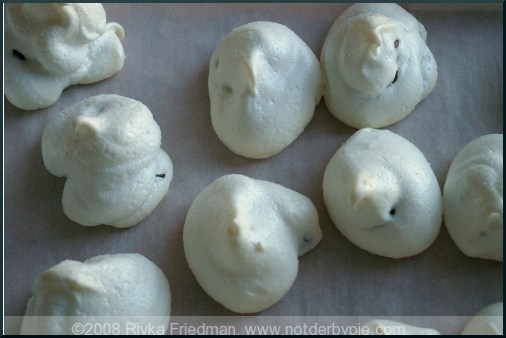
2 large egg whites, at room temperature a scant pinch teaspoon cream of tartar a pinch kosher salt 1/2 cups granulated sugar, divided 1/4 teaspoon pure vanilla extract 1/2 cup high-quality chocolate chips, optional
Preheat the oven to 200 degrees F. Line 2 baking sheets with parchment paper.
In the bowl of an electric mixer fitted with the whisk, beat the egg whites, cream of tartar, and a pinch of salt on medium speed until very soft peaks develop. Add 1/4 cup sugar and increase the speed to high until the egg whites form very stiff peaks. Whisk in the vanilla. Carefully fold the remaining 1/4 cup of sugar into the meringue. Either pipe the meringues onto the baking sheets using a pastry bag (or plastic bag with a bit cut off the end), or spoon them onto the sheets, au natural.
Bake for 2 hours, or until the meringues are dry and crisp but not browned. Turn off the heat and allow the meringues to sit in the oven for about half an hour**, then set on the counter to dry out completely.
**Meringues do not keep very well; they're best within a day of when they're made. However, if you do want to keep them, and it's not terribly humid outside, let them dry out in the oven overnight, or until the oven is completely cool and the meringues are really dry. They'll keep better this way. I stack them in tupperware between layers of parchment paper, and hope for the best.
HamentaschenFAIL
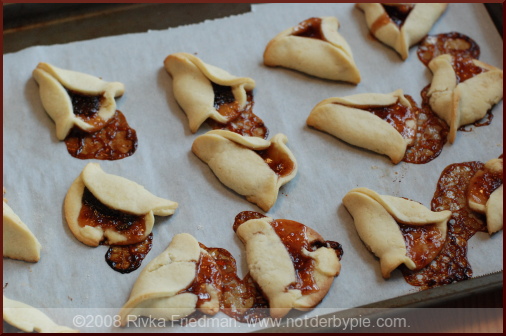 Yea, I don't know what happened this year. Normally, this dough gives me minimal frustration, but for some reason, this go-round I got half a batch of nice-looking little guys and half a batch of...well, sexyugly. Tasty, nonetheless -- but not the kind of cookie you want to pass out. Especially not when you have a food blog. Ugh.
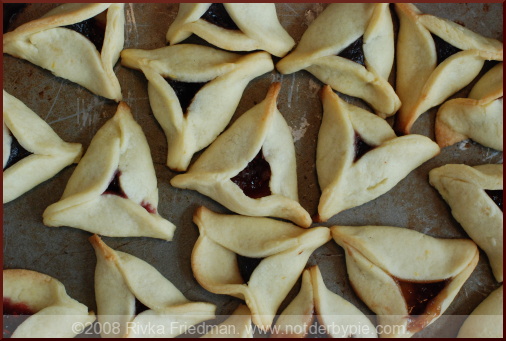
You know what? I'll own it. This dough may not produce the prettiest guys in the pack, but they're damn tasty. The dough is crunchy on the outside, nicely flaky, and flavored with tons of lemon zest. Nothing like those crumbly, nasty things they sell at the bakery. I'm just saying.
Any hamentaschen disaster stories? Share in the comments.
The Makings of a Middle Eastern Lunch
 Hard to believe it's already Thursday and another Saturday is nearly upon us. I'm still thinking about last weekend's 75-degree weather and super-chill Mediterranean style lunch. A trip to NYC will prevent me from repeating that meal this Saturday, but if I could, I would, in half a heartbeat. It's the obvious way straight to my heart: breads, spreads, salad, and a glass of wine. Easy to please, no?
I might as well pass along the recipes I used in case you're interested in replicating my lunch last Saturday. Really not hard, really really tasty. Whip up a greek salad to accompany the spreads here, get (or make) some good pita or laffa (shepherd bread), and wash it all down with some cold, fruity white wine. My mouth is totally watering.

First up: Muhamarra, the Syrian red pepper and walnut spread with a kiss of pomegranate syrup. Next, a lovely walnut hummus from Heidi at 101 cookbooks topped with paprika and sumac, the tart Middle Eastern condiment. Finally, labneh (at long last) -- the thick, tangy yogurt cheese finished with a drizzle of good olive oil and a sprinkling of za'atar, a Middle Eastern plant ground into a fine powder and mixed with sesame seeds.

Last week was the first time in a long time that I've been able to bring a part of my experience in Israel into my home in DC, and I'm still riding the wave.

(Also -- shout out to my little bro, who turned 23 today. Yowza!)
Muhammara adapted from Epicurious
1 12-ounce jar roasted red bell peppers in olive oil with garlic, drained 1 cup walnuts 1/3 cup breadcrumbs 2 tablespoons extra-virgin olive oil 2 teaspoons pomegranate molasses or fresh lemon juice 1 teaspoon ground cumin 1/4 teaspoon cayenne pepper Pita chips
Blend all ingredients except pita chips in processor until coarse puree forms. Season with salt. Transfer to bowl; serve with chips.
Hummus en Fuego adapted from 101 Cookbooks
1/2 cup walnuts, toasted 2 cups cooked (or canned) garbanzo beans, drained 1-2 medium cloves garlic, to taste juice of 1 lemon (about 4 tablespoons) 1/4-1/2 cup hot water 1/4 cup olive oil 1 Tbsp za'atar (or paprika)
To make the hummus, give the walnuts a spin in the food processor, just until they are a sandy texture. Add most of the garbanzos, 1 or 2 tablespoons of the oil, 1 clove garlic, and lemon juice. Now process until smooth. Drizzle in the water a bit at a time and puree more, until the hummus is creamy and billowy. Taste; if desired, add the second garlic clove. Let the processor run for a minute or so at this point, to incorporate air into the puree and give it a light texture. Taste, adjust the seasoning - more salt, more lemon juice, etc.
Serve in a shallow bowl, drizzled with plenty of the remaining oil and paprika, sumac, za'atar or other Middle Eastern spice. Heidi garnishes with cured olives and red pepper oil, another lovely option.
Makes roughly 2 1/2 cups.
Labneh
1 quart greek or regular yogurt 1 tsp salt olive oil za'atar
Stir salt into yogurt. Line a wire mesh strainer with either cheesecloth (at least two layers) or paper towels. Spoon yogurt into strainer; set over a bowl, cover loosely with saran wrap, and refrigerate overnight. In the morning, bowl will contain much of the whey. For regular yogurt, strain an additional 3-4 hours or more, for maximum thicknes. Greek yogurt will be ready after about 8 hours.
Serve in a shallow bowl; drizzle olive oil, and top with a generous sprinkle of za'atar.