Wheatberry Salad with Cranberries, Feta, and Mint

wheatberrysalad1 Yet another installment of my weekday lunch series; you can never have enough recipes for midday workplace eats.

I don't have anything to share about this recipe that's particularly exciting. It's just another rendition of my standard grain+bean+berry+herb salad formula. But I realized as I made this salad that it was my first time making wheatberries. At least, I'm pretty sure it was my first time -- in any event, it definitely won't be my last. Wheatberries are pretty underrated, so much so that when I served them last Friday night, most everyone around the table asked what they were. "Wheat," I replied. No one got it; "What part of the wheat? Like, they're really just wheat? Are they some sort of berries that grow off the wheat crop?" No, I replied, it's really just wheat. Funny that we don't know what the food we eat most often actually looks like, but that's a story for another time.

Wheatberries are sweet and nutty, with a nice solid texture. They're probably super versatile; I can envision them in a variety of salads, soups, and stews. Writing that line, I just remembered that I've actually used wheatberries before, when making the Sephardic version of cholent, the rib-sticking stew made on Friday and cooked at a low temperature through the night. Unlike the Eastern European recipe of barley, beans, potatoes, beef, and eggs, the Sephardic version, called "Hamin," is made with wheatberries, chickpeas, and dates in addition to the beef, chicken, and other leftovers. The wheatberries are cooked inside cheesecloth wrapper within the dish, so they can be piled separately onto the plate as a bed for the rest of the goodies.
wheatberrysalad2

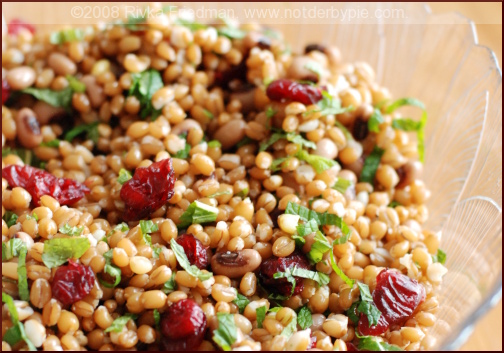
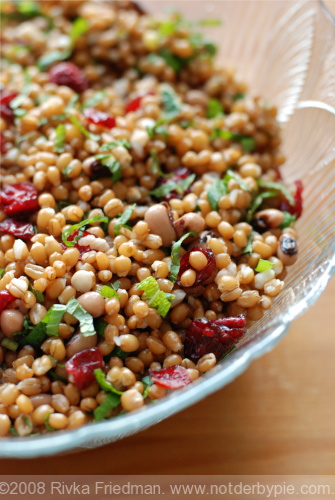
Hamin is for another day. This here salad is simple and fresh, and it's a great way to make use of any leftover herbs you may have. I used cranberries, mint, black eyed peas, and Keswick Creamery feta (the best feta on earth, btw -- would you believe it's cheaper than the imitation crap at the grocery store?), but I can envision an equally delicious version with feta, sundried tomatoes, basil, and navy beans, or with cilantro, kidney beans, fresh tomatoes, and some chipotle en adobo. I made a super-tangy vinaigrette with some Honeycup honey mustard, fresh lemon, salt, pepper, chopped shallot, and olive oil -- but any old vinaigrette would do just fine. My pics don't have the feta, because I put it in just before serving -- but don't leave it out; it adds a brininess that plays really well with the sweet tartness of the cranberries and the freshness of the mint.

Wheatberry Salad with Cranberries, Feta, and Mint

1 cup wheatberries (available at natural foods stores) 1 can or 1 cup dried black eyed peas 1/2 cup diced or crumbled Feta 1/2 cup thinly sliced red onion 1/2 cup dried cranberries, cherries, or other dried berries 1/2 cup chopped mint 5 tablespoons olive oil 5 tablespoons fresh lemon juice, or to taste 1 tablespoon mustard (I like a sharp honey mustard) freshly cracked pepper, to taste

In a pot of boiling salted water, cook the wheat berries for 1 hour, or until they are tender, and drain them. (At this stage, the wheatberries can be stored for several days in a covered container until ready to use.) In a small bowl, mix lemon juice, olice oil, salt, pepper, and mustard. Whisk to combine, and adjust as necessary. In a large bowl stir together the wheat berries and all other ingredients. Toss to combine. Serve cold or room temperature.
Pickled Cauliflower

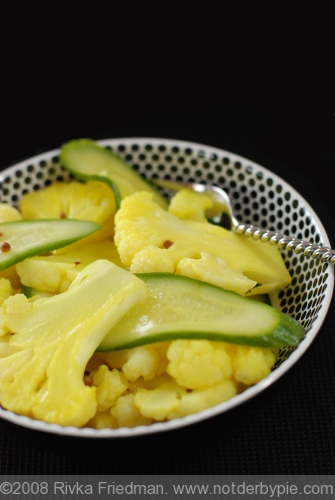
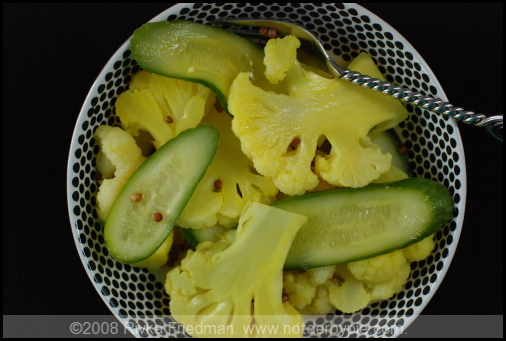
pickled-cauli-1 I absolutely love sour things. I've been known to suck on a lemon slice once in a while, just for kicks (though my dentist scolded me for doing it, so I reluctantly put the habit to rest). When it comes to pickles, I'm a full-sour kinda gal. None of that dill or bread-n-butter stuff; I like'em super super sour. I'm into cucumber pickles, but I can't say that they're my favorite -- not by a long shot. No, my absolute favorite pickle is a pickled green tomato, especially if it's from Guss' Pickles on the Lower East Side. My first time at Guss' was on an 8th grade class trip, when we stopped there very briefly on our way back from grabbing knishes, bialys, deli, and other LES specialties. I remember watching friends get themselves just one pickle, or two. When I looked deep into the plastic tub in front of me and saw green tomato quarters, bobbing up and down in the brine, I knew that's what I had to have. Sadly, Guss didn't sell the tomatoes by the single back then -- only by the pound. Obviously, I bought myself a pound of pickled green tomatoes. Reluctant to waste, I ate them all. Boy were they good.
pickled-cauli-2

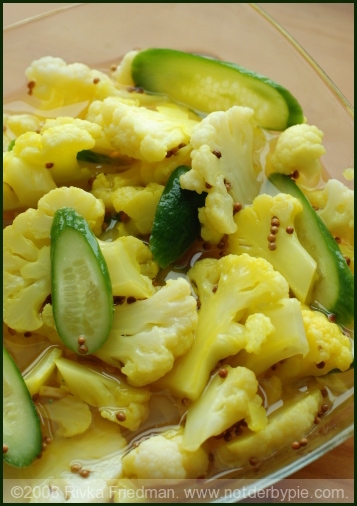
Not to dismiss cukes, but compared to the tomatoes and other exotic pickled things, they're kind of ordinary. I can promise you that this cauliflower recipe is anything but. I originally published this recipe in an article I did for My Jewish Learning on Israeli Independence Day, but these sour, cardamom-spiked florets are great year-round.

pickled-cauli-3

Before I send you off with this recipe, I want to just make note of a couple housekeeping items: first, I finally figured out how to set up comment threads, so now we can all respond to each other's comments, which is very exciting for me, since I've been wondering how to do it for almost two years.

Second, the link to my current coveted cookbook, Bittersweet, was apparently taking everyone to my last coveted cookbook, A Platter of Figs. That's a great cookbook -- but so is Bittersweet, so now the link works.

Lastly, can you hang in there for a weekend? I'm away for a couple days, but I'll be back Sunday with more delicious things to make and eat...

Pickled Cauliflower

update: thanks to reader Rachel who pointed out that the recipe should read 3 TEASPOONS salt and not 3 Tablespoons. Egad! Sorry, Rachel! 3 tsp. coriander seeds 1 tsp. turmeric ½ tsp. white mustard seeds ½ tsp. cumin seeds ½ tsp. celery seeds, optional 3 bay leaves Pinch cayenne pepper, optional 1 head cauliflower, washed and separated into florets 1 large carrot, sliced into thick chunks ½ a small yellow onion, sliced into half-moons 1 ½ cups white wine or plain white vinegar 3 tbsp. sugar 3 tsp. kosher salt

Bring a 2-quart saucepan of salted water to a boil. Boil the cauliflower and carrots for 3 minutes; drain and transfer to a large bowl. Add the onion and stir to combine. In a large sealable container (canning jars will work, but are not required if you plan to eat the salad soon and store in the fridge), add half the total amount of each spice (not including the sugar and salt). If dividing the salad among several jars, divide half the total amount of each spice among the jars, saving the other half to top the vegetables. Add the vegetables into the container(s), leaving about ¾ " of space at the top of each container. In a 4-quart saucepan, bring 2 cups water and all the sugar and salt to a boil over high heat, stirring occasionally until fully dissolved. Add vinegar and stir to combine.

Pour the vinegar solution into the container(s), leaving ½” of space below each rim. Close or seal container(s) and transfer to the refrigerator. Allow to marinate at least 24 hours before serving; the longer you wait, the better.

Vanilla Ice Cream with Stracciatella

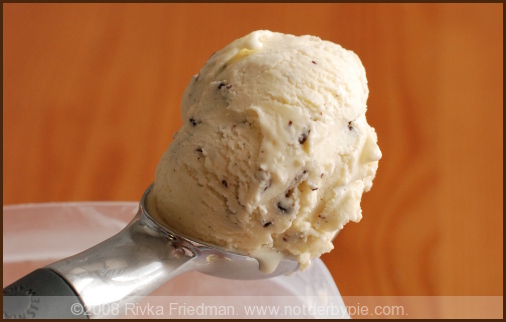
vanilla-stracciatella-1 Recently, I discovered something of an oddity in my ice cream-eating habits. When I buy ice cream, I'm pretty particular about how I like it: Ben and Jerry's coffee heath bar toffee crunch. It's really that easy. I've never been one to order vanilla, chocolate, or any other flavor that's that simple. When I order chocolate, it almost always has some swirl, ribbon, or maybe even some of those little chocolate-filled bits. Cheesy, I know, but I like my ice cream with lots of stuff in it, what can I say?
That affinity for add-ins rapidly fades when I'm making ice cream. When I'm making the stuff from scratch, I'm a total purist. Vanilla is my most frequent concoction, and in my mind, it's pretty hard to beat. If hard pressed, I think I'd probably pick my homemade vanilla over a pint of B&J's Coffee Heath. Though not without some serious deliberation.

Why is that, you'd like to know? I think it has something to do with the sheer quantity of egg yolks and cream and not-so-cheap vanilla beans that go into a good quart of frozen. (That's six egg yolks, 1 cup of whole milk, and 2 cups of heavy cream, thank you very much.) It's also got everything to do with fear of failure -- or, better put, fear that the cherry pit ice cream you were so curious to try is actually a total flop. When you're working with farmers' market eggs and organic cream, you're spending a pretty penny; I guess I want to make sure I get my money's worth. Call me a pincher, but you know what? Vanilla comes out just perfect, every single time. It also tastes so pure, so much like the ingredients that are used to make it, that I find it difficult to veer far from it.

vanilla-stracciatella-2

That's thanks in no small part to David Lebovitz, king of lots of things, including ice cream. His book, The Perfect Scoop, is my go-to resource for drooling over ice creams that I never have the courage to make. (My most recent 11th-hour-back-out flavors were maple-walnut, saffron, and ginger.)

By the time this Thursday rolled around and I saw the weekend weather forecast, I new ice cream was in the cards. And having made frozen nonfat and frozen yogurt in the past couple weeks, it was time for the full-fat stuff. Armed with David's book, I decided to venture beyond my safety blanket of vanilla and try something new, something radical: Vanilla with Stracciatella.

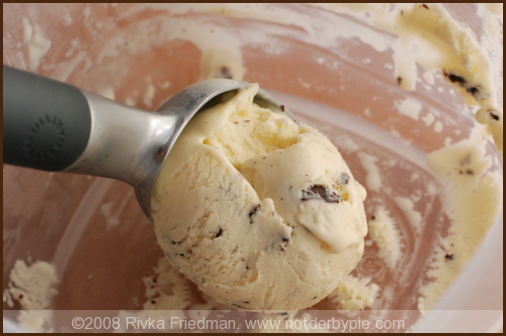
Lest you get too excited, what sounds super fancy and exotic is really just the Italian version of chocolate chip (baby steps, people, baby steps!), only worlds better. Stracciatella, literally "torn apart" in Italian, refers to thin shards of chocolate that are hidden between the layers of ice cream or gelato. They're made by drizzling melted chocolate into the ice cream maker at the last possible moment of churning. The chocolate freezes on contact, forming these thin and crunchy bits that melt in your mouth when you eat the ice cream. In a word, awesome.

Having made really good vanilla ice cream many times, I was a bit concerned about spoiling the pure stuff with chocolate, but after eating it Friday night, I can reassure you that there's nothing to worry about. If anything, the shards of chocolate complement that smooth, rich, vanilla flavor. And to those of my family members who dislike chunky things in their ice cream (yes, you!), fear not: while you do get a bit of crunch at the beginning, the chocolate really does melt in your mouth, giving the whole ice cream a smooth sensation.

Next up on the ice cream docket: maple walnut? saffron? Maybe even cherry pit ice cream. Wish me luck.

About 1 quart

Everyone should gave a great recipe for Vanilla Ice Cream in their repertoire. Here's mine, which you'll want to serve with anything from a freshly-baked pie or just covered with dark, bittersweet chocolate shop and toasted nuts.

1 cup milk A pinch of salt 3/4 cups sugar 1 vanilla bean 6 egg yolks 2 cup heavy cream 3/4 tsp. vanilla

Heat the milk, salt, sugar, and one cup of the cream in a saucepan. Split the vanilla bean lengthwise and scrape the seeds into the milk with the tip of a paring knife. Add the bean pod to the milk. Pour the remaining cup of the cream into a large bowl and set a mesh strainer overtop.

whisk together the egg yolks in a separate bowl and gradually add some of the warmed milk into the yolks, stirring constantly as you pour. Pour the warmed yolks back into the saucepan.

3. Cook over low heat, stirring constantly and scraping the bottom with a heat-proof spatula (I used a wooden spoon), until the custard thickens enough to coat the back of the spatula. Strain the custard into the heavy cream and mix to cool. Rinse the vanilla bean and put it back into the custard and cream to continue steeping. Chill thoroughly, then remove the vanilla bean and freeze in your ice cream maker according to the manufacturers instructions.

On limiting waste

leftover-components-1 I dunno about you, but I'm feeling more and more compelled to get a composter. It seems ridiculous that I throw away several pounds of biodegradable stems, peelings, cores, pits, seeds, skins, and rinds, when I could compost them instead. I know that composting in urban environments can be challenging: living as we do in the heart of DC, our access to yard space is limited nonexistent, and we aren't exactly teeming with the space (or money, for that matter) to install one of those large, expensive all-in-one electric composters. That said, the amount of waste that my one household -- a household of two -- can produce in one week is kind of mindblowing. So I'm considering getting a compost tub, just a little guy for the house. One of the biggest lobbyists for this purchase is our friend Matt, who lives with his wife Bryce around the corner from us, and has kindly volunteered to take our compost if we'll drop it off (right, Matt?). I figure, I've got someone to take the stuff, and I've definitely got room for a little bin in my kitchen: now is as good a time as any to stop wasting and start composting. Huzzah!
Composter in hand, I'll stop throwing away the bits of produce that I tend not to use in cooking. But there's another way to think about limiting waste, one that's near and dear to me as a food blogger, and that's making sure to extract as much flavor as possible from the ingredients we buy. Not only is this best practice for maximizing use of the food we buy, it's also a way to ensure that we make the most of our purchases, which in turn can save all of us a little hard-earned dough.

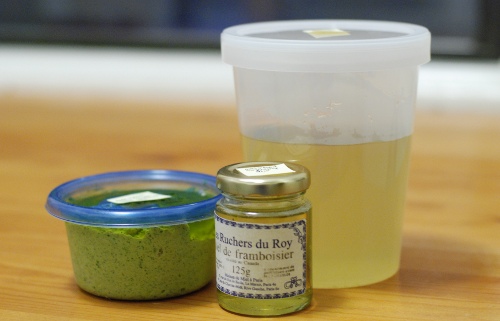
Within the past two days, I've made broth out of the stems of asparagus, cooked a mint-infused simple syrup with the stems and some leaves of a massive mint harvest that the Masseys gave me as a gift, and made an herb pesto with leftover walnuts, going-going-cilantro, and -- you guessed right -- more of those mint leaves. What'll I do with each of these things? I'm not 100% sure, but if you hear that I served herb-encrusted salmon and mint spritzers for Friday night dinner, don't be surprised.

leftover-components-2

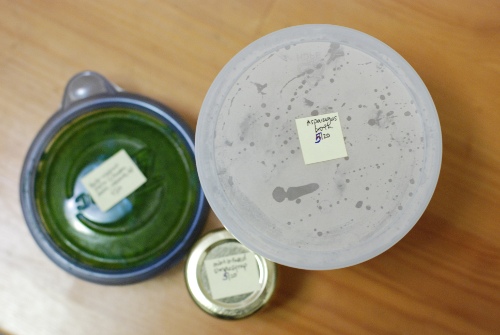
When I make these types of basic components, I store them -- in either the fridge or the freezer -- well-sealed and labeled. I usually note the item, its components, and the date I made it. That way, when I open up my freezer and see frozen rugalach dough from March, I know what to make for weekend dessert. And when I see frozen Bolognese sauce from January, I know what we'll be having for dinner, like, pronto.

Below, I've included the methods for each of the three components I made this week. As you can imagine, the possibilities here are too many to count: switch up the herbs for the ones you've got in your fridge, toss some lemon or lemon zest into the simple syrup for extra zing, and add any and all vegetable scrapings into your stock to make it more complex (and resourceful!). These are truly just a few of the infinite number of possibilities, many of which were noted in Mark Bittman's insightful column about using your freezer as a pantry.

Asparagus Broth

1 lb. Asparagus stems 6 cups water 1 tsp. salt

Bring water and salt to a boil. Add stems (and tips, if blanching for use in another recipe; I actually blanched the parts I was using in a separate batch of water (3 cups), strained them and reserved that water, and then boiled another 3 cups of salted water for the stems. where was I...) and boil for approximately 10-12 minutes, until water is a pale green and stems can be pierced with fork. Strain stems over a large bowl, reserving cooking water. Allow to cool half an hour, then package in tall plastic container and make sure to label with name, ingredients, amount of salt, and date.

Mint-Infused Simple Syrup 1/2 cup sugar 1/2 cup water large handful mint stems and leaves

Bring the water to a boil. Add sugar, and swirl around to dissolve completely. Add mint; remove from heat, and allow to steep at least 30 minutes, preferably overnight. Discard or compost mint, package syrup in small sealable container with clear label. Will keep for several weeks.

Herb Pesto

3-4 heaping cups herb leaves; I used mint and cilantro, but feel free to add parsley, basil, sage, tarragon, marjoram, or any other herb 1/2 cup chopped or whole walnuts large pinch salt, to taste Parmesan or other hard, dry cheese, optional (I didn't use any) 1/2 a lemon, optional (I had one leftover) 3 Tbsp. water olive oil

In a blender, combine herbs, walnuts, salt, lemon juice if using, and water. Blend on medium speed until herbs are chopped into small bits. With the mixer on, pour oil in a steady stream until mixture begins to come together. Stop pouring oil, continuing to blend until the pesto is as emulsified or as chunky as you like it. Taste, and adjust salt if necessary. Store in a sealable container: be sure to leave 1/2 an inch at the top of the container to fill with oil. This will ensure that your pesto stays fresh as long as possible.