Sugar High Friday: Toasted Edition, the Roundup!

toastedflour1 It always takes me a while to get over the end of summer's abundance; I spend a good part of September missing peak tomatoes and fretting about corn's impending end. But once October comes around, I'm fully ready for fall, which brings pleasure of a different sort.

Once I've left summer behind, I'm ready for the reds, oranges, and deep golden yellows of the leaves in Rock Creek Park. I'm ready to put on one of those big, chunky sweaters, a pair of my favorite jeans, and my steadfastly loyal black riding boots, and take a walk through the park. I love the crunch of those leaves beneath my feet. the crisp chill of the air that sneaks between my scarf and the neck of my sweater, the smell of my favorite lip balm that makes its annual debut this time of year. It's fall, people.

When the air is as crisp as the leaves, I often find myself standing over the stove, watching walnuts toast and inhaling that intoxicating smell, and occasionally sneaking my hands out of my sweater sleeves for a quick toasting of their own over the hot pan.
toastedflour3

Fall is the perfect time for all things toasted. Toasting can intensify the flavors of nuts and spices, caramelize the natural sugars in fruits and even some vegetables (like onions), and bring out rich, nutty undertones that might otherwise remain dormant in the food we eat.

With yours truly playing hostess, Sugar High Friday's Toasted Edition is finally here. Several wonderful bloggers cooked up some scrumptious-looking desserts, all of which incorporated at least one toasted element, and I've made something toasted of my own -- something fairly unconventional, which I hope you'll enjoy.

But without further ado, the round-up:

dhanggitskitchen

First, we have Dhanggit of Dhanggit's Kitchen, who made a Pineapple, Toasted Almond and Rum Cupcake. Bright flavors, but the toasted almond lands this dessert squarely in fall territory. Looks delicious!
erbeincucina

Next, we have Graziana from Erbe in cucina (Cooking with herbs), who made Cinnamon Basil Pancakes. I'd never heard of cinnamon basil before, but it sounds fascinating! Graziana says you can substitute regular basil and a bit of cinnamon if you don't have access to a cinnamon basil plant.
SN852844

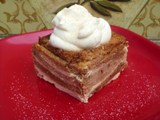
Up next is Rocquie from Sage Trifle, who baked up some delicious-looking Cinnamon Toast Bread Pudding for all of us to drool over. It's hard to imagine what could be better than layer upon layer of cinnamon toast sandwiching pecans and raisins and topped with whipped cream. 'Scuse me for drooling!
fahrenheit350

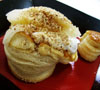
Then there's Kitty from Fahrenheit 350°, who made something she calls Pear Eclipse: call it what you will; it's got homemade puff pastry, pears, and mascarpone cream. Say no more.
aficionado

And last but not least, Cathy from Aficionado made a Toasted PB and Choco-Banana Sandwich, a recipe that comes complete with its own warning label: Do not make this at home, says Cathy! Seriously. It's dangerously unhealthy and, if I had to guess, dangerously tasty.

There you have it -- our Sugar High Friday Toasted Edition Round-up! Thanks to all who contributed, and I look forward to trying my hand at some of these sweet treats.

My submission to this month's event is the shy girl-next-door to the queen bees listed above. It's ingredients are more simple, and its toasted flavor is more subtle, though plenty complex. I was inspired by Clotilde's post on Chocolate and Zucchini a while back about re-imagining her favorite sable recipe using a technique from Pierre Gagnaire: Clotilde remade her mother's sables, but subbed toasted flour for the regular raw flour called for in the recipe. The resulting dough may have been hard to shape, but she just swooned over the "grilled" flavor that came through in the finished product. I simply had to try my hand at this.

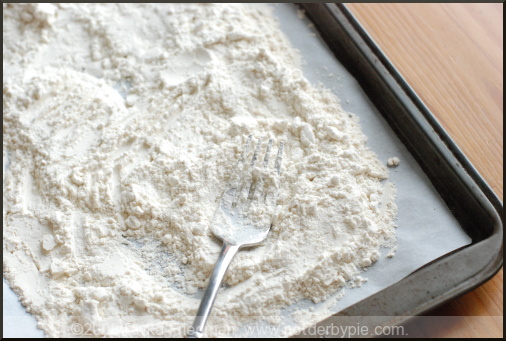
Clotilde explains that the concept of toasting flour is similar to roasting coffee beans, the goal being to partially carbonize the beans and make them more fragrant. Toasting flour isn't hard: you spread it in a thin layer on a rimmed baking sheet, and pop it in a 320-degree oven for about 20 minutes, stirring every 5 minutes or so, until flour smells nutty and fragrant. The flour won't take on much if any color, so let your nose guide you.
toastedflour2

One thing to note about toasted flour is that, not surprisingly, its chemical structure is different from that of regular flour, and weakens the gluten molecules, which makes toasted-flour dough less elastic than its traditional counterpart. While it wouldn't be ideal for bread-making, toasted flour is perfect for sables or sand cookies, which are meant to have a more crumbly consistency.

In deciding which sable recipe to make, I considered several possibilities. Poilane, the famed boulangerie in Paris, has a most delectable sable they call "punitions" (punishment cookies, though eating them is exactly the opposite). The sable comprises just wheat flour, sugar, butter, and eggs -- nothing else -- and achieves both flavorful simplicity and textural perfection. I agreed with Clotilde that vanilla and other flavorings should be withheld to let the flavor of the toasted flour shine through on its own, so Poilane was certainly a possibility. I was intrigued, however, by Clotilde's sable recipe, which calls for milk. I suspected that the milk might lend the cookies a smooth, velvety quality, and was curious to try it out. In researching sable recipes, I also found that some bakers prefer a mix of granulated and powdered sugar, which is said to act more like a liquid and make the sables softer. I knew I wanted a crisp, crunchy cookie, so powdered sugar was out.

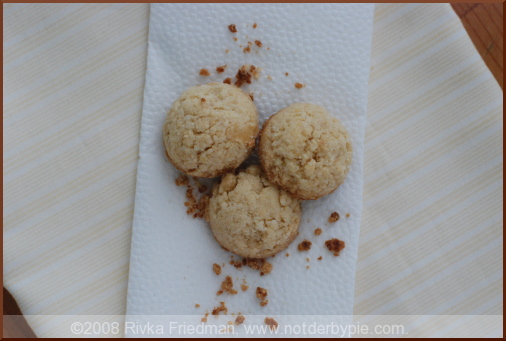
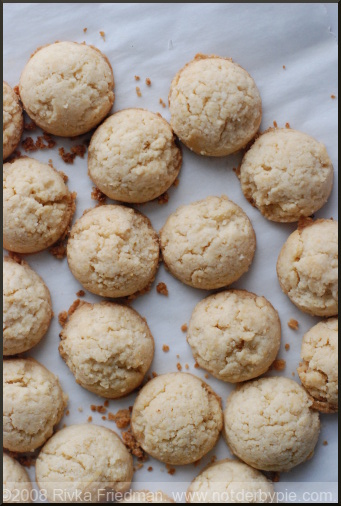
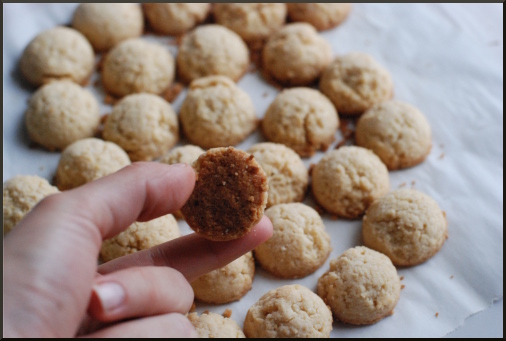
In the end, I settled on a mix of Clotilde's and Poilane's recipes, including salt and milk (which Poilane doesn't) in my dough. I found, as Clotilde did, that the toasted flour made for a very crumbly dough that fought my efforts to make it adhere; undeterred, I pulled out my trusty melon baller, using it to compress little half-spheres of dough and rapping it a few times against my baking sheet to release the mounds. So I had button cookies instead of the flat, cylindrical wafers I'm used to; I guarantee, they tasted no less delicious. The sables were just as pure and simple as they always are, only their flavor was more intensified. No vanilla was needed, and I'm glad I didn't include it; once toasted, the flour became a flavoring agent strong enough to stand on its own. I'm glad I included the salt, though, because it added another dimension in which to taste that nuttiness of the toasted flour. And the texture was just so interesting: more crumbly than traditional sables, perhaps less sandy. Needless to elaborate, I really, really liked them.
toastedflour4

I'll provide the recipe I used, but definitely feel free to experiment: try your favorite sable recipe, or even a chocolate cookie. Who knows? Toasted flour could be the next big thing. I might try it next in linzer cookies, which I made this week and quickly devoured. But definitely do try toasting flour; its flavor is unlike anything I've ever had before, and I can't wait to explore its many possible uses.

Toasted Flour Sables adapted from Clotilde and Poilane Bakery

1 1/2 cups all-purpose flour, toasted according to instructions above (in a 350-degree oven for 20 minutes); if you've ever considered splurging on fancy farmers' market flour, this would be the time 1 stick butter, cut into chunks 1/3 cup sugar 1 egg yolk 2-3 tablespoons milk 1/2 teaspoon salt flakes, the best you've got

In the bowl of a food processor, combine flour, sugar, and salt. Pulse a couple times to combine. Add butter, and process until dough forms fine crumbs. Add egg yolk and pulse a few more times to incorporate. Then add milk, one tablespoon at a time, and pulse until dough is moist enough that when you squeeze it, it sticks together.

Line a baking sheet with parchment paper. Using a melon baller or two teaspoons if you prefer, gather clumps of the dough right from the processor bowl and press against the side of the bowl to ensure that dough holds together. Turn the melon baller upside so that the cookie inside can fall onto the cookie sheet, and rap the melon baller against the sheet until the cookie falls out. Organize cookies on the baking sheet and refrigerate 1 hour to harden. Bake at 350 degrees for 15 minutes, watching them carefully all the while, until they're golden at the edges. Let rest for 5 minutes, then transfer to a cooling rack.

On the Occasional Chicken Dinner

roast chicken1 I've been thinking a lot about Jonathan Safran Foer's article in the New York Times Magazine's recent Food Issue about why he stopped eating meat. If you haven't read the article, take a look. Safran Foer tells the story of his long-time struggle with vegetarianism and the ways in which fatherhood helped him strengthen his convictions to not eat meat. The question with which he grapples has been posed many times before: how do we reconcile our appetites for meat with the ethical questions of animal cruelty and environmental damage that are part and parcel to the process by which 99% of American meat is produced? While Safran Foer's insights and answers aren't new, not everyone reads The Omnivore's Dilemma and shops at farmers' markets. I imagine that given the wide circulation of NYT, the author's message reached a wider, less "in-the-loop" audience. I'm glad for that.

Still, I struggle with something he said, one sentence in particular:

According to an analysis of U.S.D.A. data by the advocacy group Farm Forward, factory farms now produce more than 99 percent of the animals eaten in this country. And despite labels that suggest otherwise, genuine alternatives — which do exist, and make many of the ethical questions about meat moot — are very difficult for even an educated eater to find. I don’t have the ability to do so with regularity and confidence. (“Free range,” “cage free,” “natural” and “organic” are nearly meaningless when it comes to animal welfare.)"

That sentence about how alternatives to factory-farmed meat are hard for even the most educated eater to find? That's just not true. Now, there certainly aren't enough alternative sources out there to feed Americans' insatiable appetite for meat and poultry, and the price-point of said alternatives may make meat and poultry consumption cost-prohibitive for many families, but alternatives most certainly do exist, and they're as accessible (geographically) as the nearest farmers' market. Yes, they require some research to discover, but they're there. The issue isn't that they're hard to find, it's that people simply aren't looking.

About a year ago, just around the time I got back from our cruise to Alaska, I started looking for those alternative sources. Remember that in addition to the various ethical concerns I had, I also needed the meat to bear a kosher certification; that notwithstanding, I managed to find a source of meat and, eventually, poultry, that was both ethically and technically "kosher." If I didn't keep a kosher home, it would have been as simple as hitting up the Polyface stand at the Dupont Circle farmers' market. Rumor has it their chicken is out of this world.

Admittedly, many have tried to profit by abusing terms like "free range" and "cage free," causing those labels to lose their significance; however, when you buy directly from a farmer, you don't have to worry so much about these terms. Most farmers' markets have policies about who can and cannot sell, meaning there usually is at least a baseline standard for those who sell there. If you're still not convinced, talk to the farmer; are the chickens actually raised in pasture or are they raised in cages with a gate cracked open? Are cows grass-grazing? If not, is their diet vegetarian and hormone/antibiotic free? Ask the questions whose answers will help you decide whether you're comfortable eating that animal or not. These are questions we should be asking.

One more thing. I grew up in a pescatarian house and am fully comfortable with a vegetarian diet; you'll notice that most recipes on this site do not involve meat. However, I have no problem with occasional meat and poultry consumption, so long as it's actually "occasional." I feel very strongly that meat and poultry should be consumed in moderation; not for every meal, or even every five meals, and certainly not in the quantities most are accustomed to eating. As Safran Foer says, the meat and poultry industries have truly deleterious effects on the environment, and do nothing to try to curb the American appetite for chicken and beef, since our appetite is their dollar. In fact, earlier today I read a great piece in the Atlantic about Baltimore Public Schools' Meatless Mondays program, in which the 80,000 public school students in Baltimore eat an ever-changing selection of vegetarian lunch dishes on Mondays, and about the unsurprisingly angry responses of American Meat Institute, along with the Animal Agriculture Alliance, the Missouri Beef Council, and the editors of Pork Magazine (all of which were replete with fallacious information, equally unsurprisingly).

I probably eat meat and poultry once to twice a month, and am pretty repulsed by the regularity with which Americans eat animal products. However, I am not a vegetarian, and I have no intention of being one. If anything, I think it's important to eat meat and poultry that are ethically raised and slaughtered. I'm not convinced that being a vegetarian makes any more of a statement than buying from those farmers who raise their animals well. Plus, there's that whole taste thing. I truly love the taste of chicken, the taste of beef. After all, I'm an omnivore. That's how we evolved, so as long as we don't abuse the animals that become our food supply or the land that we all inhabit, I'm very thankful, and eager, for the occasional roasted chicken.

Which brings me to today's recipe. A good bird deserves only the simplest of preparations, which this is. Judy Rogers has you season the bird with nothing but salt, pepper, and one herb (your choice). By salting the bird overnight and cooking in a piping hot oven in a preheated pan, the skin gets incredibly crispy while the flesh stays tender. The bread salad is one of the best things I've ever eaten. Moist but crispy chunks of tuscan bread are brushed with olive oil and broiled to a golden brown, combined with pine nuts, currants (I used cherries) and arugula (and mizuna, if you're me), and drizzled with a champagne vinaigrette and chicken drippings. What could be better?

bread salad2

Now don't judge from that picture at the top of the post; my bird got much, much browner after it was shot. I had to photograph before dark, and my bird wasn't quite finished roasting, so I made the ultimate blogger sacrifice and took the half-finished bird out for its glamour shots. As a result, I ended up having to cook the bird for longer than 1 hour to compensate for the internal heat it likely lost during the photo shoot. Truthfully, I don't think the bird suffered at all. The skin on my thigh was crispy as hell, and the folks that ate the white meat frankly don't care much about crispy skin, so all worked out. Seriously, this is one memorable chicken recipe.

Occasional Roasted Chicken with Bread Salad adapted from the Zuni Cafe

There are two keys to making a roast chicken Zuni-style: the first is to buy a small bird instead of the large ones typically sold as roasters, and the second is to salt it and let it dry out overnight. I had no control over either of these two factors, as my pasture-raised bird was a gift from the fabulous folks at KOL, and being kosher, it had already been salted, thus precluding the need to do it again the Zuni way. Undeterred from my mission to make this recipe, I prepared the bread salad as described in the book, roasted the chicken as instructed, and served what I can assure you was the most flavorful roast chicken dish I've ever made. I don't even like chicken all that much, and I was reaching for seconds. The takeaway? It's just as much about the cooking and side-dishing as it is about the buying and salting. Phew.

I don't want to try to paraphrase Judy Rogers' original recipe. It's written so beautifully, with such expert and detailed descriptions, that there's no way I'd do it justice. It's also three pages long. For the sake of brevity, I've boiled it down into essential steps so that you can recreate this masterpiece at home. For the unedited version, buy The Zuni Cafe Cookbook; you certainly won't be disappointed.

One small, 2 3/4-3 1/2-pound bird 4 sprigs fresh thyme, marjoram, rosemary, or sage salt 1/4 teaspoon freshly cracked black pepper a little water

Season the chicken 1-3 days before serving: remove and discard the lump of fat inside the chicken. Rinse the bird and pat very dry, both inside and out. Be thorough, as a wet chicken will end up steaming for much of the cooking time and thus won't brown.

Slide a finger under the skin of each of the breasts, making a small pocket on either side. Now create a similar pocket on the outside of the thickest section of each thigh. Using your finger, insert a sprig of herb into each pocket.

Season chicken liberally with salt and pepper. If using a kosher bird, use the salt sparingly; I used 1/4-1/2 a teaspoon for a 3-pound bird. Season thick sections more than thinner sections, and season the cavity as well. Cover loosely and refrigerate.

Preheat the oven to 475. Preheat a shallow flameproof roasting pan, dish, or skillet about the size of the bird. Wipe the chicken dry and set it breast-side up in the pan. It should sizzle.

Place the pan in the center of the oven and listen for more sizzling, which should happen within 20 minutes. If it doesn't, raise the heat progressively until it does. If you find that the bird begins to char or the fat begins to smoke, lower the heat 25 degrees.

Flip the bird after about 30 minutes. Roast for another 10-20 minutes, depending on size, then flip back over to re-crisp the breast skin, another 5-10 minutes. Total oven time will be 45 minutes to an hour (though mine was longer -- see above.)

Lift the chicken from the roasting pan and set on a plate. Carefully pour off most of the clear fat from the roasting pan, leaving behind all the drippings (i.e. the good stuff). Add a tablespoon of water to the pan and swirl it. I actually used a wooden spoon at this point to loosen all the good brown bits.

Slash the skin between the thigh and breast, then hold the chicken plate over the roasting pan and let the juice drip off. Set the chicken on top of the stove to keep warm, and leave to rest while you assemble the bread salad.

Zuni Cafe Bread Salad adapted from the Zuni Cafe Cookbook

8 oz. slightly stale open-crumbed, chewy, peasant-style bread 6-8 tablespoons milk olive oil 1.5 tablespoons champagne vinegar or white wine vinegar salt and pepper 1 tablespoon dried currants (I used dried cherries and heard no complaints) 1 teaspoon red wine vinegar 2 tablespoons pine nuts 2-3 garlic cloves 1/4 cup slivered scallions, including some of the green part chicken drippings from above recipe

(This part can be done up to several hours in advance) Cut the bread into a couple large chunks. Brush bread all over with olive oil. Broil very briefly to crisp and lightly color the surface. Turn bread over and repeat. Tear broiled bread into chunks and bits. Pieces should be irregular and not uniformly sized; you're aiming for some big chunks, some big crumbs.

Combine 1/4 cup olive oil and champagne or white wine vinegar and salt and pepper. Toss about 1/4 cup of this vinaigrette with torn bread in a wide salad bowl. bread will be unevenly dressed. Taste and adjust seasoning if necessary.

While chicken is cooking:

Put red wine vinegar and currants or cherries in small bowl to marinate. Toast pine nuts in dry skillet until golden.

Put a spoonful of olive oil in a small skillet, add garlic and scallions, and cook on medium-low heat until softened, stirring constantly. Don't let them color; scrape into bread and fold to combine. Remove plumped cherries or currants and fold in. Dribble chicken drippings in and fold again. Taste and adjust.

Pile bread salad in large baking dish and tent with foil, then set aside. Carve chicken and slice into manageable pieces, reserving drippings as much as possible. When chicken has been sliced, tip bread salad into the salad bowl. Drizzle reserved drippings overtop, then add chicken pieces and serve warm.

Eating with Grandpa

My grandfather loved to eat. He and my grandmother went to restaurants about three times a week as far back as I can remember. For them it was never about trying the newest place or getting a coveted table at a popular joint; it was about old haunts. They had their usual spots -- hell, they had their usual tables at those spots -- and after years of frequenting the same Chicago institutions, they earned recognition as regulars. The maitre d' always came over to say hi and schmooze. Grandpa was a classy guy, and he always chatted up our server. My brother and I both remember feeling proud at Grandpa's easy way. Grandpa and Grandma loved restaurants; they loved the company, the nostalgia of it all, for certain. But they came for the food. I vividly remember the first time I realized that food was a love we shared. We were sitting at Kiki's Bistro, which has been around for almost 20 years. Grandma was eating a caramelized onion torte, and Grandpa and I were digging beneath the Gruyere-cloaked croutons in a bowl of piping hot onion soup. I asked Grandpa what he thought. He said, "there's no such thing as bad soup. There's only good soup and very good soup. This is very good soup." He then went on to explain that Kiki's has one of the best baguettes in the city, with the crispiest crust -- he broke off a piece to show me how the crust shattered just so -- and the best flavor. Grandpa was a food lover, through and through.

Sometime midday on Tuesday of this week, my grandfather passed away. As my brother so eloquently said, it's hard to call his death at the age of 96 a tragedy. His life was not cut short. But without him, nothing can ever be the same again.

I've mentioned many times on this site that I owe my love of cooking to my mother. But it was Grandpa who opened my eyes to the pleasures of eating. By the time we started dining out together, Grandpa's appetite was, well, petite. He usually made a meal of two appetizers. At Hugo's, he ordered a small plate of frog's legs, which I'd never seen before. After a few visits, I worked up the guts to try one. As I bit in, Grandpa looked up, eagerly awaiting my response. I ventured that they tasted a lot like chicken; Grandpa cracked up.

At Coco Pazzo, an Italian joint, I remember Grandpa swooning over a squid-ink spaghetti and insisting that I try some. Well, not insisting, exactly: every few bites, Grandpa would push his plate a couple inches in my direction, catch some strands of spaghetti on his fork, and nudge them toward me. I looked up, and he'd start looking at me, then at his plate, signaling for me to take a bite. Finally, I consented. He looked up at me with inquisitive eyes: did I like it? I nodded, equally focused on the smooth noodles and their delightfully garlicky sauce as I was on letting Grandpa know I approved.

By the time I was in my early twenties, I could tell that Grandpa knew I shared his love of eating out. I could tell this because he decided to make reservations at Topolobampo, Rick Bayless' excellent (and expensive) Mexican restaurant downtown. I don't quite remember what Grandpa said before he made the call -- he always called for reservations, finding the number on the back of the restaurant's matchbox, which he collected in a big bowl under the coffee table; and he did so the day of, as 5:30 isn't exactly prime time and he could always get a table -- but it was something to the effect of "I know where we'll go. This one's a real good one. You'll like this one." It was as though he'd been silently evaluating me, that only now did he know I was ready to appreciate when a restaurant pulled out all the stops. And boy was I ready. Topolobampo was one of the most fantastic meals I've ever had, and I took immeasurable pleasure from eating there with Grandpa.

It's been only three days since he died, and already, I miss so much. I miss his silly aphorisms -- his "owww! That was a hard five! [sticks out his hand tentatively] Give me an eaaasy five" and his "speak slowly, I have slow ears." I miss the way he'd always sing, "I'm forever blowing bubbles, pretty bubbles in the air..." and I had no idea what the song was or where it came from, but I loved every minute of it. I miss the way he called my Grandma "Babe" and always pulled her coat from the closet, helping her slip it on the old-fashioned way. But perhaps most of all, I miss sitting across from him as he dipped his spoon into that bowl of onion soup -- his favorite -- for the first time. Eating out with Grandpa was one of life's rare pleasures, and I'll carry those memories with me for many years to come.

Soup of Fresh Shelling Beans and Sorrel

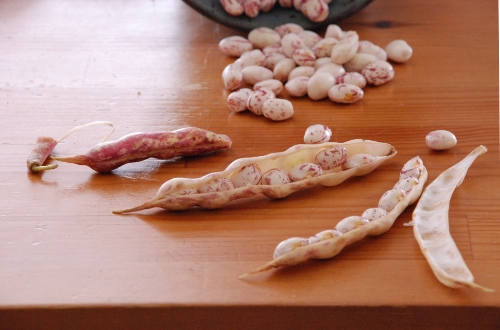
beansorelsoup1 Is it Monday? I’m pretty sure it’s Monday. The last two weeks have been a blur of sniffles, tissues, and gallons (I mean it) of chai. I came down with a cold just around the start of the month. Chalk it up to a late recovery from August’s crunch time at work. I took a couple of days on the couch to recover, and when it started to fade, I headed back to the office. But the cold wasn’t finished yet, and by trying to rush it, I only invited it to extend its stay. Sure enough, it hung around, bringing a sinus infection to the party, and before I knew it, two weeks passed. Well now I’m better, but in anticipation of the many unwelcome colds sure to pay visits this summer, I’ll share a godsend of a recipe with you. It’s for a soup so simple, yet so restorative, that I probably wouldn’t have made it through the past half-month without it.
beansorelsoup2

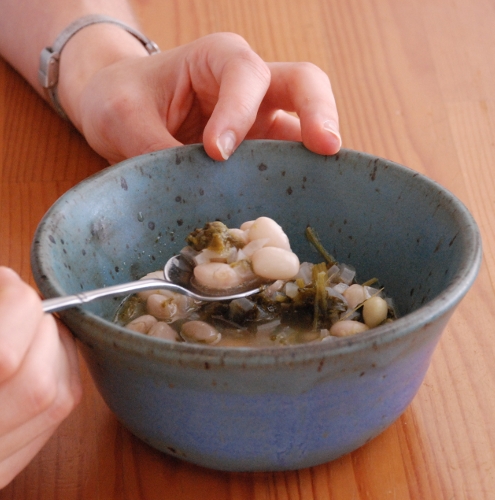
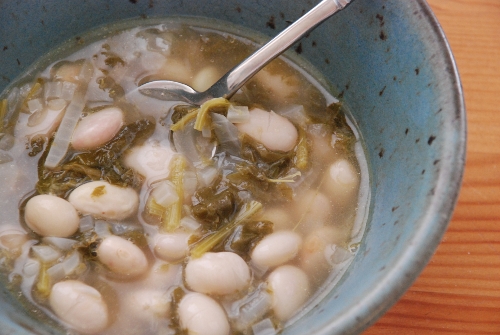
One morning when I was feeling unusually chipper, I shelled some fresh cranberry beans and threw them in a pot. I added a couple teaspoons of olive oil, half an onion chopped, 2 whole cloves of garlic, water, and, about 20 minutes in, a big bunch of sorrel leaves (NOT the stems, which, I learned the hard way, separate into sharp spindles that are incredibly NOT fun to eat, especially when glands are swollen. Ouch.) I let the whole thing boil away for 25 minutes total; by then, the beans were pretty soft but not mushy, the sorrel was fully cooked, and the broth was incredibly fragrant and a bit tart from the sorrel.

My cold was of the particularly nasty variety that made swallowing a luxury just out of reach. My glands were the size of golf balls, and I literally struggled to get food down my craw. This soup was easy on the throat, really simple to make, and flavorful enough that even my stuffy nose could detect aromas. Highly recommended for winter, sick and healthy days alike.

beansorelsoup3

About 1 lb. fresh shelling beans 1 bunch sorrel leaves, stems discarded Salt and pepper Olive oil Half an onion, chopped 2 cloves garlic

Sweat onion and garlic in a couple glugs of olive oil until translucent but not brown. Add shelling beans and several cups of water, and boil til almost soft enough. Add salt and pepper to taste. Add chopped sorrel leaves and boil 3 more minutes. Taste the broth, not the beans, for seasoning: add more salt, pepper, or a squeeze or lemon juice or white wine if necessary. Serve hot.