Sour Cherry Almond Torte

Remember last week when I gushed about the beginning of sour cherry season? Well, the gushing continues. I've gone through 3 pounds of cherries so far, and while I know that's not very much for folks making 12 jars of jam, the cherry pits are accumulating rapidly. Sour cherries have made their way into 5 or 6 different recipes, and I'm just getting started.

Yes, there was jam. Thick, gooey jam that, after just a quick stint in the fridge, got much firmer than I expected it to! And there are pickled sour cherries. Well -- there will be pickled sour cherries. They need to sit for a couple days. But in the meantime, I'm feeding my sour cherry craving with slices of this sour cherry almond torte.

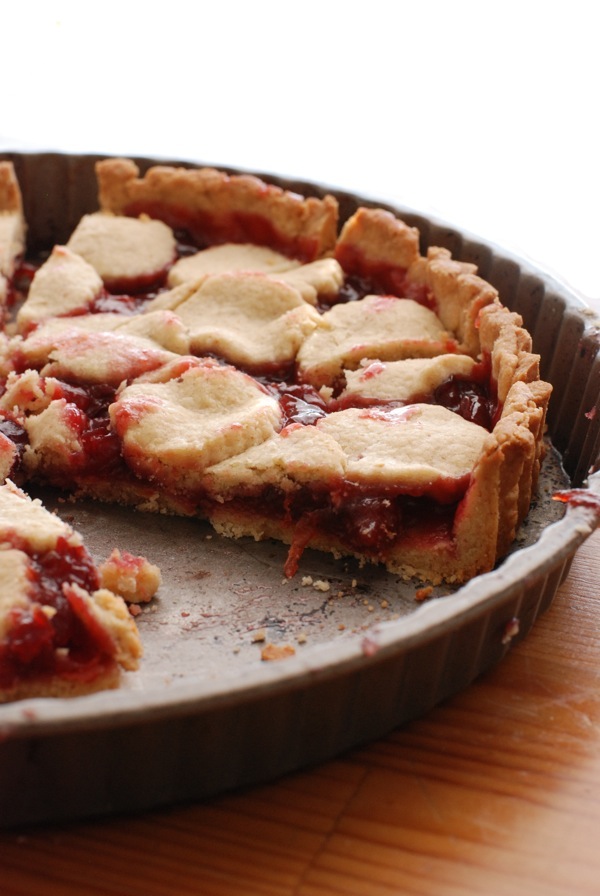
Last week, I told you all about how handpies are the perfect way to skirt the soggy-bottom-crust issue. This torte is an equally good alternative. Ok...it may be even better. The crust, made with part almond flour, is reminiscent of linzer torte. It's rich and flavorful, but not too sweet. It's a bit more crumbly than pie crust -- and, admittedly, a bit harder to work with -- but sweet and tangy cherries sandwiched between two layers of this crust is like a grown-up, more sophisticated thumbprint cookie.
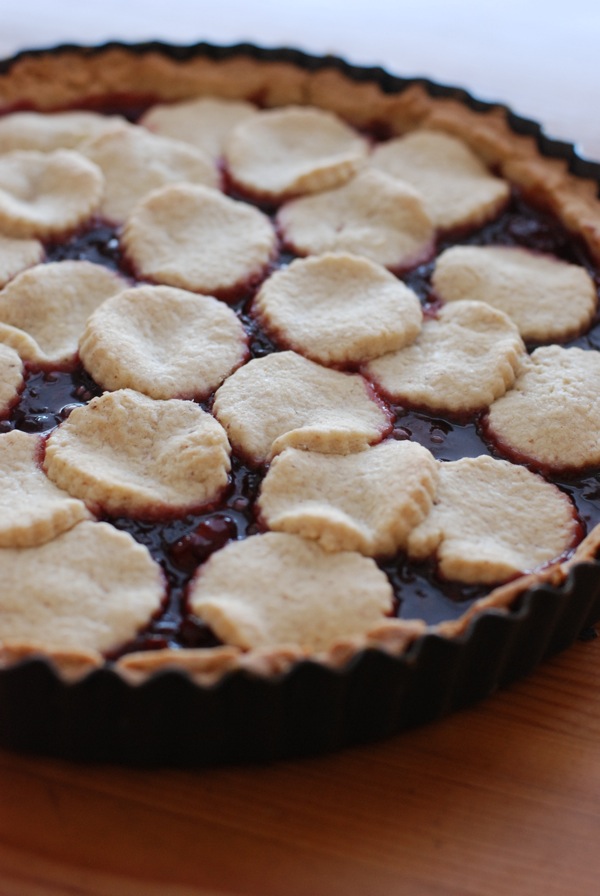
I hope you didn't bolt at my mention of a challenging crust. If you're not up for fighting with dough, there're a couple ways to make it more friendly. There's no way around rolling out the first half, for the bottom crust, but a good hour or so in the fridge will make the dough less tacky, and with a generous sprinkling of flour on the workspace, it'll roll out pretty easily. For the top crust, lots of options: you can make a normal top crust, or you can slice the dough into strips and make a lattice -- though, like I said, this isn't the easiest dough, so you may want to save lattice crusts for another time. Me? I just rolled out the second half of the dough on a floured workspace, and used a scalloped cookie cutter to create pretty shapes that I overlapped slightly on top of the cherry filling. Easier than lattice, but just as elegant.
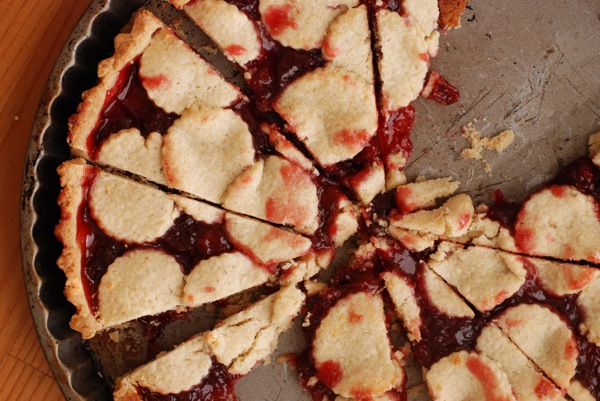
Speaking of elegant, after sitting on my hands for 2 hours waiting for the torte to cool, I finally got up to remove it from its shell....and turned the whole darned thing over itself onto the table. My resulting torte was the work of a true klutz, but no less delicious all the same.

Sour Cherry Almond Torte heavily adapted from an old Gourmet recipe

For the crust: 1 1/2 sticks (3/4 cup) unsalted butter 2 cups flour 2/3 cup almond flour 1/3 cup plus 1 tablespoon sugar 1 large egg, lightly beaten 1 teaspoon vanilla 1/2 teaspoon salt 2 teaspoons lemon zest

For the filling: 2 pounds fresh sour cherries, pitted 3 tablespoons unsalted butter 3/4 cup sugar 3 tablespoons cornstarch 2 teaspoons lemon juice

In the bowl of a food processor or stand mixer, beat together butter and 1/3 cup sugar at medium speed until pale and fluffy. Beat or mix egg into butter mixture, then add vanilla, beating well. Reduce speed to low and mix in flour, almond flour, salt, and zest until mixture just comes together to form a dough.

Halve dough and form each half into a disk. Wrap disks in plastic and chill until firm, at least 1 hour, more if the weather is warm.

Meanwhile, make the filling: heat 3 tablespoons butter in a large skillet over medium heat until foam subsides, then add cherries with any juices and the sugar and simmer, stirring, until sugar is dissolved. (Cherries will exude juices.) Transfer a couple tablespoons of the cherry liquid into a small bowl, and add cornstarch, whisking to form a thick paste. Continue to simmer the cherry mixture until cherries are tender but not falling apart, about 8 minutes. Then stir cornstarch mixture into simmering filling and boil, stirring frequently, 2 minutes. Transfer filling to a bowl and put in fridge.

Put a large baking sheet in middle of oven and preheat oven to 375°F.

While cherries are cooling, remove one piece of dough from fridge and roll out between 2 sheets of floured wax paper into a 12-inch disk. Remove top sheet of paper and invert dough into 9-inch tart pan. Trim overhanging dough so edge of crust lies flush with edge of tart pan. Bake shell about 15 minutes (no need to weigh it down; it will puff slightly, but when you add the filling it’ll shrink back into pan), then remove and set on counter. Spread cooled filling evenly in tart shell.

Roll out second half of dough on a floured workspace without wax paper, and use a cookie cutter to cut scalloped circles (or other fun shapes) out of the dough. Top the cherry filling with dough cut-outs in an overlapping pattern. Sprinkle remaining tablespoon sugar over top layer of dough.

Transfer torte in tart pan onto baking sheet in oven until pastry is golden and filling is bubbling, about 1 hour. Cool completely in pan on a rack, 1 1/2 to 2 hours, to allow juices to thicken. Serve warm or at room temperature. A scoop of vanilla ice cream would really put it over the edge.

Cheese Puffs

One of the first cookbooks I owned was Nigella Lawson's Nigella Bites. I bought it at Anthropologie, back when Nigella was a Travel Channel sensation. The Food Network had already gone the way of the dodo, its cleavage-showing hostesses flashing smiles as they tasted "delicious" homemade tarts filled with the scooped-out innards of a store-bought pumpkin pie. No thanks. Nigella's show was where the fun was at. You could catch the gorgeous broad sneaking downstairs at 1 am in adorable pink PJs, in search of a late-night snack. The camera would zoom really close as she opened the fridge, stuck a finger into a big bowl of chocolate mousse, and licked her finger clean. A dip into the chocolate mousse, pudding, anything, at 1 am is a classic Friedman move. When I saw Nigella do it, I was hooked. She seemed real.

Her cookbook conveyed that same honesty. There were pictures of her with curlers in, wearing a bathrobe. There were sweet ramblings about her favorite suppers, and a mouthwatering picture of homemade pasta and meatballs. And it didn't stop there. Nigella devoted a chapter of the book to what she called “Legacy.” The section contained humble recipes that were the hallmark of her childhood, things like “Granny Lawson’s Lunch Dish” (a slab-pie of sorts, filled with hard boiled eggs, ground beef, and olives) and “Soft Boiled Eggs with Asparagus Soldiers.” I loved this section because even though I’m pretty sure I never made any of the recipes contained within, it provided the most sincere picture of where Nigella came from.

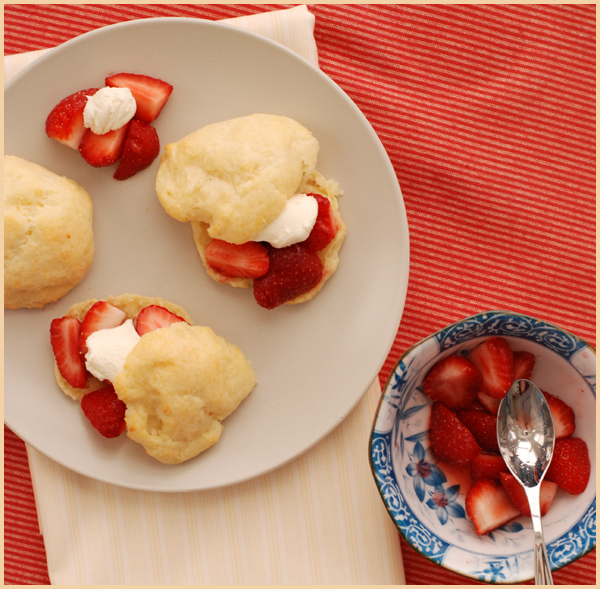
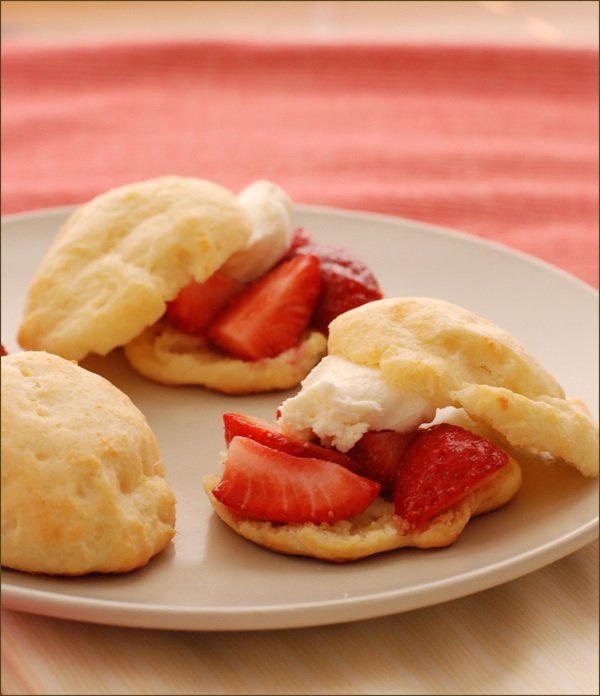
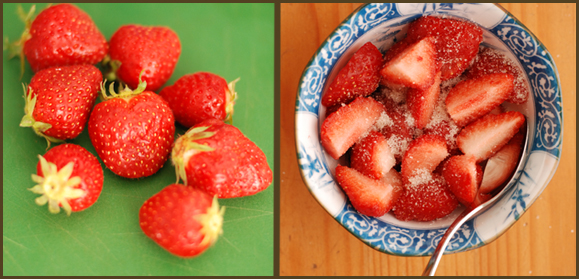
If I had a cookbook (to dream!), and it had a legacy section, this recipe for cheese puffs would certainly make the cut. It's a humble recipe; if you saw cheese puffs at a party, you'd probably pass over them in favor of the the rhubarb curd. But to do so would be quite a mistake. A cross between pancakes and biscuits, cheese puffs are crispy and golden around the edges, soft and chewy within. They're a bit sweet, but unexpectedly, refreshingly, tangy. My father likes them with just sour cream, but I prefer a bit of mascarpone cheese or greek yogurt, and fresh strawberries. But however you eat them -- with sour cream, with greek yogurt, with berries, with nothing at all -- once you start, you kinda can't stop.

Lately, I've been thinking a lot about the recipes of my childhood and how they've shaped the kind of food I like to cook, the kind of food I love to eat. Cheese puffs epitomize the legacy of my family's cooking and eating style because they're easy enough to make on a deadline, but intriguing enough to be addictive.

That's legacy.

I'd love to hear about the recipes of your childhood, the legacies of the kitchen where you grew up. Let's get this conversation started. And if y'all are interested, I'd like to share more of the recipes from my mom's kitchen.

Cheese Puffs

Cheese Puffs Adapted from Norene Gilletz's The Pleasures of Your Processor, via my mother

Note: I use Friendship brand farmer cheese, which is the only one I've seen recently. If you can't find farmer cheese, you can strain some ricotta for a couple hours until some of the whey drains. You can also use cream cheese, in a pinch.

1 lb farmer cheese (2 6 oz. packages will work just fine if that's what your store carries) 3 eggs 1 stick (8 tablespoons) butter, melted 1/2 teaspoons salt 1/4 cup sugar 1 1/2 cups unbleached all-purpose flour 2 teaspoons baking powder

Preheat the oven to 350.

Place all ingredients in bowl of food processor and process until combined, about 30 seconds. Don't over process; the batter should be mixed completely but still somewhat chunky or lumpy. It should be moist but not runny.

Drop by heaping spoonfuls onto cookie sheets lined with parchment, or lined with foil and greased well. I prefer the parchment because the puffs brown more evenly on the bottom that way.

Bake for 25-28 minutes. The puffs should be just lightly golden and still very soft. Serve warm with sour cream, creme fraiche or Greek yogurt and fresh berries. I sometimes slice them open and put the mascarpone or yogurt and berries inside, but usually just eat the fix-ins alongside.

Cheese puffs freeze and reheat very well. Freeze them on lined cookie sheets in a single layer; once frozen, transfer to air-tight plastic bags. They'll keep for a couple months, if you don't eat them before then.

The recipe makes 18-20. If you have an extra large processor you can double and make 3 dozen puffs. Otherwise make two batches.

Two Bruschette for Spring

While I've usually thought of May as the true spring-to-summer transition month, these days, June seems to be taking on that role. One day the weather's as hot and sticky as boiling caramel, the next it's as cold and damp as the dish towel. But the erratic weather carries with it the promise of vegetable bounty. I may be mourning the end of asparagus season (how did I not realize until now that asparagus are the best vegetable on earth?) but I'm ramping up for my full-blown annual tomato courtship. And it's just tomatoes that roll around in June -- peas, snap and shelling varieties, have finally made their debut. Few things make me happier than bright green peas and tender, juicy tomatoes: there, I've exposed myself in all my nerdiness.

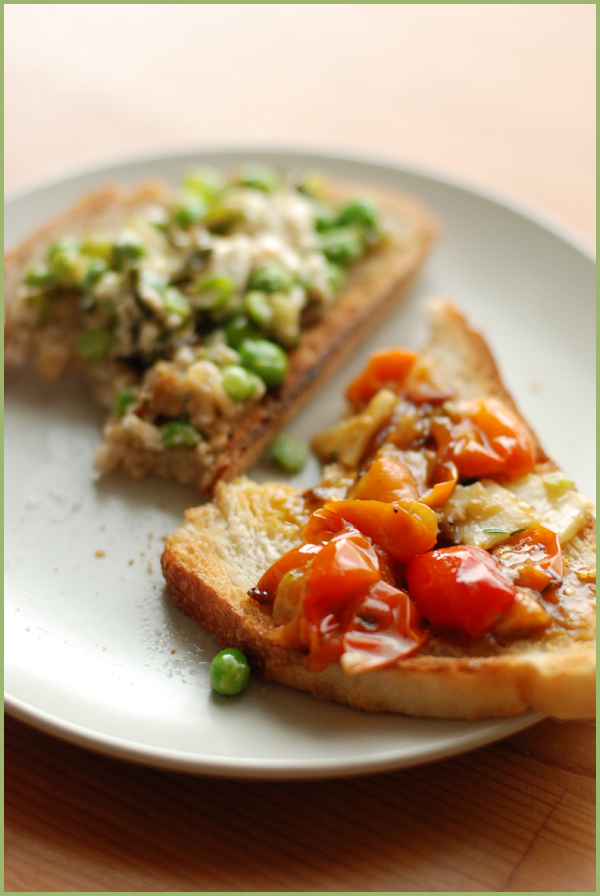
Over the past few years, I've settled into something of a routine when it comes to tomatoes and peas. I love tomatoes raw in salad, or simply sliced with a little flaky salt and olive oil. I get thrills from popping peas out of their pods and into blanching water, or tossing them with asparagus into pasta primavera. These bruschette are every bit a part of that routine. The tomato bruschetta occupies that middle ground between unadulterated raw tomato slices and a good, rich, labored tomato sauce, concentrating the flavor of the tomato without sacrificing its essential texture. Ditto the pea bruschetta, which celebrates the freshness of the peas' by adding complementary flavors, but retaining their plump firmness. I suppose by now it's pretty clear: I'm totally hooked on pea and tomato bruschette.

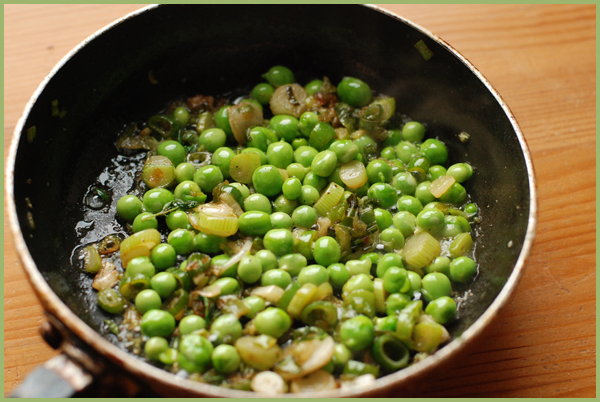
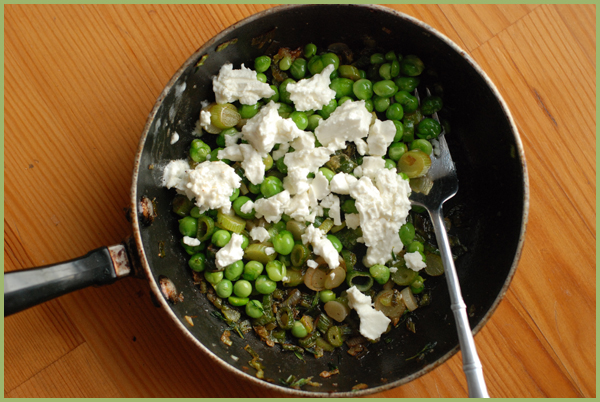
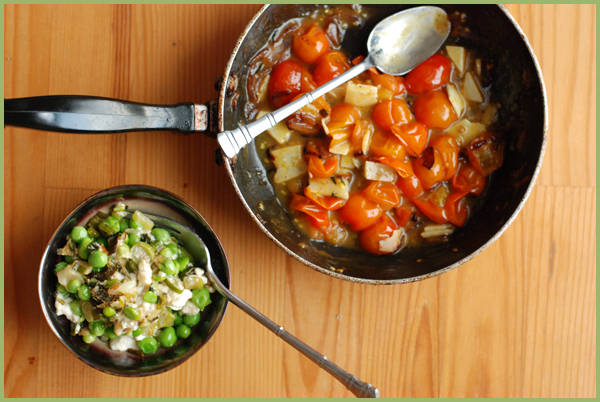
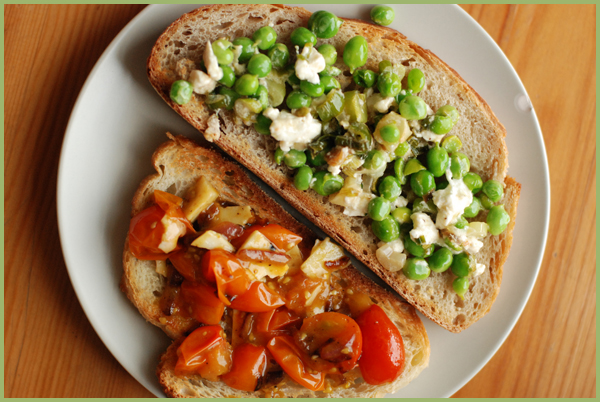
I've used a pretty simple method to make these bruschette. First, I saute some aromatics in butter (scallions with the peas, red onions with the tomato). I deglaze the pan a couple times with a bit of water, which reduces with the butter and onion to form a base for the vegetable. In goes either a handful of cherry tomatoes or a cup of peas, a bit of thyme, plus a pinch of salt and a grind of pepper. Five minutes of tossing and stirring later, I add just a bit of cheese (feta with the peas, sliced Pecorino Romano with the tomatoes) to tie it all together, and dump the whole panful on a piece of toasted sourdough (peas) or Italian (tomatoes) bread. Fin.

Naturally, you shouldn't feel tied to my specifications. Prefer a different bread? Happen to have yellow onions instead of green or red? Whatever. It'll still be delicious. And if you don't have pecorino on hand, which I usually don't, a thick grating of parmigiano reggiano would be great with the tomatoes.

If you're the type who likes a proper dinner -- one that requires a knife and fork and, oh, a table -- then, maybe, file this under "snack." But it makes a pretty darned good supper for the rest of us, and I've been known to whip these up for breakfast in the morning before heading off to work. Can you blame me?

Pea or Tomato Bruschette makes enough for 2 slices of bread; as you can see, I made 1 portion with peas and 1 with tomatoes, and the total was enough for dinner for 2.

2 tablespoons butter 2 scallions or half a red onion, chopped 1 cup of freshly-shelled peas, or 1/2 pint cherry tomatoes, halved 2 small sprigs thyme salt and pepper 1/3 cup feta or Pecorino Romano cheese a lemon wedge, for pea bruschette 2 slices bread olive oil for finishing, if you're feeling luxurious

Set a saute pan over medium heat, and add butter. when butter begins to bubble, add onion. Shake pan to distribute, and give a stir if you need to. When onion begins to turn golden at the edges, sprinkle a couple tablespoons water into the pan; it should pop and sizzle. Stir or shake pan to distribute water evenly, and continue cooking. As water evaporates, onions will begin to color some more. When that happens, add a couple more spoonfuls of water and stir. Repeat this step once more the next time onions color; by then, you should have a brownish onion mixture in the pan, that's more flavorful than you can imagine.

Add tomatoes or peas, leaves from the thyme sprigs, a pinch of salt, and a grind of the pepper mill. Shake the pan or give contents a stir to distribute tomatoes or peas among the onions. Leaving the heat at medium, cook for about 5 minutes, stirring regularly, to allow vegetables to soften.

When tomatoes are soft and juicy, or peas are bright green and perfectly bursting, turn off the heat and add the cheese. Stir the cheese into the vegetables. Meanwhile, pop the bread into the toaster. When bread is golden brown, set on a plate, top with bruschette, and finish with a swirl of olive oil. Eat. Now.

Jam-Filled Hand Pies

Pies are finicky, finicky things. Taming bursting, juicy berries into a perfect pie is the ultimate challenge of summer, and getting that bottom crust to stay crispy requires nothing short of a miracle. I've tried everything: I paint the inside of the bottom crust with egg before adding the fruit, I've drained the fruit, tossed it with extra flour, with cornstarch, with tapioca, with playdough, and still -- apple pies are fine, but the piece of dough resting beneath those juicy rasp/straw/blue/blackberries just gets suffocated by all that juice.

If you're reading my pie confession and think, "don't give up just yet!," that's great. I'm ready for help. Have any advice for making the perfect berry pie? Don't hesitate to share it in the comments. (Mrs. Wheelbarrow, I'm looking at you -- I know you're canning pie filling, and I'd love your tips!) But amid this pie nay-saying, don't for a second think I've given up on crusty summer fruit desserts. Au contraire, mon frere! I have moved on to smaller but better things. Hand pies are the way of the future.

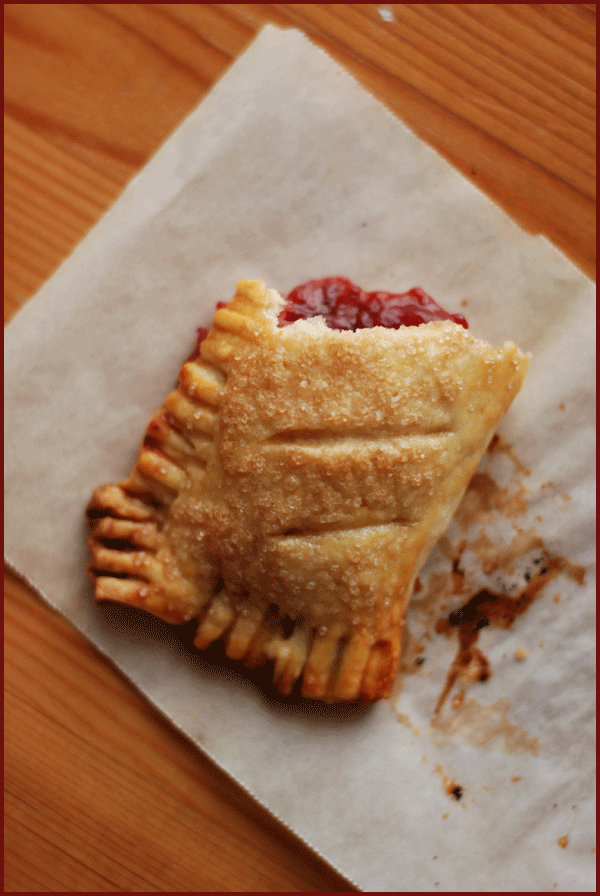
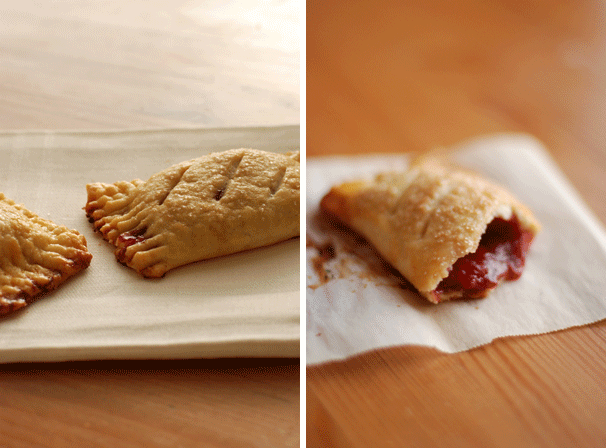
No more soggy bottom crusts, no more fretting over runny filling. Hand pies eliminate the guesswork. Their top and bottom crusts stay equally flaky and crispy; their innards, made here with jam, are sure to be perfectly thick without any of that cornstarch flavor. And I shouldn't forget to mention that hand pies are perfectly portioned, so no more ruining that first slice of pie.

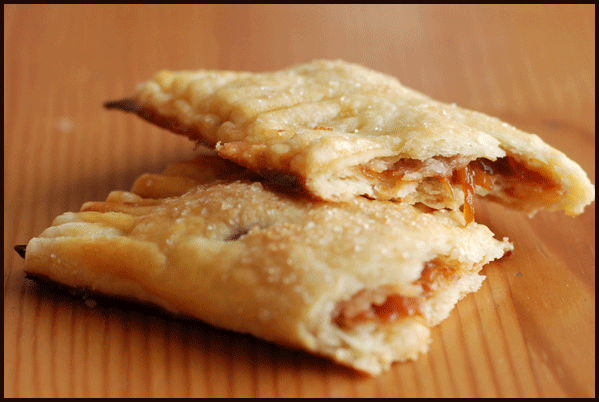
Flavors are limited only by your imagination. I used some of last year's butterscotch peach preserves to fill half of my batch, and Amanda Hesser's strawberry-chile preserves to fill the other. If I'd made the sour cherry jam one day earlier, we'd be having sour cherry hand pies, too. Maybe next year week.

Jam-Filled Hand Pies

For the crust:

2 1/2 cups all-purpose flour 2 tablespoons sugar 1 teaspoon salt 2 sticks unsalted butter, very cold, cut into small pieces

1 1/2 cups jam(s) 1 egg, for brushing turbinado sugar, for sprinkling

Put all ingredients in a mixing bowl or a food processor. If using a processor, pulse 6-8 times, until butter is in pea-sized pieces. If mixing manually, use either a pastry cutter, a fork, or your fingers (that's what I used) to break the butter into the flour, stopping when the butter is in pea-sized pieces. Sprinkle 1/2 cup ice cold water over the flour-butter mixture, and use a stiff spatula to fold together. It really should be moist enough, but if it's not, add a couple more tablespoons water, just until the dough comes together. Wrap the dough in plastic and refrigerate about 30 minutes, until no longer soft.

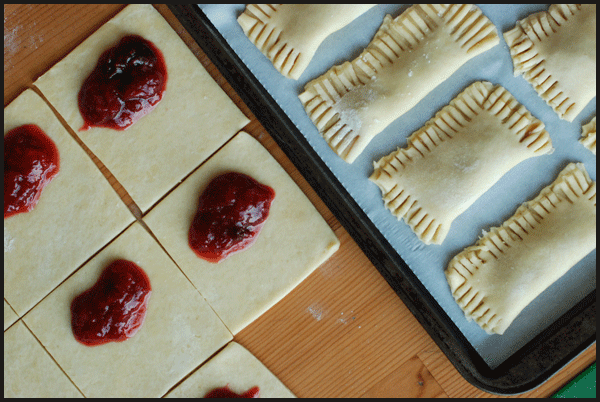
Preheat oven to 375. On lightly floured surface, roll out half the dough to about 1/4-inch thick. slice into 4" x 6" rectangles. With the short end of a rectangle facing you, spread 1 1/2 tablespoons of jam horizontally, a bit more than halfway past the center, leaving a 1/2-inch border on either side. You're going to fold the long half over itself, so spread jam such that after folding the tart in half, you'll have jam running throughout the tart. Use the tines of a fork to seal the edges of each tart. Brush the tops with egg, sprinkle with sugar, and make three small diagonal incisions on each tart.

Line two baking sheets with parchment paper, and place finished tarts on the sheet about 1/2 inch apart. Bake 25 minutes, until tops are a light golden brown and pastry no longer feels raw or soft. Transfer to a rack to cool completely.