• Home
  • About
  • Recipe Index
  • Contact
Menu

Rivka Friedman

Street Address
City, State, Zip
Phone Number

Your Custom Text Here

Rivka Friedman

  • Home
  • About
  • Recipe Index
  • Contact

Masala Dosas

March 29, 2013 Rivka
1-DSC_1284.jpg

When I was a kid, my favorite restaurant was a spot called Siddhartha, in downtown Silver Spring. Siddhartha was unfussy, inexpensive, and – at least when we started going – patronized almost exclusively by Indians. In retrospect, I suppose it’s a parent’s dream: kid loves cheap, relatively health Indian food more than pizza, chicken nuggets, whatever. But when we were at Siddhartha, chicken nuggets were off the menu. I could think of only one thing, and that was masala dosa.

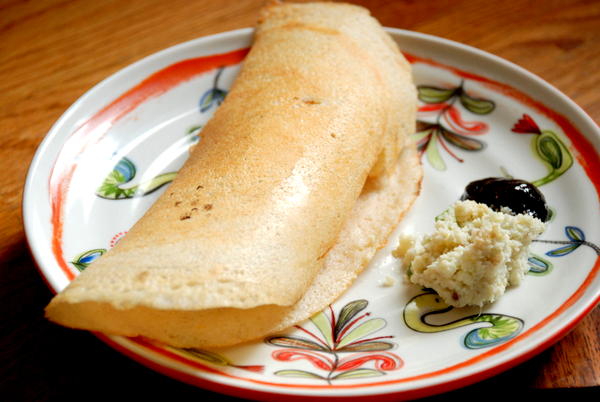
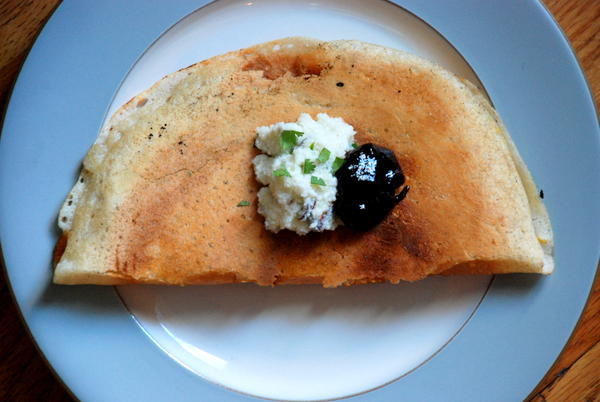
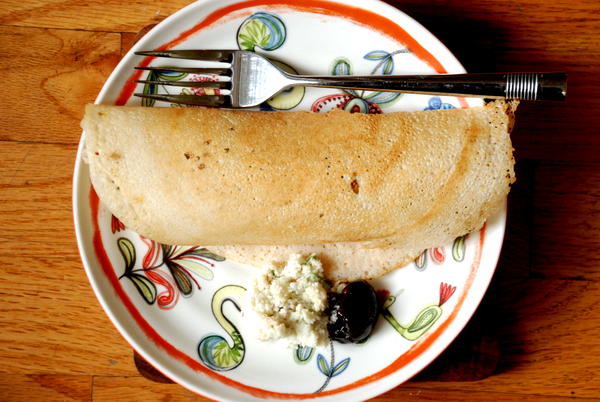
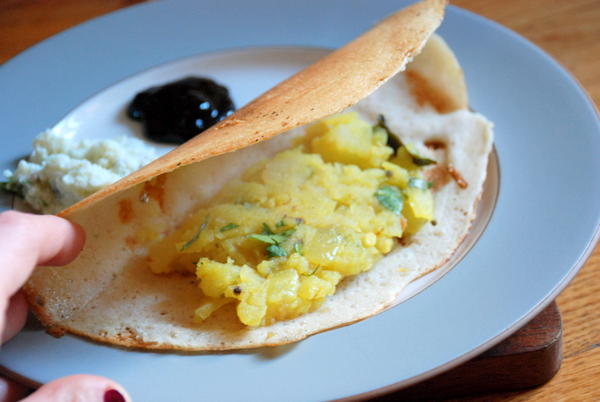
For the uninitiated, a masala dosa an Indian pancake, crisp and lacy outside but soft within. It’s cooked like a crepe, and then filled with a mixture of spiced potatoes and onions. Dosa batter is made of ground rice and lentils which have been fermented, so the pancake takes on a slightly sour, funky flavor (like sourdough bread: less sour, but equally distinctive).
1-DSC_1209.jpg
1-DSC_1261.jpg

If it isn’t clear already, I am obsessed with dosas.

If I’m being truthful, dosas fell off the map for me. There were probably 5 or 6 years when I didn’t have a single one. Looking back, that was pretty stupid. I went without because I couldn’t find a decent restaurant nearby that made them. Now I realize I could have been making them at home, all along.
1-resize.jpg

Dosas came back into my life, of all things, because of a food truck. Actually, two food trucks.

Do you know about food trucks? We’ve got them all over DC, but we’re hardly the first city to develop mobile cuisine. Austin has had them for years, and the last time I was in town, strolling down South Lamar, I stopped at the food trailer park for lunch. There, set up on the gravel, was a shiny silver truck called Nomad Dosa. Natch, choosing my lunch spot was no challenge. I had one masala dosa, returned the next day at lunch for one more, and came home thinking half-seriously about quitting my job and starting a dosa truck in DC.
1-DSC_1253.jpg

Seriously, if two Texan hippies with one trip to India under their belt could make decent dosas, why couldn’t I? Right then and there, I committed to finding and perfecting (perfecting!) the recipe.

Fortunately, I’ll be keeping my job for now. There’s a newish food truck in town, and it’s called Chatpat. If you live in DC and haven’t yet tried it, stop wasting time. Chatpat is a South Indian food truck that serves a slew of appetizers, one thali, and two dosa options every day. Not only do they park at my office two times a week – making a daily dosa a real possibility – but Mr. Chatpat worked with me, over several weeks, to perfect my dosa recipe so that it tastes like my best meals at Siddhartha.
1-DSC_1232.jpg

You guys, I am over the moon. In the past month, I’ve had dosas for breakfast, lunch, dinner, and snack. It seems I could eat nothing but dosas for weeks straight. And now, thanks to the magic of I-tested-this-recipe-1500-times , you can make them – and eat a million of them – too.
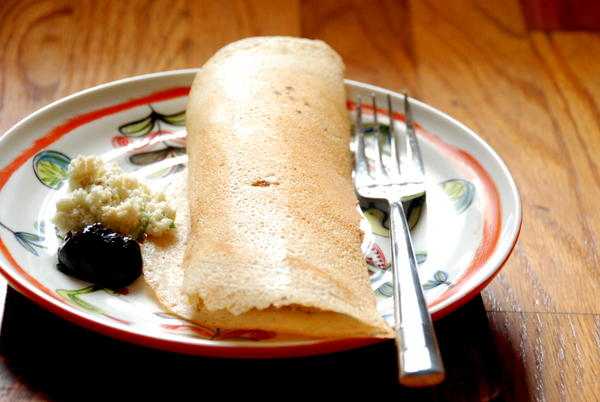
1-DSC_1269.jpg

So thank you, Mr. Chatpat! And Todd, the Nomad Dosa man, for reminding me that dosas exist and are wonderful. I’m indebted to both of you. Perhaps, one of these days, I’ll show up with a token of my gratitude: one perfectly cooked, perfectly filled dosa. My treat.
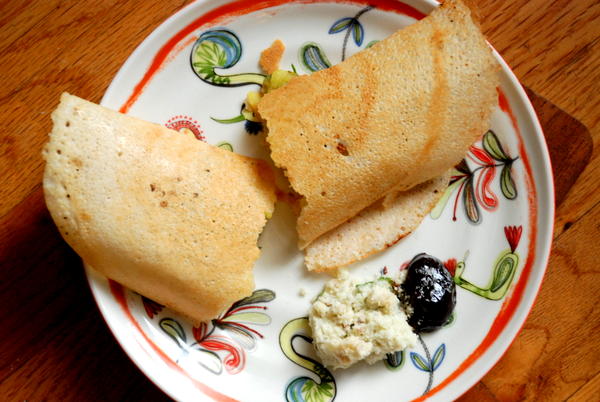
1-DSC_1286.jpg

Masala Dosas with Coconut ChutneyLoosely adapted from this, this, this, my friends Trial and Error, and tips from Mr. Chatpat

Don't be fooled by the abundance of notes and the long recipe: dosas aren't hard to make, and they require minimal active time. However, there's a learning curve when it comes to making good ones, which is where my miniature bible of notes comes in. 

Notes:

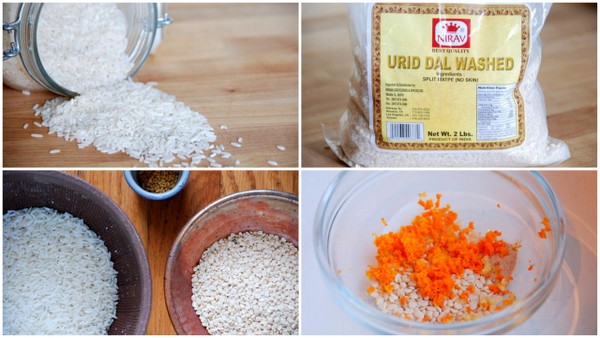
For those of you who try to avoid buying “special” ingredients, my apologies. I’ve managed to do away with the special rice some recipes call for, but you do need to buy washed urad dal and fenugreek seeds. For the urad dal, you want “hulled and split black gram.” You don’t want the flour, and you want the lentils to look pale taupe, not black. The black ones have not been hulled. Urad dal are available at Indian grocery stores, as well as Kalustyan’s and Amazon (the small bag is cheaper, but the big bag is a better value). Fenugreek seeds are also available on Amazon and Kalustyans. Lastly, to make the filling and chutney, you'll need curry leaves. Available on Amazon and at Kalustyans.

Dosa batter is made by allowing raw rice and lentils to soak and soften in water, then blending them smooth, combining them, and fermenting the combined mixture. Because rice and lentils soak up different amounts of water depending on quality and age, it is impossible to say with certainty how much water you will need for your batter. Mr. Chatpat confirmed this for me. So we’re all going to have to be comfortable with a little trial and error of our own. Here’s the good news, though – if your dosa batter is too thick, you can add water as needed, at any stage of the process. My best dosas have come from batter to which I added water by the tablespoonful as I made the dosas. Tried one, too thick, add some water, tried another, etc. You’re going for batter with a consistency somewhere between pancake batter (gloopy) and crepe batter (very runny). As your dosa skills improve, you may find you want to adjust the thickness of your batter. Again, you’ll have to play around with it.

But it’s worth it. It really is.

And if you want to be really traditional about it, make sambar and/or coconut chutney to go alongside. We also served it with purchased tamarind chutney, which certainly isn’t traditional, but it is very tasty.

Sorry, one last thing. I’m told that dosa batter is supposed to double in volume while it ferments. Mine never, ever has doubled. It has increased in volume marginally, but it’s never even come close to doubling. This may have to do with the fact that it’s cold out, or it may have to do with my tap water being DC’s finest. If you want your dosa batter to rise, use room temperature filtered water, and live somewhere warm. Jokes: I’ve got strategies for keeping your dosa batter toasty below. But I have a feeling that part will be much easier come summer. Okay, onto the recipe.

1 ½ cups regular, unfancy, long-grain rice (basmati will also work, but the former is cheaper)
½ cup urad dal
½ teaspoon methi (fenugreek) seeds
1 teaspoon salt
A few tablespoons of olive oil or ghee
Wedge of an onion, for cooking the dosas

Soak the Grains: Put the rice in a medium-large bowl, and fill with room temperature water so the water level is a couple inches above the rice. Put the lentils and fenugreek in a separate bowl, and fill it, too, well above the level of the lentils. Cover the two bowls and set on the counter to soak for at least 5 hours (no harm if it’s longer – I typically leave mine overnight). The lentils and rice both will have soaked up most of the water in the bowls, and the rice will be soft enough to break with your fingers.

Make the Batter: Strain the lentils. If you reserve the water, you can use some of it to blend the lentils; otherwise, you can just use water straight from the tap (or Brita). Pour the lentils into the bowl of a food processor (best) or blender, add 2 tablespoons of water, and turn the machine on. After 30 seconds or so, stop the machine and scrape down the sides of the container. Then recover and blend until the lentils are absolutely, positively smooth. You may need to add a few more tablespoons of water as you go.  In my food processor on high, this took about 4 minutes. You’re looking for light, fluffy clouds of whipped lentil batter. Think liquid marshmallows.

Use a spatula to scrape your whipped lentils into a large pyrex or other mixing bowl – the more insulated, the better. You’re going to want your dosa batter to stay warm as it ferments.

No need to clean the processor bowl; just strain the rice (reserving the liquid), and transfer it straight into the bowl, with 1 cup of the soaking liquid. Blend until the mixture is runny, milky white, and as smooth as possible, about 3 minutes. The mixture may feel ever so slightly gritty if you pinch some of it between your fingers, but you’re going for as smooth a mixture as possible.

Pour the rice mixture into the lentil mixture and use a spatula to gently fold them together. Keep folding as you would chocolate mousse or soufflé batter, until the mixture is totally uniform.

Ferment the Dosa Batter: Cover with a towel or with plastic wrap into which you've poked some holes. Set in an area that hovers around 80 or 90 degrees, and leave it there to ferment and (hopefully) grow in volume, 8-12 hours.

If your house is cold, you have a couple options. One is to turn your oven on to about 100 degrees, then put the dosa batter inside and turn off the oven. It won’t stay hot forever, but if you choose an insulated bowl, your dosa batter will have a couple warm hours at the start of its rest. You can also turn on the light in the oven to raise the temperature inside slightly. But best case scenario (which, note, I’ve never done) would be to ferment your dosa batter while you’re awake, so you can adjust the oven temperature from time to time.

If your kitchen is particularly cold, your dosa batter may need up to 18 hours of fermenting time, so be sure to make the batter in advance. The beautiful thing about making it in a cold house is that you can basically leave the batter out on the counter for a day or so, and it will get slightly more sour, but not too much. You’re looking for the batter to have become slightly frothy, and grown slightly in volume. However, if it’s cold, this may happen either slightly or not at all. Don’t worry about it. I’ve made great dosa from batter that looks exactly as it did when I first mixed it up.

Cook the Dosas: Keep in mind that dosas are like crepes. The first one, you will most likely throw away, and the best dosa comes with practice.

Set your largest cast iron or other very well-seasoned pan over medium-high heat. Nonstick is a second-best option here; you ideally want a pan with heft, but that won’t allow the dosas to stick. And you want the pan hot enough that when you sprinkle a couple drops of water, they immediately sizzle and disappear – but not hot enough that it smokes.

When the pan is hot, drizzle a couple drops of olive oil or ghee onto the cut side the onion wedge, spear the wedge with a fork, and rub the cut side of the wedge onto the pan to coat it ever so slightly with oil. (The onion will sizzle).

Use a ¼ cup measure or a ladle to pour a puddle of batter into the center of the pan, and then use the back of a wooden spoon or (if you have one) a crepe spreader. I don’t have one, and I’ve actually come to love my flat-bottomed metal ¼ cup as the perfect tool here. I fill it, pour it, and then use the bottom of the measuring cup to spread it.

To spread the dosa, move gently from the center of the dosa out to the edge in a fluid spiral motion. There may be spots you miss – you can always go back and correct them. Your technique the first couple times is going to suck. Be cool with it – you’ll get better as you go. If you need a confidence booster, check my first dosa photos on instagram. Not pretty.

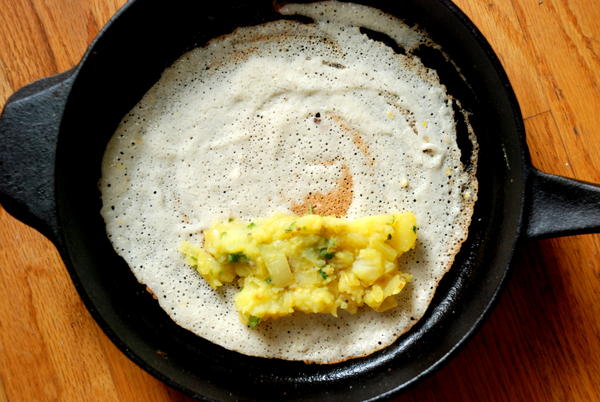
Once you’ve spread your batter around the pan, drizzle a couple more drops of olive oil or ghee over the top surface of the dosa. (At this point, if you are filling the dosas, this is when you would add a spoonful of filling either to one side of the dosa (if planning to fold in half) or along the center of the dosa (if planning to roll up).)

Cook over medium-high heat until the bottom of the dosa is thoroughly golden. You’ll notice that the edges of your dosa start to lift and curl slightly when the dosa is close to done. Use a wooden spatula to lift the dosa, and either fold it over itself to make a semi-circle, or gently roll it up into a cylinder.

You can serve the dosas just like this, with sambar and coconut chutney (recipe below), or you can fill them with the potato masala filling (recipe also below). But unfilled, they make a fantastic snack.

The dosa batter will keep in the fridge for up to 1 week, but it needs to be brought back to room temperature before making dosas.

Potato Masala Filling

1 ½ lbs. gold (waxy) potatoes, peeled, boiled in salted water, and cooled slightly
3 tablespoons oil or ghee
½ teaspoon yellow mustard seeds
2 teaspoons urad dal
1/8 teaspoon asafetida (optional)
½ teaspoon turmeric (fresh if available, otherwise dry ground)
5 curry leaves
1 tablespoon minced or grated ginger
2 serrano or jalapeno chilies, membranes and seeds removed, diced
½ medium yellow onion, coarsely chopped
1 cup water
1 teaspoon salt
1 cup chopped cilantro

When the potatoes are just warm, cut them roughly into 1-inch cubes.

Gather all your ingredients before starting, because once the pan is hot, everything moves quickly. Put the mustard seeds in a small bowl, the urad dal, asafedita, turmeric, curry, ginger, and chilies in another medium bowl, and the onion in a third bowl. Set the bowls near the stove.

Heat a large sauté pan over medium heat and add oil or ghee. When oil shimmers, add mustard seeds and wait until they pop, about 30 seconds. Then add the contents of the second bowl (urad dal, asafedita, turmeric, curry, ginger, and chilies) and stir to coat with the oil. Cook 30 seconds more.

Add onions, stir to coat with spices, and cook over medium heat until they start to soften and turn translucent, about 8 minutes. Add potatoes and continue cooking another 2 minutes or so, until the potatoes start to break down.

Add the water and half a teaspoon of salt. Scrape the bottom of the pan to loosen the browned bits into the potato mixture, then turn up the heat until the water comes to a boil. Cook 5 minutes, then turn off the heat.

Use the back of a fork to lightly mash the potatoes. You still want plenty of cubes, but you also want some mashed bits.

Add the cilantro, and taste the mixture; if it isn’t salty enough, add the remaining half-teaspoon of salt.

At this point, you can use the potato masala immediately, or store covered in the fridge for up to 1 week. Be sure to bring to room temperature (or even warm slightly in a microwave or on the stove) before using to fill dosas.

Coconut Chutney

For the initial mixture: 1 cup fresh grated coconut (can susbtitute dry unsweetened coconut, but you'll need to add double the water) 2 small serrano or 1 jalapeno chile, chopped (seeds and membrane removed if you're worried about spice) 1 teaspoon grated ginger 1 tablespoon roasted chana dal or urad dal, lightly toasted in a dry skillet ½ teaspoon salt

For the tempering: 1 teaspoon ghee or flavorless oil (grapeseed, canola, etc.) ½ teaspoon yellow mustard seeds 1 red chile, crushed (or substitute 1 teaspoon chile flakes) 3 curry leaves, crushed

In a mini-prep food processor or blender, combine coconut, green chile, ginger, dal, and salt and blend with 1/4 cup water until smooth, adding more water if necessary and scraping down the sides of the canister as needed. Transfer to a bowl.

In a small skillet, heat the ghee or oil until it shimmers, then add the mustard seeds. After they pop, add the chile and curry leaves and remove from the heat immediately. Pour the flavored oil (with all the spices) into the coconut mixture and stir to combine. Serve with masala dosas or other indian dishes.
In gluten-free, main dishes, vegan, vegetarian, healthy
18 Comments

Pineapple Macaroons

March 24, 2013 Rivka
1-DSC_0171
1-DSC_0171

I always say that the true test of a Passover dessert is one simple question: would you eat it not on Passover.

In the case of these macaroons, which I first made last June, again in July, and once again in the fall, clearly the answer is yes. They remind me of those piña cola cookies I made back in October, but – dare I say it? – they’re better.

1-DSC_0140
1-DSC_0140

No surprise there: David Lebovitz masterminded these macaroons, and most everything he makes – especially ice cream – is awesome. Pineapple macaroons, blissfully, are no exception.

Here’s how it all goes down.

1-DSC_0139
1-DSC_0139

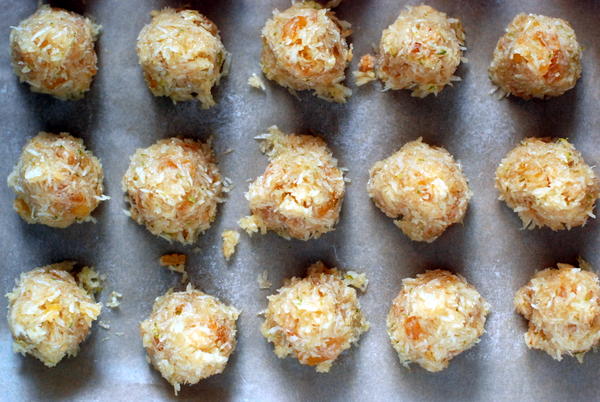
The first step is the most important: you’ll be caramelizing pineapple. Think of regular caramel, where you heat sugar until it turns golden. Same concept, except this time, you’ve got little bits of pineapple in the mix. When the pineapple has caramelized, it’ll be stiffer, golden brown, and really fragrant. That’s when you combine it with the usual macaroon suspects (coconut, egg whites, sugar), mush the dough into mounds, and bake them off.

1-DSC_0167
1-DSC_0167

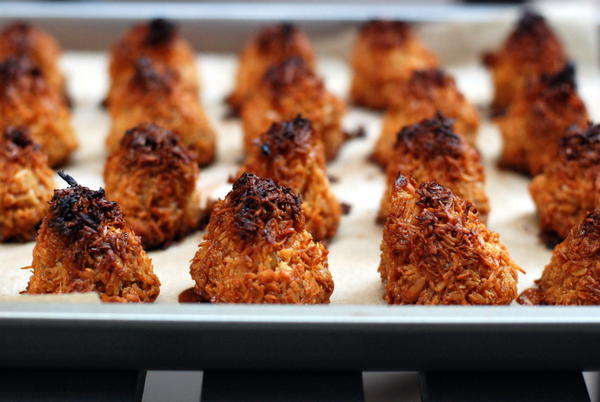
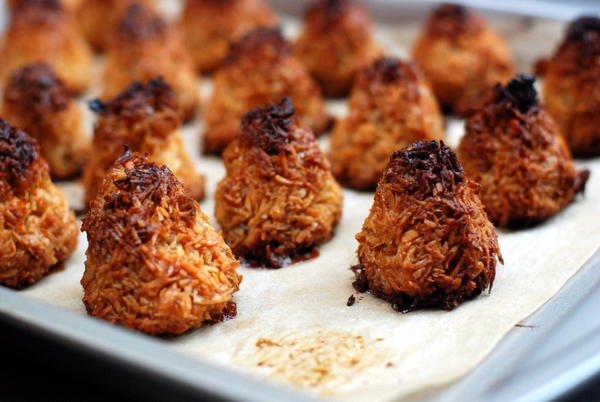
The result? Like a really good chocolate chip cookie, these macaroons have three distinct sections. They have a perfect outer crust, which gets crunchy and caramelized. They’ve got a soft inner core. And then they have that middle, which isn’t quite soft, but isn’t really crunchy either. It’s kind of perfect.

The first time I made these macaroons, I brought a huge tray of them to friends’. I was sure I’d leave a few for them to nibble on the next day, but slowly and surely, the six of us ate every last macaroon. Okay, true story: I made a second batch the very next day, they were that good.

And, with very little effort, they can be the star of the cookie platter at your seder table. I guarantee people will love them. I also guarantee that if, by some off chance, you end up with extras at the end of the holiday, you’ll have no urge to toss them out with that extra matzah. Like all good Passover desserts, these have staying power.

Pineapple MacaroonsAdapted from David Lebovitz

So David recommends using crushed pineapple, but I found that diced pineapple works much better. The crushed pineapple sort of melts into the coconut, and the texture of the resulting cookies is less...wonderful. The coconut gets less glazed, the pineapple is less distinctive, and the macaroons are generally not as addictive as when I used diced fruit. Either works, though, so use whatever you can find.

One 20 oz. can (about 600 g) diced unsweetened pineapple, with juice 1 cup (200 g) sugar pinch of salt 3 1/2 cups (245 g) dried unsweetened shredded coconut (available at health food stores, some supermarkets, and online zest of one lime, grated 3 large egg whites (not whipped) 1/2 teaspoon vanilla extract

Put the pineapple, juice, sugar, and salt into a large shallow skillet (David recommends nonstick, but I used a regular skillet and it worked just fine) and set over medium heat.

Cook until the liquid mostly evaporates, stirring occasionally. Then keep cooking for 8-10 more minutes, stirring regularly, until the pineapple firms up, turns golden, and gets very sticky. Transfer the sticky pineapple bits to a medium mixing bowl.

Add coconut to pineapple, and use your fingers to combine the two, pressing the coconut into the pineapple. Then add the egg whites and vanilla, and again, use your fingers to combine the mixture until it is uniform. Your fingers will get covered in sticky macaroon batter; do your best to scrape the batter off your fingers back into the bowl, and rinse your hands before shaping the macaroons.

Preheat the oven to 350° and line a large baking sheet with parchment paper or silpat.

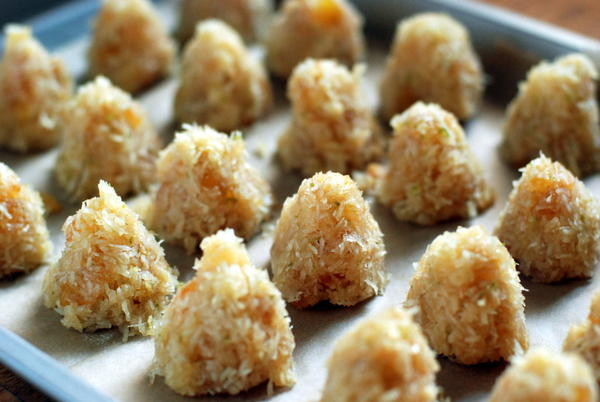
Take a golf ball's worth of batter in your clean hands, and shape it into a sphere. Set the sphere onto the baking sheet, flattening the bottom side of the sphere against the sheet. Then cup your fingers around the top half of the sphere, pinching toward the tip until you wind up with a cone shape. Repeat with remaining batter; no need to leave much space between cookies – 1/2 an inch will do.

Bake cookies for 25 to 30 minutes, until their tips are a deep dark brown and their exteriors are mostly golden. Start checking at 20 minutes, to ensure that cookies don't burn (too much).

Serve cookies at room temperature. These cookies are best the day they're made, but they're not half bad the day after. The batter can also be kept in the fridge for up to 5 days and baked off as needed.

In cookies and bars, dessert, gluten-free, kosher for passover
3 Comments

Marion Cunningham's Nutmeg Muffins

March 15, 2013 Rivka
1-DSC_1062
1-DSC_1062

A few months back, I bought a cookbook for just one recipe. The book was Marion Cunningham's The Breakfast Book. The recipe was Cream Biscuits, i.e. the most perfect and foolproof biscuits that ever were. I read about them on Molly's site and knew at once that whatever book they were in was a book I should own.

I have something of a history when it comes to buying books based on one great recipe. When I was in college, I bought The New Best Recipe because a friend had made these thick and chewy triple chocolate cookies from it that absolutely blew me away. I bought Nigel Slater's Appetite because our friend Josh made this oxtail stew that had me going, against all good judgement, for a fourth helping. So I wasn't too worried that a biscuit recipe, already available online, had me jonesing for a book. I figured there were plenty of other things in it worth making.

Turns out, I was right.

Nutmeg Muffins were the second recipe I made from The Breakfast Book. The recipe jumped out at me because rarely, if ever, do you see nutmeg in the title of a recipe. Cinnamon, sure – that’s a flavor. I’ve had cinnamon cookies and cinnamon buns and even cinnamon ice cream. But nutmeg is a supporting cast member. It’s what makes béchamel sauce and cheese soufflé and eggnog taste so distinctive, but it’s also just barely there.

Nutmeg muffins aren't the sort of thing I’d think to make, but here was this book, which I’d bought on impulse because of some biscuits, and it was claiming the “Last Word in Nutmeg Muffins.” Better follow instructions.

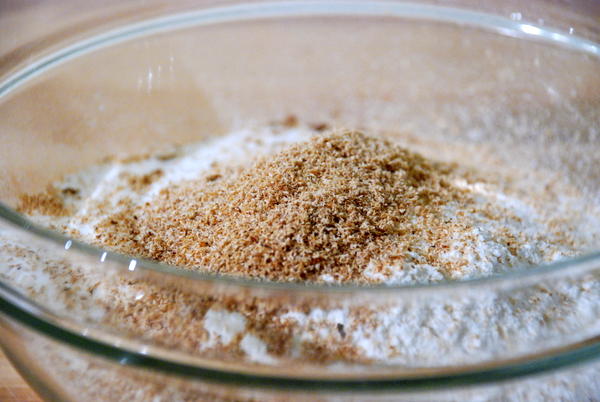
I perched on a stool and dutifully grated one-and-a-half whole nutmegs. Did she really mean 1.5 whole nutmegs? Is it supposed to take this long? Am I really breaking a sweat from grating nutmeg? When it was all grated, I beheld the fruits of my labor:

1-DSC_0944
1-DSC_0944

That’s a whole lot of nutmeg. Yowza.

Mysteriously missing from the ingredient list? Vanilla. Or, come to think of it, any other flavoring at all. This is a bare-bones muffin batter with nutmeg carrying the heavy lift. After making them, and restraining yourself multiple times from adding just a splash of vanilla, you might be as surprised as I was to bite into a muffin still hot from its bake and learn that it is delicious.

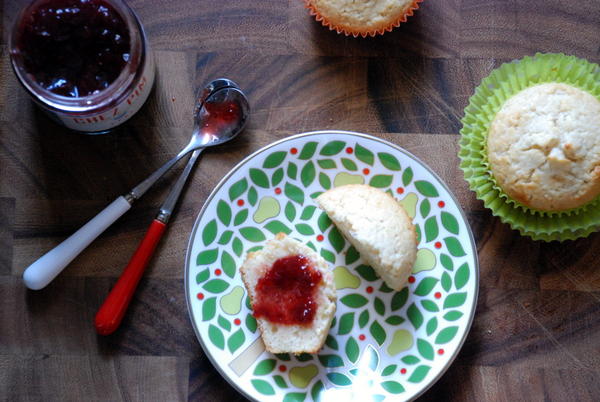
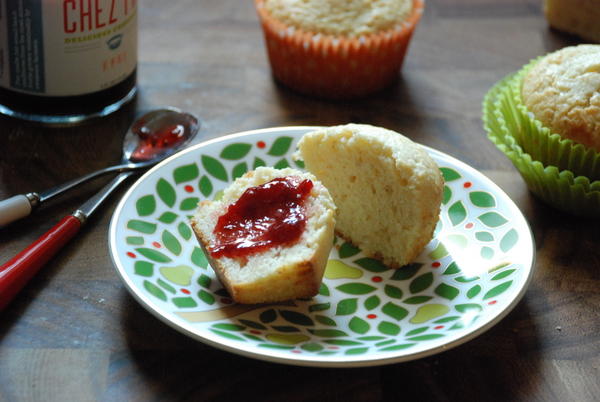
The nutmeg is a subtle flavor, but it isn’t bland. It’s there, and it’s actually quite complex, if you give it your attention.  With a spot of jam, these muffins are perfect. Having served them once to guests and once to just my unsuspecting wife, I guarantee folks will look at them puzzled and ask you what secret thing you tucked inside. You’ll tell them it’s just nutmeg; they won’t believe you. And then, maybe they’ll be as intrigued as I was by the subtle genius of this recipe that they’ll figure there must be other great recipes where it came from, so they’ll buy the book. And they’ll be right.

1-DSC_1078
1-DSC_1078

Marion Cunningham's Nutmeg MuffinsAdapted from The Breakfast Book Makes 12 muffins

Note: When making a bechamel or a souffle. maybe you use ground nutmeg from the jar. You can't do that here. Nutmeg is the star of the show; it must be fresh. You can get it at Indian markets, some Whole Foods, specialty stores, and online. As my friend Josh told me, the first time he cooked with fresh whole nutmeg, he promptly took his jar of ground nutmeg off the shelf and threw it away. Now that's a meaningful difference.

2 cups of flour ¾ cup sugar 1 tablespoon baking powder ½ teaspoon salt 1 ½ whole nutmegs, grated 1 egg ¾ cup heavy cream ¾ cup milk 5 tablespoons butter, melted

Preheat the oven to 400° and grease a muffin tin. Even if you line it with paper, spray the liners. These muffins really stick. If you have silicone liners, you’re in the clear. In a large mixing bowl, combine flour, sugar, baking powder, salt, and grated nutmeg. In a separate medium bowl, beat together the egg, cream, and milk until mixture is smooth. Add butter and stir to combine; little bits of the butter will solidify, which is totally fine.

Make a well in the center of your dry ingredients and add the wet ingredients all at once. Use a fork to mix the batter together just until the streaks of flour disappear. (Incidentally: have I ever told you that I mix almost all batter with a fork? Most are too thick for whisks. Forks are the secret weapon of batter mixing. Anyway.)

Use a ¼-cup measure to scoop muffin batter into the tins. You’re aiming to fill the tins ¾ of the way full. Once you’ve added batter to all 12 tins, distribute whatever’s left evenly.

Bake the muffins for 20 minutes, until just starting to turn light brown. Remove from the oven and set on a rack to cool for 5 minutes, or – whom are we kidding – be a good host and bring’em straight to the table so folks can dig in while they’re piping hot.

In breakfast and brunch, easy
1 Comment

April Bloomfield's Porridge

March 13, 2013 Rivka
1-DSC_0732
1-DSC_0732

So far, it's been the kind of month where I'm eating lunch from food trucks and takeout for dinner at the office. Stew season is slipping away, and I haven't nearly had my fill. (Though, just to be clear, I've had more than enough winter weather. Who's ready for spring?)

In weeks like these, where I feel constantly behind, it's hard to find down time at night. As a result, I occasionally take the extra 20 minutes at home in the morning to make a proper breakfast. I understand this flexibility to be a luxury; these days, most of my friends are packing diaper bags and hustling a herd of children out the door every morning. But for me, those 20 minutes make me feel civilized and satisfied.

In spring, it's yogurt, granola, and some frozen blueberries (which I rinse with warm water to thaw). But it's still March, and much as I'd like to deny it, it's still pretty cold out. For frosty mornings like this one, I humbly recommend this porridge.

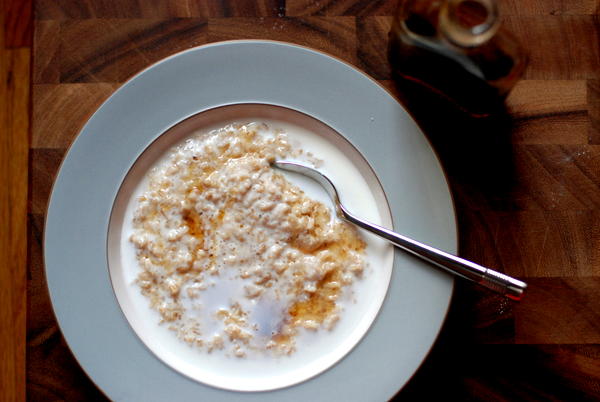
I'll cut right to the chase: this porridge, it is salty. I mean, it's seriously got a punch of salt. But, as April says, after that first hit of "whoa, savory!", the porridge fades into milky sweetness. Oatmeal is a humble food, but this porridge feels somehow luxurious. Which, incidentally, makes it the perfect porridge for an ever-slightly-slower weekday morning.

For those of you without time to spare on workdays: not every nice weekend breakfast must include biscuits or pancakes (though if you're making those, I recommend these and these. And these. Okay okay, one more.) When I visited Jess and Eli last year, Jess gave me options for brunch, and one of those was oatmeal. I loved that she'd make oatmeal for company. What a revelation! Of course, oatmeal is the perfect company-for-brunch food. Make a big pot and let guests dress it up as they wish. So I guess I'm saying, this weekend, let this oatmeal be your porridge-for-company recipe. It won't disappoint. If anything, your guests will think you brilliant. Yea, brilliant.

April Bloomfield's PorridgeAdapted from A Girl and Her Pig, April Bloomfield's new book, which just won the Food52 Piglet award and almost as quickly found its way into my library; it's a fantastic book. You will learn a ton from reading and cooking Bloomfield's recipes. See here for a lovely review by Stanley Tucci.

Serves 2

As I said above, this porridge is Salty, with a capital s. That's why I love it. If you're nervous about the salt and want to start slow, reduce the quantity to 1 teaspoon. Also, if you don't have salt that is truly flaky, as Maldon is, reduce the quantity even further. You should probably use only about 3/4 teaspoon of fine sea salt.

1 1/2 cups milk (preferably whole but whatever you have is fine), plus more for serving 1 1/2 cups water 1 1/2 teaspoons Maldon or other flaky sea salt; if using fine salt, use less - start at 3/4 teaspoon and adjust as needed 1/2 cup steel-cut oats 1/2 cup rolled (not quick-cooking) oats 2 tablespoons maple syrup, maple sugar, maple butter, or brown sugar (I used maple butter, which I happened to have, and it was delicious)

bring milk, water, and salt to a simmer in a medium pot over high heat. When liquid starts to simmer, add both oats, stir to combine, and reduce heat to medium. Cook the oats at a steady simmer, adjusting the heat as necessary and stirring occasionally to prevent the mixture from boiling over. At 20 minutes, the steel-cut oats will be just cooked and the rolled oats will have melted into the porridge.

Taste the porridge. Salty! You're now going to adjust the flavor by adding maple syrup or brown sugar to taste. I used the full 2 tablespoons, and maybe even a wink more to serve, but start with 1 and see where you are. You want the porridge to start salty and then fade into sweetness. What I'm about to say will sound a bit blasphemous, but the balance of salty and sweet is a much more refined, successful version of what those instant oatmeal packets are trying to accomplish. Here, it works.

Once you've achieved the balance of salty and sweet, spoon the porridge into bowls and top with a splash of cold milk and maybe a pinch more of brown sugar or a dribble of maple syrup. Serve immediately.

In breakfast and brunch, comfort food
1 Comment
← Newer Posts Older Posts →

Subscribe by email:

  • books (1)
  • crisps and crumbles (1)
  • frozen (1)
  • toys (2)
  • gifts (3)
  • egg whites (5)
  • fried (5)
  • how to use--- (6)
  • drinks (10)
  • menus (11)
  • travel (11)
  • fish (12)
  • kosher for passover (14)
  • thanksgiving (14)
  • vegan (20)
  • snacks (21)
  • techniques (21)
  • soup (26)
  • bread (28)
  • pies and tarts (28)
  • cake (33)
  • events (34)
  • condiments (36)
  • various and sundry (39)
  • uncategorized (42)
  • cookies and bars (46)
  • weekday lunch (47)
  • appetizers (48)
  • salad (51)
  • gluten-free (56)
  • comfort food (61)
  • breakfast and brunch (77)
  • sides (81)
  • dessert (90)
  • main dishes (100)
  • healthy (139)
  • easy (155)
  • vegetarian (180)

| LATEST |

Featured
Blue Chair Fruit's Black Raspberry Jam
Thai Grapefruit Salad
Mango Sticky Rice
Winter 2016: Odds and Ends
Povitica: The Best Babka Ever
Persimmon Walnut Bread
Sprout Chaat Salad + New Site!
Maple Walnut Squares
How to Give Thanks
Croissants (really, I made croissants) + other croissant-ish things

| hEALTHY |

Featured
Sprout Chaat Salad + New Site!
Fennel frond pesto + what to do with those pesky stalks
Asparagus Toasts with Pistachios and Mint
Eggplant-Walnut Pâté + Passover Ideas
1-DSC_0861-600x401.jpg
Lentils and Rice with Tamarind Sauce and Dukkah
Big Kale Salad with Pomegranate and Feta
Punchy Crunchy Ginger Salad

| BreakfAST |

Featured
Povitica: The Best Babka Ever
Croissants (really, I made croissants) + other croissant-ish things
Mushroom and Kale Breakfast Strata
Barley Porridge with Orange and Black Sesame
Ramps 'n' Eggs Biscuit Sandwiches
Asparagus Toasts with Pistachios and Mint
Apple-Cheddar Scones with Sage
Menemen - Turkish Eggs with Tomatoes and Peppers
You must select a collection to display.

© 2016 Rivka Friedman. All Rights Reserved.