• Home
  • About
  • Recipe Index
  • Contact
Menu

Rivka Friedman

Street Address
City, State, Zip
Phone Number

Your Custom Text Here

Rivka Friedman

  • Home
  • About
  • Recipe Index
  • Contact

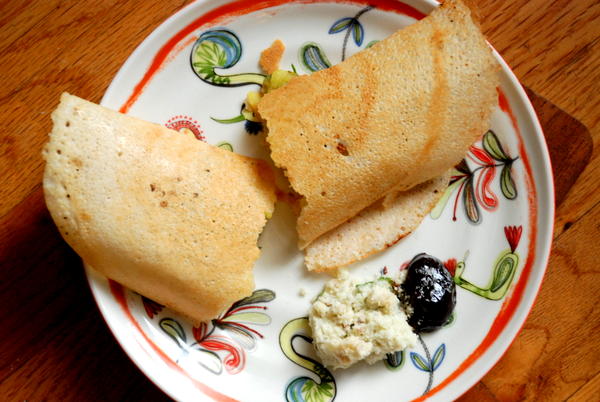
Masala Dosas

March 29, 2013 Rivka
1-DSC_1284.jpg

When I was a kid, my favorite restaurant was a spot called Siddhartha, in downtown Silver Spring. Siddhartha was unfussy, inexpensive, and – at least when we started going – patronized almost exclusively by Indians. In retrospect, I suppose it’s a parent’s dream: kid loves cheap, relatively health Indian food more than pizza, chicken nuggets, whatever. But when we were at Siddhartha, chicken nuggets were off the menu. I could think of only one thing, and that was masala dosa.

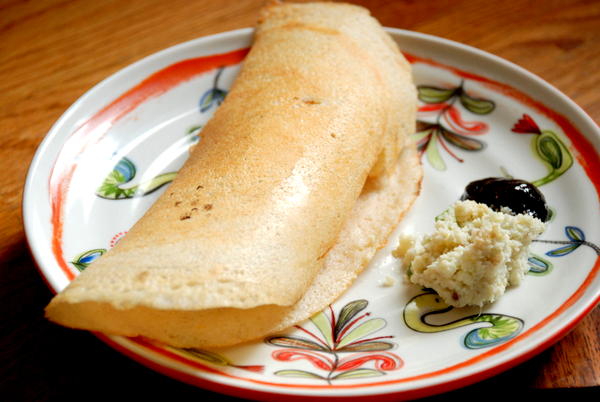
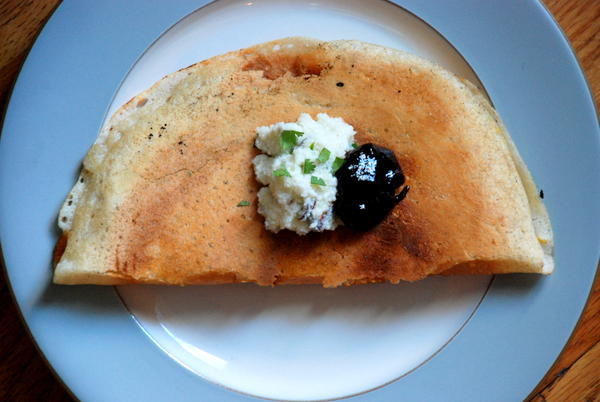
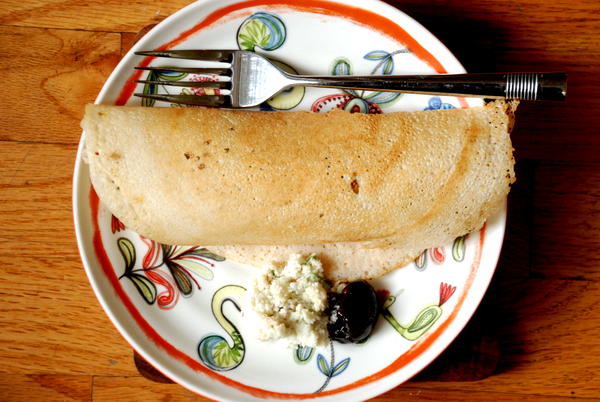
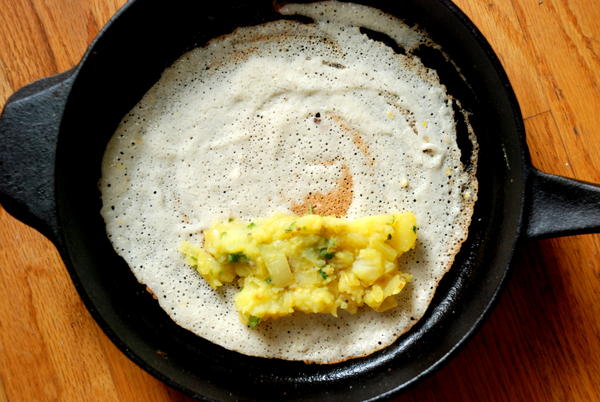
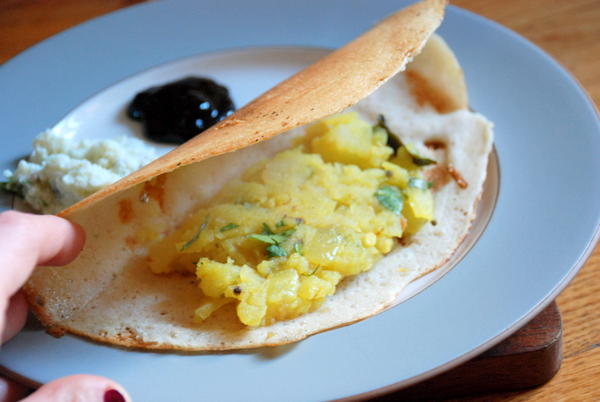
For the uninitiated, a masala dosa an Indian pancake, crisp and lacy outside but soft within. It’s cooked like a crepe, and then filled with a mixture of spiced potatoes and onions. Dosa batter is made of ground rice and lentils which have been fermented, so the pancake takes on a slightly sour, funky flavor (like sourdough bread: less sour, but equally distinctive).
1-DSC_1209.jpg
1-DSC_1261.jpg

If it isn’t clear already, I am obsessed with dosas.

If I’m being truthful, dosas fell off the map for me. There were probably 5 or 6 years when I didn’t have a single one. Looking back, that was pretty stupid. I went without because I couldn’t find a decent restaurant nearby that made them. Now I realize I could have been making them at home, all along.
1-resize.jpg

Dosas came back into my life, of all things, because of a food truck. Actually, two food trucks.

Do you know about food trucks? We’ve got them all over DC, but we’re hardly the first city to develop mobile cuisine. Austin has had them for years, and the last time I was in town, strolling down South Lamar, I stopped at the food trailer park for lunch. There, set up on the gravel, was a shiny silver truck called Nomad Dosa. Natch, choosing my lunch spot was no challenge. I had one masala dosa, returned the next day at lunch for one more, and came home thinking half-seriously about quitting my job and starting a dosa truck in DC.
1-DSC_1253.jpg

Seriously, if two Texan hippies with one trip to India under their belt could make decent dosas, why couldn’t I? Right then and there, I committed to finding and perfecting (perfecting!) the recipe.

Fortunately, I’ll be keeping my job for now. There’s a newish food truck in town, and it’s called Chatpat. If you live in DC and haven’t yet tried it, stop wasting time. Chatpat is a South Indian food truck that serves a slew of appetizers, one thali, and two dosa options every day. Not only do they park at my office two times a week – making a daily dosa a real possibility – but Mr. Chatpat worked with me, over several weeks, to perfect my dosa recipe so that it tastes like my best meals at Siddhartha.
1-DSC_1232.jpg

You guys, I am over the moon. In the past month, I’ve had dosas for breakfast, lunch, dinner, and snack. It seems I could eat nothing but dosas for weeks straight. And now, thanks to the magic of I-tested-this-recipe-1500-times , you can make them – and eat a million of them – too.
1-DSC_1269.jpg

So thank you, Mr. Chatpat! And Todd, the Nomad Dosa man, for reminding me that dosas exist and are wonderful. I’m indebted to both of you. Perhaps, one of these days, I’ll show up with a token of my gratitude: one perfectly cooked, perfectly filled dosa. My treat.
1-DSC_1286.jpg

Masala Dosas with Coconut ChutneyLoosely adapted from this, this, this, my friends Trial and Error, and tips from Mr. Chatpat

Don't be fooled by the abundance of notes and the long recipe: dosas aren't hard to make, and they require minimal active time. However, there's a learning curve when it comes to making good ones, which is where my miniature bible of notes comes in. 

Notes:

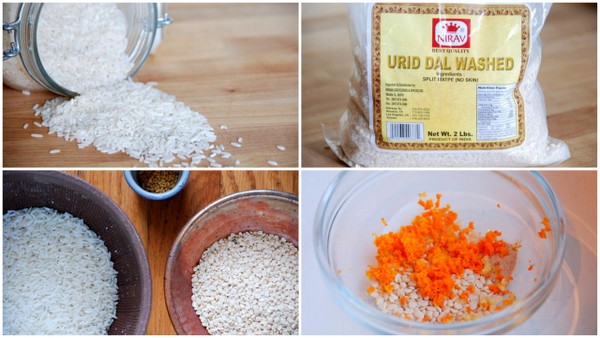
For those of you who try to avoid buying “special” ingredients, my apologies. I’ve managed to do away with the special rice some recipes call for, but you do need to buy washed urad dal and fenugreek seeds. For the urad dal, you want “hulled and split black gram.” You don’t want the flour, and you want the lentils to look pale taupe, not black. The black ones have not been hulled. Urad dal are available at Indian grocery stores, as well as Kalustyan’s and Amazon (the small bag is cheaper, but the big bag is a better value). Fenugreek seeds are also available on Amazon and Kalustyans. Lastly, to make the filling and chutney, you'll need curry leaves. Available on Amazon and at Kalustyans.

Dosa batter is made by allowing raw rice and lentils to soak and soften in water, then blending them smooth, combining them, and fermenting the combined mixture. Because rice and lentils soak up different amounts of water depending on quality and age, it is impossible to say with certainty how much water you will need for your batter. Mr. Chatpat confirmed this for me. So we’re all going to have to be comfortable with a little trial and error of our own. Here’s the good news, though – if your dosa batter is too thick, you can add water as needed, at any stage of the process. My best dosas have come from batter to which I added water by the tablespoonful as I made the dosas. Tried one, too thick, add some water, tried another, etc. You’re going for batter with a consistency somewhere between pancake batter (gloopy) and crepe batter (very runny). As your dosa skills improve, you may find you want to adjust the thickness of your batter. Again, you’ll have to play around with it.

But it’s worth it. It really is.

And if you want to be really traditional about it, make sambar and/or coconut chutney to go alongside. We also served it with purchased tamarind chutney, which certainly isn’t traditional, but it is very tasty.

Sorry, one last thing. I’m told that dosa batter is supposed to double in volume while it ferments. Mine never, ever has doubled. It has increased in volume marginally, but it’s never even come close to doubling. This may have to do with the fact that it’s cold out, or it may have to do with my tap water being DC’s finest. If you want your dosa batter to rise, use room temperature filtered water, and live somewhere warm. Jokes: I’ve got strategies for keeping your dosa batter toasty below. But I have a feeling that part will be much easier come summer. Okay, onto the recipe.

1 ½ cups regular, unfancy, long-grain rice (basmati will also work, but the former is cheaper)
½ cup urad dal
½ teaspoon methi (fenugreek) seeds
1 teaspoon salt
A few tablespoons of olive oil or ghee
Wedge of an onion, for cooking the dosas

Soak the Grains: Put the rice in a medium-large bowl, and fill with room temperature water so the water level is a couple inches above the rice. Put the lentils and fenugreek in a separate bowl, and fill it, too, well above the level of the lentils. Cover the two bowls and set on the counter to soak for at least 5 hours (no harm if it’s longer – I typically leave mine overnight). The lentils and rice both will have soaked up most of the water in the bowls, and the rice will be soft enough to break with your fingers.

Make the Batter: Strain the lentils. If you reserve the water, you can use some of it to blend the lentils; otherwise, you can just use water straight from the tap (or Brita). Pour the lentils into the bowl of a food processor (best) or blender, add 2 tablespoons of water, and turn the machine on. After 30 seconds or so, stop the machine and scrape down the sides of the container. Then recover and blend until the lentils are absolutely, positively smooth. You may need to add a few more tablespoons of water as you go.  In my food processor on high, this took about 4 minutes. You’re looking for light, fluffy clouds of whipped lentil batter. Think liquid marshmallows.

Use a spatula to scrape your whipped lentils into a large pyrex or other mixing bowl – the more insulated, the better. You’re going to want your dosa batter to stay warm as it ferments.

No need to clean the processor bowl; just strain the rice (reserving the liquid), and transfer it straight into the bowl, with 1 cup of the soaking liquid. Blend until the mixture is runny, milky white, and as smooth as possible, about 3 minutes. The mixture may feel ever so slightly gritty if you pinch some of it between your fingers, but you’re going for as smooth a mixture as possible.

Pour the rice mixture into the lentil mixture and use a spatula to gently fold them together. Keep folding as you would chocolate mousse or soufflé batter, until the mixture is totally uniform.

Ferment the Dosa Batter: Cover with a towel or with plastic wrap into which you've poked some holes. Set in an area that hovers around 80 or 90 degrees, and leave it there to ferment and (hopefully) grow in volume, 8-12 hours.

If your house is cold, you have a couple options. One is to turn your oven on to about 100 degrees, then put the dosa batter inside and turn off the oven. It won’t stay hot forever, but if you choose an insulated bowl, your dosa batter will have a couple warm hours at the start of its rest. You can also turn on the light in the oven to raise the temperature inside slightly. But best case scenario (which, note, I’ve never done) would be to ferment your dosa batter while you’re awake, so you can adjust the oven temperature from time to time.

If your kitchen is particularly cold, your dosa batter may need up to 18 hours of fermenting time, so be sure to make the batter in advance. The beautiful thing about making it in a cold house is that you can basically leave the batter out on the counter for a day or so, and it will get slightly more sour, but not too much. You’re looking for the batter to have become slightly frothy, and grown slightly in volume. However, if it’s cold, this may happen either slightly or not at all. Don’t worry about it. I’ve made great dosa from batter that looks exactly as it did when I first mixed it up.

Cook the Dosas: Keep in mind that dosas are like crepes. The first one, you will most likely throw away, and the best dosa comes with practice.

Set your largest cast iron or other very well-seasoned pan over medium-high heat. Nonstick is a second-best option here; you ideally want a pan with heft, but that won’t allow the dosas to stick. And you want the pan hot enough that when you sprinkle a couple drops of water, they immediately sizzle and disappear – but not hot enough that it smokes.

When the pan is hot, drizzle a couple drops of olive oil or ghee onto the cut side the onion wedge, spear the wedge with a fork, and rub the cut side of the wedge onto the pan to coat it ever so slightly with oil. (The onion will sizzle).

Use a ¼ cup measure or a ladle to pour a puddle of batter into the center of the pan, and then use the back of a wooden spoon or (if you have one) a crepe spreader. I don’t have one, and I’ve actually come to love my flat-bottomed metal ¼ cup as the perfect tool here. I fill it, pour it, and then use the bottom of the measuring cup to spread it.

To spread the dosa, move gently from the center of the dosa out to the edge in a fluid spiral motion. There may be spots you miss – you can always go back and correct them. Your technique the first couple times is going to suck. Be cool with it – you’ll get better as you go. If you need a confidence booster, check my first dosa photos on instagram. Not pretty.

Once you’ve spread your batter around the pan, drizzle a couple more drops of olive oil or ghee over the top surface of the dosa. (At this point, if you are filling the dosas, this is when you would add a spoonful of filling either to one side of the dosa (if planning to fold in half) or along the center of the dosa (if planning to roll up).)

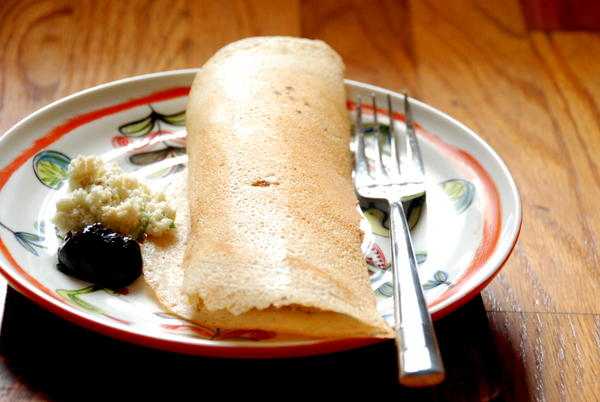
Cook over medium-high heat until the bottom of the dosa is thoroughly golden. You’ll notice that the edges of your dosa start to lift and curl slightly when the dosa is close to done. Use a wooden spatula to lift the dosa, and either fold it over itself to make a semi-circle, or gently roll it up into a cylinder.

You can serve the dosas just like this, with sambar and coconut chutney (recipe below), or you can fill them with the potato masala filling (recipe also below). But unfilled, they make a fantastic snack.

The dosa batter will keep in the fridge for up to 1 week, but it needs to be brought back to room temperature before making dosas.

Potato Masala Filling

1 ½ lbs. gold (waxy) potatoes, peeled, boiled in salted water, and cooled slightly
3 tablespoons oil or ghee
½ teaspoon yellow mustard seeds
2 teaspoons urad dal
1/8 teaspoon asafetida (optional)
½ teaspoon turmeric (fresh if available, otherwise dry ground)
5 curry leaves
1 tablespoon minced or grated ginger
2 serrano or jalapeno chilies, membranes and seeds removed, diced
½ medium yellow onion, coarsely chopped
1 cup water
1 teaspoon salt
1 cup chopped cilantro

When the potatoes are just warm, cut them roughly into 1-inch cubes.

Gather all your ingredients before starting, because once the pan is hot, everything moves quickly. Put the mustard seeds in a small bowl, the urad dal, asafedita, turmeric, curry, ginger, and chilies in another medium bowl, and the onion in a third bowl. Set the bowls near the stove.

Heat a large sauté pan over medium heat and add oil or ghee. When oil shimmers, add mustard seeds and wait until they pop, about 30 seconds. Then add the contents of the second bowl (urad dal, asafedita, turmeric, curry, ginger, and chilies) and stir to coat with the oil. Cook 30 seconds more.

Add onions, stir to coat with spices, and cook over medium heat until they start to soften and turn translucent, about 8 minutes. Add potatoes and continue cooking another 2 minutes or so, until the potatoes start to break down.

Add the water and half a teaspoon of salt. Scrape the bottom of the pan to loosen the browned bits into the potato mixture, then turn up the heat until the water comes to a boil. Cook 5 minutes, then turn off the heat.

Use the back of a fork to lightly mash the potatoes. You still want plenty of cubes, but you also want some mashed bits.

Add the cilantro, and taste the mixture; if it isn’t salty enough, add the remaining half-teaspoon of salt.

At this point, you can use the potato masala immediately, or store covered in the fridge for up to 1 week. Be sure to bring to room temperature (or even warm slightly in a microwave or on the stove) before using to fill dosas.

Coconut Chutney

For the initial mixture: 1 cup fresh grated coconut (can susbtitute dry unsweetened coconut, but you'll need to add double the water) 2 small serrano or 1 jalapeno chile, chopped (seeds and membrane removed if you're worried about spice) 1 teaspoon grated ginger 1 tablespoon roasted chana dal or urad dal, lightly toasted in a dry skillet ½ teaspoon salt

For the tempering: 1 teaspoon ghee or flavorless oil (grapeseed, canola, etc.) ½ teaspoon yellow mustard seeds 1 red chile, crushed (or substitute 1 teaspoon chile flakes) 3 curry leaves, crushed

In a mini-prep food processor or blender, combine coconut, green chile, ginger, dal, and salt and blend with 1/4 cup water until smooth, adding more water if necessary and scraping down the sides of the canister as needed. Transfer to a bowl.

In a small skillet, heat the ghee or oil until it shimmers, then add the mustard seeds. After they pop, add the chile and curry leaves and remove from the heat immediately. Pour the flavored oil (with all the spices) into the coconut mixture and stir to combine. Serve with masala dosas or other indian dishes.
In gluten-free, main dishes, vegan, vegetarian, healthy
18 Comments

Mushroom Tacos with Tomatillo-Chipotle Sauce

February 13, 2013 Rivka
DSC_0596
DSC_0596

I've been traveling a bunch for work, which has left our fridge less packed than usual. It's a bummer to open the fridge and so few bags of produce, but D gets positively gleeful about all the open space. O.C.D Organized people just love empty fridges, am I right?

With less time at home, I'm on the lookout for quick weeknight dinners that make use of whatever precious little food I've got in the fridge. Bonus points for dishes that aren't pasta, which is a fallback too often.

This week, I barely cooked at all. I only had one night in town when I wasn't working late, and our friend Abby was visiting from NY, so we met her at El Chucho, the new Mexican restaurant in Columbia Heights. It's got a dimly lit interior, tall tables and bar stools, and lots of bearded dudes in plaid shirts walking languidly around with plastic baskets in hand. Walk in, and you feel like you've walked into Brooklyn; Abby felt right at home. The food wasn't bad, the ambiance was fun, and margaritas were on tap. Of course. I bet we'll be back soon. Meanwhile, we're copying their dishes at home.

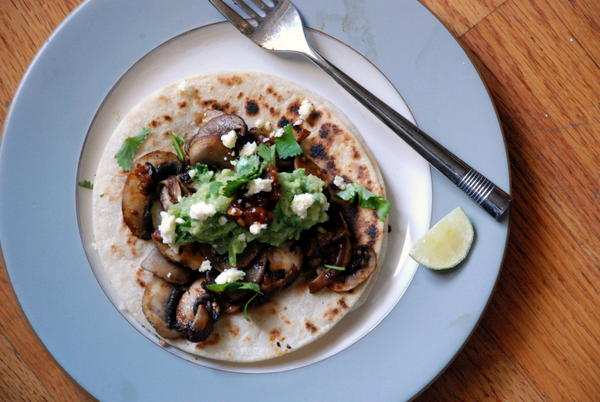
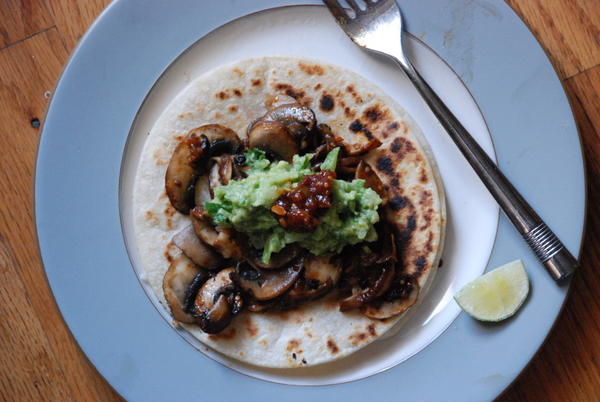
El Chucho had tacos de calabacitas on order, made with breaded fried squash. They were so addictive, we didn't miss the meat. When the weekend rolled around, I was hungry for more Mexican food but didn't have any squash on hand (it tends to be limp and sad in wintertime). I did have a bag of mushrooms that needed using, and a handful of tomatillos left over from the previous week's dinner party. I braced myself for a bit of fussing, figuring it was worth it - a craving is a craving, yes? But much to my surprise, dinner came together quite quickly. Corn tacos were heated. The mushrooms were tossed with a quick sauce of tomatillos and canned chipotles. Everything cooked through while I mashed up an avocado's worth of guacamole and opened a jar of the salsa I made this summer. We didn't have any queso at home, so I topped the tacos with a pinch of feta cheese, which in retrospect wasn't at all necessary. Done and done: dinner on the table in 20 minutes.

DSC_0576
DSC_0576

What I like most about these mushrooms is their versatility. I can see stuffing them into burritos or enchiladas, folding them into short vermicelli for a Mexican riff on fideos, or even adding some to a handful of melty cheese, piling the mixture into a flour tortilla, and making a mean quesadilla. They can go on pretty much anything. Come to think of it, they're the sort of thing I'd make a big bowl of, then tuck in the fridge for a busy day's dinner. Cooked mushrooms are smaller than raw ones; everyone's happy.

Mushroom Tacos with Chipotle Serves 4

For the mushrooms: 2 tablespoon olive oil, divided 2 cloves garlic, smashed and chopped 1/2 lb. tomatillos, husked, rinsed, dried, and roughly chopped 1 canned chipotle, chopped, plus 1 tablespoon of the canning sauce (start with half a chipotle if you're sensitive to heat) juice of half a lime 1 lb. cremini mushrooms, wiped clean and sliced salt

For serving: a big pile of small corn tacos guacamole and salsa (purchased is fine) queso fresco or feta cheese, optional

Put a large frying pan over medium heat and add 1 tablespoon olive oil. When oil shimmers, add garlic. Stir around to distribute, and cook for 1 minute. Then add tomatillos, stir into the garlic, and cook until they break down slightly, 2 minutes. Add chopped chipotle, stir through to incorporate, and cook until the mixture softens and becomes mostly smooth, about 2-4 more minutes. Spoon the sauce into a bowl, taste, and add salt or pepper as needed.

Give the pan a rinse and wipe it dry, then return it to medium-high heat and add the other tablespoon of olive oil. When oil shimmers, add mushrooms. Toss to distribute evenly, and then let them sit there for a few minutes, until the mushrooms on the bottom of the pan develop some color. Every couple of minutes, give the pan a shake to move mushrooms from top to bottom and vice versa. After 5 minutes or so, the mushrooms will have emitted enough water to shrink slightly, and the pan will be less crowded. When this happens, spoon in the tomatillo-chipotle sauce, stir it around to coat the mushrooms, and cook 1 or 2 more minutes, until mushrooms are coated and browned. Squeeze the half a lime into the pan, stir to incorporate, and turn off the heat. Scrape the mushrooms into the bowl that held the tomatillo-chipotle sauce. Wipe the pan out a bit, and return it to the heat.

Heat corn tortillas one at a time by leaving them in the hot pan just until warmed through (or, if you're crazy as I am, until the bottom of the tortilla is a bit brown and crispy), then stack them on a plate as they finish warming. When you've warmed enough tortillas for either one or two per person (depending on preference: I like two per taco, D prefers one), put the tortillas on plates, spoon some of the mushroom mixture onto the tortillas, and top with guacamole, salsa, and/or cheese. Serve immediately.

In gluten-free, main dishes, vegetarian, easy, healthy
1 Comment

Crispy Kale Tart with Grapes

November 16, 2012 Rivka
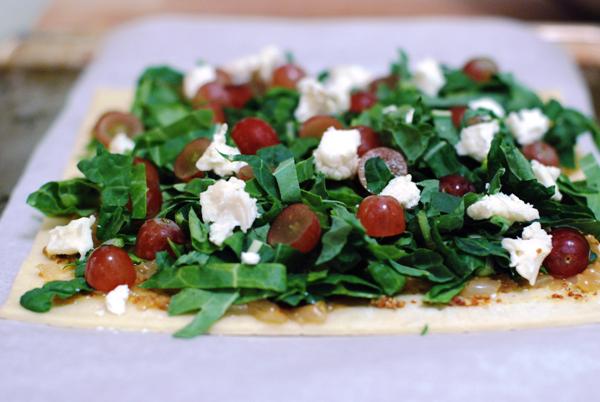
kale and grape tart
kale and grape tart

There may be nothing better than taking the most virtuous ingredient, like kale, and making it as delicious as deep-fried potato slices. I lovekale chips.

If we're being honest about our allegiances, I'll tell you that I might like my taters au gratin even more than as chips. You get that crunchy, browned exterior, but you also get that soft, melty, creamy underbelly. And if you want to sprinkle some extra grated parmesan on top, well, don't let me stop you.

My kale repertoire boils down to three main things: chips, sauteed kale, and raw kale salad. So the greens are either very very crunchy, or totally soft. What never occurred to me -- until last week, that is -- was the idea of treating kale like potatoes au gratin, giving them soft parts and crunchy parts in the same dish. That's what I was going for with this crispy kale tart.

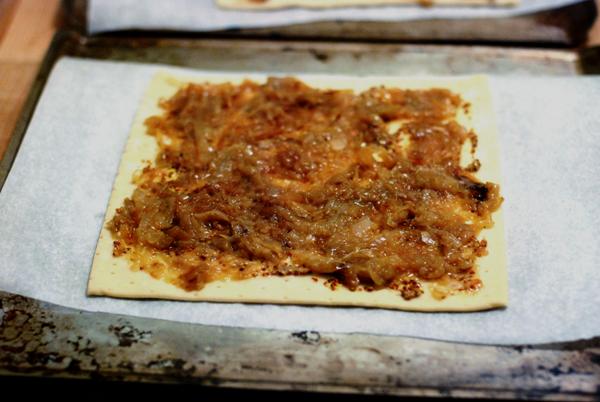
onions on kale tart
onions on kale tart
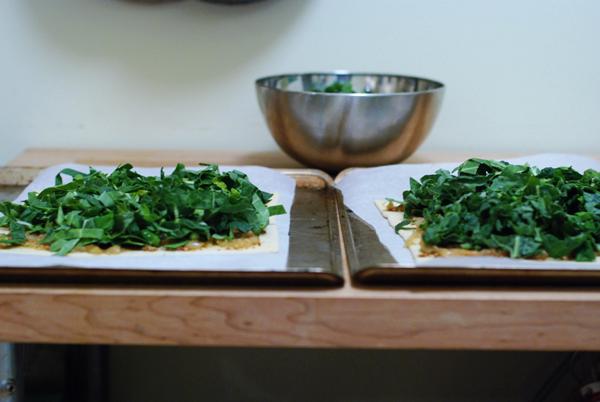
kale tarts before baking

It all started when I overbought kale at the market a few weeks ago, I washed and cut it up all at once, figuring I'd be more likely to use it if it were all ready to go. (This is a strategy I employ whenever I buy lettuce, green beans, cauliflower, broccoli, or any greens. Prepping them in advance makes cooking from scratch seem so much less work-intensive.) Because I know myself too well, I also halved some grapes while I was at it. Those went in the bag with the kale. So did some chopped scallions. Boom: salad.

After 4 straight days of kale-grape salad for lunch, I still had some leftover and I wanted to do something different with it. We had planned to bring dinner to friends who just had a baby, and I was thinking I'd make some sort of open-faced puff pastry tart. Opened the fridge, saw the kale, wheels started churning.

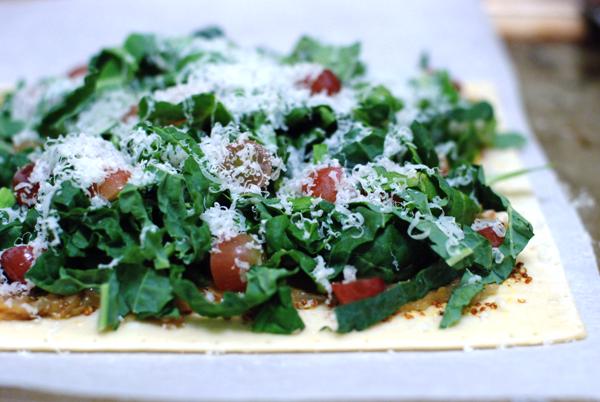
parmesan kale tart
parmesan kale tart
kale tart with goat cheese

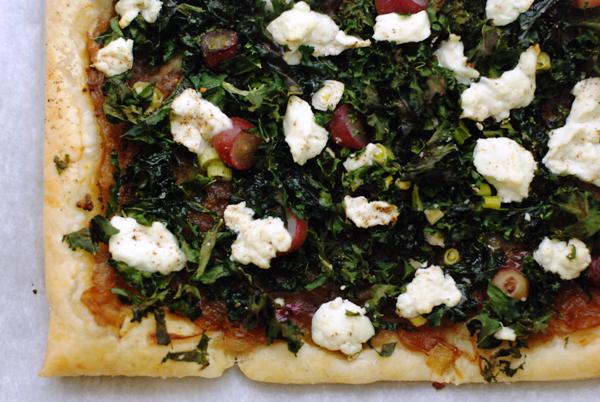
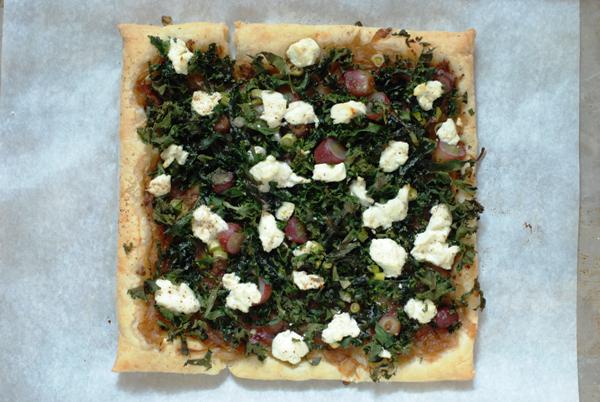
30 minutes later, something beautiful emerged from the oven: the kale, which had been drizzled with olive oil and liberally salted, tasted like kale chips on top - but there were soft bits, too, reinforced by plenty of caramelized onions and bits of melty goat cheese. And those grapes! Why don't we cook grapes more often? The heat concentrates them; they come out looking like sparkly little gems. The tart didn't need scallions, but those grapes? The goat cheese? Amazing.

Now's the part where I admit to you that apparently, I can't come up with much else to eat. I've made this tart three times. I've eaten it 4 days this week. I probably won't stop there.

But if I do, at any point, decide to incorporate some other foods into my diet, this tart definitely will go into the regular rotation.

kale tart with grapes 2

Crispy Kale Tart and Grape Tart Makes 1 9-inch tart, enough to serve 4 as an appetizer or, with a salad, a light dinner

A few notes about this tart. First: I've made it with fresh goat cheese, which I really like. If you don't love goat cheese, try it with grated parmesan, which works equally well. Don't use aged goat cheese, though -- that combination was sort of weird. Second: use the most flavorful grapes you can find. If concord grapes are in season, use those. Otherwise, try to find unsprayed red or black grapes. Lastly: any kind of kale works here. I like curly kale best, because the leaves are very unruly, so you end up with lots of crispy bits. That said, I've tried the tart with dinosaur (lacinato) kale and even with a mix of swiss chard and collard greens (which get less crispy, but still taste good). In short, any greens will do.

1 lb. (16 ounces, 454 grams) yellow onions (about 2 medium), halved and thinly sliced 2 tablespoons butter 2 tablespoons olive oil, 1 for the onions and 1 for the kale 1 sheet puff pastry 1 tablespoon grainy or dijon mustard 3 ounces (113 grams) kale, shredded 1 cup (about 3.5 ounces, 99 grams) red or black seedless grapes, halved 2 ounces (57 grams) fresh goat cheese or parmesan cheese salt and pepper

Put 2 tablespoons butter and 1 tablespoon olive oil in a wide shallow pan that has a cover, and set over medium-low heat. When butter had melted, add onions and a healthy pinch of salt. Stir to coat, cover the pan, and turn heat to low. Cook, stirring occasionally, until onions have softened and started to caramelize, about 20 minutes.

Remove cover, turn heat to medium-low, and let the onions start to brown more, stirring at more regular intervals. Cook for 10-15 minutes more, until onions are very soft and golden brown. Set aside.

Meanwhile, set puff pastry on a flat surface, cover lightly with a dish towel, and allow to thaw enough that if it's folded, you can open it up without ripping it. I find this takes roughly 25 minutes. Alternatively, you can stick the package of puff pastry in the fridge overnight, which also does the trick. Trader Joe's puff pastry comes in a flat 9-inch square which makes thawing less important. If you make your own, well, you're fancy-pants. Ignore all of this.

Preheat the oven to 350.

When puff pastry is ready to use, unfold or roll into roughly a 9-inch square (though exact size and shape really don't matter here) on a lined baking sheet. Spread a very thin layer of mustard - 1 tablespoon total - on the puff pastry, leaving a 1/2-inch border. Distribute caramelized onions over the mustard, and then pile on the kale. Distribute halved grapes evenly over the kale, and top with little bits of goat cheese or clouds of grated parmesan.

Drizzle the remaining tablespoon of oil (ok, maybe a a tablespoon and a half) over the kale, and sprinkle with salt and pepper.

Transfer puff pastry on baking sheet into the oven, and bake for 25-30 minutes, until pastry is golden, kale is browned and crisped, and grapes are glistening. Cut the tart into 9 equal squares, and serve warm or at room temperature. You can also refrigerate the tart and then reheat it in a low (225-degree) oven for 10-15 minutes before serving.

In main dishes
1 Comment

Snapper with Harissa and Rose

November 9, 2012 Rivka
harissa snapper
harissa snapper

Jerusalem is a city of enclaves. There are Yemenites and Iranians and Bukharians, Russians and Syrians and Brazilians, Ethiopians and Venezuelans and Jordanians, Libyans and Italians, French and Americans. Each group has its own neighborhoods, its own language, its own culture, its own food. And now, there's finally a book cataloguing everything.

Yotam Ottolenghi was raised in mostly-Jewish western Jerusalem. His partner, Sami Tamimi, was raised in Muslim east Jerusalem. They now live in London, where they run restaurants - but both still think of Jerusalem as their home. The two have collaborated on a new cookbook called Jerusalem, which they claim is a self-indulgent nostalgia trip. I've been leafing through this book before bed for a couple weeks now, and I couldn't be happier to be along for the ride.

harissa snapper ingredients

If you've cooked from Plenty, you'll instantly recognize the style of recipes in Jerusalem. Lots of fresh vegetables, plenty of legumes, olive oil in every pan, generous use of eggs and yogurt. This book isn't vegetarian, but I'd say probably 85% of the recipes are. And while in Jerusalem there are 200 ways to eat meat, it's the fruit and vegetables that I (and clearly they) miss the most. They are in such abundance there that you can't not use them. You can't not top every salad with a handful of fresh herbs, chop up an Israeli salad to go with your meal, cut open as perfect a tomato as you'll find outside of Italy. This book is a celebration of all that makes Jerusalem's food life quirky and intimate and conflicted and wonderful. I can't stop reading it; and while I've only just begun to cook from it, I can tell I'll be doing that regularly from now on, too.

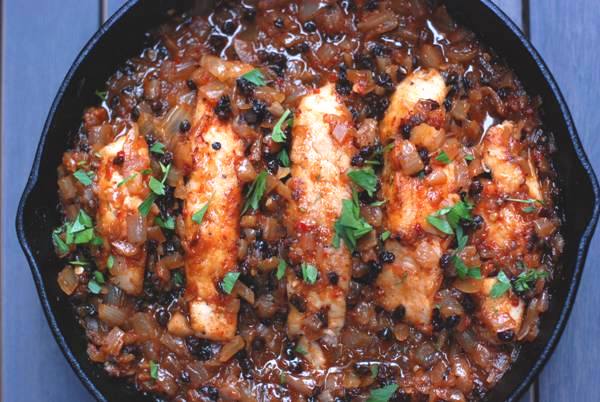
If you do have the book, here are a couple of recipes to make now. Make the roasted cauliflower and hazelnut salad. It looks simple, but the cinnamon and roasted hazelnuts make the cauliflower somehow more romantic. If you still have access to good tomatoes, make Na'ama's fattoush. It's not the fattoush I ate in Jerusalem, but I think that's the point. Make the kubbeh hamousta, which still is my favorite food in Jerusalem (especially if you eat it at Morduch). And then, if you want to be totally and completely wowed, suspend judgement and make this: pan-fried snapper with spicy harissa and rose.

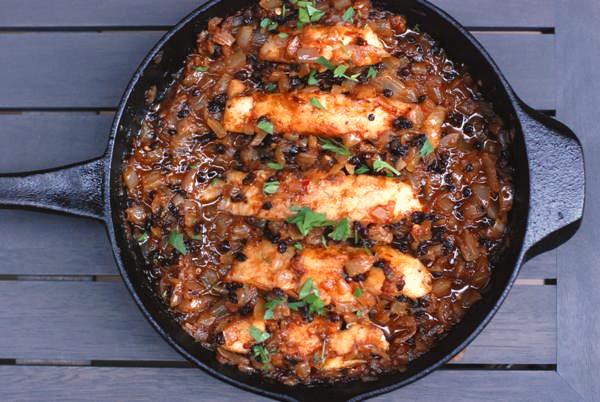
I'm not a huge fan of rose water. I usually find the flavor too strong and perfume-y. But for some reason, this recipe spoke to me. The fish and the spicy harissa lasso the rose water into subtle submission. It lends scent and sophistication to the dish without overpowering it. The result is a line-up of firm fillets, crowned with vivid red sauce that's as spicy as you want it to be, but also sweet from currants and soft onions. And that rose water - I was as surprised as you probably are. D, too. This isn't the kind of recipe I'd put into the regular rotation, but I'm officially looking for an occasion to make it again.

harissa snapper 2
harissa snapper 2

And krantz cakes. And Muttabaq. And burnt eggplant with garlic, lemon, and pomegranate seeds.

You know where to find me.

Snapper with Harissa and RoseAdapted fromJerusalem, by Yotam Ottolenghi and Sami Tamimi

The book calls for sea bass, but sustainable sea bass isn't available where we live, so I used snapper. Make things easy by asking your fishmonger to remove the pin bones and cut the fish into 1/4-pound fillets.

Ottolenghi calls for 1/2 cup of currants, but this makes the sauce a bit too sweet. I cut the amount to 1/4 cup and was happier. He also says the cilantro is optional; I disagree. It adds an important fresh note to the finished dish.

If you're feeling fancy, you can buy edible rose petals, which Ottolenghi and Tamimi use in the book and which look gorgeous. I was feeling practical and somewhat harried; I skipped them.

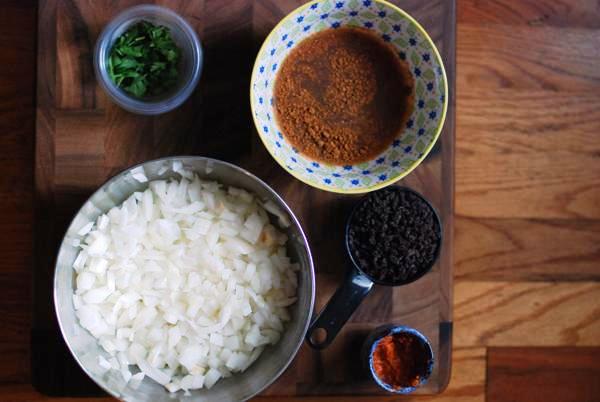
2 tablespoons harissa 1 teaspoon ground cumin Four 1/4-pound fillets of any firm, fleshy white fish, skinned and with pin bones removed All-purpose flour, for dusting 2 tablespoons olive oil 1 large onion, diced 6 tablespoons red wine vinegar 1 teaspoon cinnamon 1 cup water 1 1/2 tablespoons honey 1 tablespoon rose water 1/4 cup currants 2 tablespoons chopped cilantro 2 teaspoons edible rose petals (optional) salt and pepper

Prep the fish:: Mix 1 tablespoon of harissa, the cumin, and 1/2 teaspoon of salt together and rub all over the fish. Set aside.

Heat the olive oil in a wide frying pan (preferably nonstick or castiron) over medium heat. Dust fillets with flour and shake off excess. Gently lay fillets in the pan and fry for two minutes on each side. If you're concerned about overcrowding the pan, cook the fish in batches. Remove cooked fish to a plate, leaving the oil in the pan.

Make the sauce: Add the onions and cook for about 8 minutes, stirring periodically, until soft and golden but not browned. Add the remaining harissa, vinegar, cinnamon, 1/2 teaspoon salt, and several grinds of black pepper. Pour in the water, stir to combine, lower the heat, and cook for 10 minutes, until sauce has thickened considerably.

Add the currants, rose water, and honey. Simmer for a couple more minutes. Taste and adjust the seasoning as necessary, then return the fish back to the pan, spooning some of the sauce overtop. Leave the fish to heat up in the sauce for about three minutes, adding a tablespoon or two of water if the sauce is too thick. Remove from heat, sprinkle with cilantro, and serve immediately with plain rice or crusty bread.

In fish, main dishes
2 Comments
← Newer Posts Older Posts →
No results found

Subscribe by email:

  • books (1)
  • crisps and crumbles (1)
  • frozen (1)
  • toys (2)
  • gifts (3)
  • egg whites (5)
  • fried (5)
  • how to use--- (6)
  • drinks (10)
  • menus (11)
  • travel (11)
  • fish (12)
  • kosher for passover (14)
  • thanksgiving (14)
  • vegan (20)
  • snacks (21)
  • techniques (21)
  • soup (26)
  • bread (28)
  • pies and tarts (28)
  • cake (33)
  • events (34)
  • condiments (36)
  • various and sundry (39)
  • uncategorized (42)
  • cookies and bars (46)
  • weekday lunch (47)
  • appetizers (48)
  • salad (51)
  • gluten-free (56)
  • comfort food (61)
  • breakfast and brunch (77)
  • sides (81)
  • dessert (90)
  • main dishes (100)
  • healthy (139)
  • easy (155)
  • vegetarian (180)

| LATEST |

Featured
Blue Chair Fruit's Black Raspberry Jam

One Saturday night a few weeks ago, friends tipped us off that Butler's Orchard had snap peas and blueberries and black raspberries all ready to go at once. Needless to say, we canceled all other plans for the next day, and by 8:30 am Sunday morning, we were off to the races. 

Blueberries are awesome to pick with an 18-month old. They free from the bush easily, they're plentiful at toddler height, and us oldies can reach the higher ones and save our backs while the kid gets the low-hanging fruit. We came home with 5 pounds of blueberries, 5 pounds of black raspberries, and stains just about everywhere.

Read more →
Thai Grapefruit Salad

If you've seen me in the past few weeks and expressed even vague interest in Asian food and/or cooking, I've probably bored you to tears gushing on about the best cookbook of the year (IMHO), 101 Easy Asian Recipes. The title is both accurate and a bit tongue-in-cheek, since it makes the book sound like something fusion-y and inauthentic and terrible, when in fact, it inauthentic, and unabashedly so, and wonderful. The back of the book has big speech bubbles boasting "100% inauthentic" and "very good" and "easy, really." It's fab.

The book comes from Peter Meehan, who has worked with David Chang (Momofuku) and Danny Bowein (Mission Chinese) for years, co-authored the Momofuku cookbook, and now edits Lucky Peach magazine. He's clearly a meticulous guy who gets how Asian food works -- the balance of flavors, the precision with cooking times, etc. But this book takes a step away from the "this has 500 ingredients/steps, but it's worth it"-style of recipes, opting instead for formulas that follow two important ground rules: no deep-frying, and no recipes within recipes. The rationale: Asian food isn't just for Sunday projects, it's for weeknight dinner with kids. Good bless you, Peter Meehan. 

Read more →
Mango Sticky Rice
Mango Sticky Rice

've had this Thai glutinous rice sitting in the bottom of my cupboard for months, but never quite worked up the guts to make it into something until, a few  weeks ago, the waiter at our little Laotian spot in the neighborhood told me that sticky rice may be the easiest thing on their menu to make at home. That doesn't necessarily say much, considering the menu includes items like crispy rice salad (involving rice that's cooked, mixed with other stuff, formed into balls, deep-fried, broken into pieces, and tossed with a gazillion other ingredients, which I know only because I've made it and whoa, pain in the butt doesn't even start). Still: "easier" was motivation enough not to let that rice sit untouched.

Read more →
Winter 2016: Odds and Ends

Not a full post today, but a bunch of odds and ends that I've been meaning to share.

Marmalading: That's what kept me out of trouble and away from insanity during our two-ish weeks of hibernation under an impenetrable and, apparently, unplowable 30 inches of snow. (Attention DC officials: occasionally, it snows here. Surprise! Buy another plow or two.) Fortunately, my fridge was chock-full of citrus you've never heard us, because Cathy went to Texas for a marathon series of cooking classes, and her trip coincided with Central Market's wonderful Citrus Festival, and she is a goddess and a wonderful friend and a crazy lover of citrus like yours truly. (I paid her in Barcelonian anchovies, yes). For most of last weekend, our home smelled like a heavenly mix of chartreuse hot cocoa (thank you Pam!) and boiling citrus peel. Not shabby. Not shabby at all.

Read more →
Povitica: The Best Babka Ever

It's snowing! It's snowing! THE APOCALYPSE IS COMING! I hope you bought flour and sugar. I hope you happen to have walnuts in the house. Yes? Wonderful.

Meet my latest, love, the Povitica. It comes from my other latest love, the Great British Baking Show. If I may, for just a moment, evangelize on its (the show's) behalf, it is the sweetest, coziest little food show on television. Contestants do their preparation in advance, and come to weekly competition with dog-eared copies of recipes they’ve developed. If someone runs behind, others pitch in to help out. Even the hosts of the show sometimes provide assistance. There’s a lot of smiling and hugging, absolutely no product placement, and so much Englishness, you won’t know what to do with yourself. It's Victorian sponge for miles.

Don't let the coziness fool you: each episode brings a "bake" more ambitious than the last.  There are hot-water pastries and raised yeasted loaves, tiered pies and sculptured cakes. There are desserts you’ve never heard of, from Germany and Poland and France and Croatia, which if you saw in a cookbook might give you pause: lots of ingredients, pages of instruction, no sense of what the thing is supposed to look like if baked correctly. But when a bunch of (okay, very accomplished) home bakers give these recipes a go, under the pressure of a short timeline a televised competition, you watch them, and you think, yeah, maybe I could do that. One minute I’m watching the show, then next, I’m all I must have this in my oven now. That is why last week I up and baked a dobos torte, just because. And then this week, I got baking shpilkes  again, so I went totally mad and baked my beloved povitica.

Read more →
Persimmon Walnut Bread

This is a happy-accident story, but it doesn't start that way. This past fall, I was determined to make hachiya persimmons into smooth, spiced butter. But each time I tried, I created something so ruined, so mouth-dryingly inedible, that I had to dump the entire thing. I did this too many times. cough three.

Fuyu persimmons are sweet and crunchy. They can be eaten as you would an apple. Hachiya persimmons are not as friendly. If you buy them hard, you must wait to eat them, or you will take a bite and your entire mouth will turn dry and chalky, like what tannins in wine do to your mouth but unpleasant, a thousand times unpleasant. To avoid this, you must tend to your hachiyas: put them in a paper bag, set them somewhere warm but not too warm, encourage them to ripen but protect them dutifully against spoilage. Hachiyas can be eaten when they are soft all over, and plump like a balloon. At that point, their astringency goes away, leaving behind soft, floral-flavored flesh that's wonderful as is, or in dozens of baked goods.

The catch, though, is that if even one bit of the persimmon hasn't reached that perfect stage of ripeness, its astringency will infiltrate and ruin whatever you're making with it. This is especially true in the case of butter, where the persimmons are cooked together and then pureed. And so it was for me, time after time, I found persimmons, coddled them to ripeness, cooked them, blended them, tasted them, cursed, and tossed the mixture into the trash. So wasteful, so frustrating. There must be a better way.

Read more →
Sprout Chaat Salad + New Site!

I want desperately to tell you all about this chaat-style salad I've been making almost daily, but it's probably rude to offer guests something to eat without first saying hi, so: 

Hi! I've got a new home.

Not Derby Pie is still there - go see for yourself - but it was time for a fresh start. I never really had the technical wherewithal to manage my own website. I faked it pretty well for 8 (!) years, but with every automatic Wordpress update, my site would break a little bit more – the header, gone! the comments, gone! etc – and late last year, I finally decided I needed a full reboot.  So, here we are: From now on, I'll be sharing new recipes over here, at rivkafriedman.net. 

I used Squarespace to build this site, and I hope you love its clean interface as much as I do. The search function is simpler, the design is 100% mobile-friendly, and I've managed to haul all of my old posts over to this new home, with only minor glitches in spacing and captions and whatnot. I'm 90% of the way there. The biggest issue is that ingredient lists in recipes transfer as a block, not a list. You may see some other minor formatting issues for a little while longer. If a recipe looks particularly garbled, you can always find it back on NDP.

New year, new start. I'm so excited to finally share this with you.

Now then, onto business. 2016's first sprouts are ready for a salad.

Read more →
Maple Walnut Squares

I know it's almost Christmas, but I'm about one month behind (on everything) and right now, I need to commit a tiny act of Thanksgiving blasphemy. I tell you this: the best dessert I ate on Thanksgiving was not pie.

By 7 pm the evening of the holiday, our house was full of neighbors who had decided to stay local. Our table was overflowing with pies, many of which our friends had brought: a glistening, lattice-topped sour cherry pie; several bourbon/brandy-filled pumpkin pies; a gorgeous rendition of Deb's chocolate tart with gingersnap crust (a slice of which I carefully set aside for myself, which my unsuspecting and always-cleaning lady accidentally threw away, *sob*) and many more. I tried too many; I loved them all. But I think my favorite bite of all was a slice of these maple walnut squares.

Read more →
How to Give Thanks
How to Give Thanks
Read more →
Croissants (really, I made croissants) + other croissant-ish things
Read more →

| hEALTHY |

Featured
Sprout Chaat Salad + New Site!

I want desperately to tell you all about this chaat-style salad I've been making almost daily, but it's probably rude to offer guests something to eat without first saying hi, so: 

Hi! I've got a new home.

Not Derby Pie is still there - go see for yourself - but it was time for a fresh start. I never really had the technical wherewithal to manage my own website. I faked it pretty well for 8 (!) years, but with every automatic Wordpress update, my site would break a little bit more – the header, gone! the comments, gone! etc – and late last year, I finally decided I needed a full reboot.  So, here we are: From now on, I'll be sharing new recipes over here, at rivkafriedman.net. 

I used Squarespace to build this site, and I hope you love its clean interface as much as I do. The search function is simpler, the design is 100% mobile-friendly, and I've managed to haul all of my old posts over to this new home, with only minor glitches in spacing and captions and whatnot. I'm 90% of the way there. The biggest issue is that ingredient lists in recipes transfer as a block, not a list. You may see some other minor formatting issues for a little while longer. If a recipe looks particularly garbled, you can always find it back on NDP.

New year, new start. I'm so excited to finally share this with you.

Now then, onto business. 2016's first sprouts are ready for a salad.

Read more →
Fennel frond pesto + what to do with those pesky stalks
Read more →
Asparagus Toasts with Pistachios and Mint
Read more →
Eggplant-Walnut Pâté + Passover Ideas
Read more →
1-DSC_0861-600x401.jpg
Best Mushroom Pizza (or any white pie, really)
Read more →
Lentils and Rice with Tamarind Sauce and Dukkah
Read more →
Big Kale Salad with Pomegranate and Feta
Read more →
Punchy Crunchy Ginger Salad
Read more →

| BreakfAST |

Featured
Povitica: The Best Babka Ever

It's snowing! It's snowing! THE APOCALYPSE IS COMING! I hope you bought flour and sugar. I hope you happen to have walnuts in the house. Yes? Wonderful.

Meet my latest, love, the Povitica. It comes from my other latest love, the Great British Baking Show. If I may, for just a moment, evangelize on its (the show's) behalf, it is the sweetest, coziest little food show on television. Contestants do their preparation in advance, and come to weekly competition with dog-eared copies of recipes they’ve developed. If someone runs behind, others pitch in to help out. Even the hosts of the show sometimes provide assistance. There’s a lot of smiling and hugging, absolutely no product placement, and so much Englishness, you won’t know what to do with yourself. It's Victorian sponge for miles.

Don't let the coziness fool you: each episode brings a "bake" more ambitious than the last.  There are hot-water pastries and raised yeasted loaves, tiered pies and sculptured cakes. There are desserts you’ve never heard of, from Germany and Poland and France and Croatia, which if you saw in a cookbook might give you pause: lots of ingredients, pages of instruction, no sense of what the thing is supposed to look like if baked correctly. But when a bunch of (okay, very accomplished) home bakers give these recipes a go, under the pressure of a short timeline a televised competition, you watch them, and you think, yeah, maybe I could do that. One minute I’m watching the show, then next, I’m all I must have this in my oven now. That is why last week I up and baked a dobos torte, just because. And then this week, I got baking shpilkes  again, so I went totally mad and baked my beloved povitica.

Read more →
Croissants (really, I made croissants) + other croissant-ish things
Read more →
Mushroom and Kale Breakfast Strata
Read more →
Barley Porridge with Orange and Black Sesame
Read more →
Ramps 'n' Eggs Biscuit Sandwiches
Read more →
Asparagus Toasts with Pistachios and Mint
Read more →
Apple-Cheddar Scones with Sage
Read more →
Menemen - Turkish Eggs with Tomatoes and Peppers
Read more →
You must select a collection to display.

© 2016 Rivka Friedman. All Rights Reserved.