• Home
  • About
  • Recipe Index
  • Contact
Menu

Rivka Friedman

Street Address
City, State, Zip
Phone Number

Your Custom Text Here

Rivka Friedman

  • Home
  • About
  • Recipe Index
  • Contact

Lentils and Rice with Tamarind Sauce and Dukkah

March 9, 2015 Rivka
1-DSC_1161-600x401.jpg

As someone who rarely eats meat and almost never makes it to the fishmonger, I'm always on the lookout for vegetarian main dishes that don't just feel large side dishes. Mujadarra is one of my favorites: basmati rice, Puy lentils, and lots of spiced yogurt for serving and scooping.

This here is another rice+lentils creation, the idea for which came from a couple of Food52 recipes. The first is a pistachio dukkah, which I've had my eye on for a while; do you know all about dukkah already? It's pretty new to me, and altogether delightful: a combination of nuts, seeds, and spices that's technically a condiment but very easily slips into savory granola territory. The Food52 folks warned me that I might shovel this stuff straight into my mouth, and that's pretty much what happened. Fortunately, I made a double batch.

1-DSC_1156-600x401.jpg
1-DSC_1159
1-DSC_1159

The other recipe was for lentils and rice with tamarind sauce, which rather ingeniously called for tempering nigella seeds before mixing them with tamarind paste. Nigella seeds are a favorite discovery from my time living in Jerusalem: their flavor is subtle, a bit like caraway but less severe and more mysterious. I don't use them nearly enough.

Combined, these two recipes became a pretty magical vegetarian main: a pile of rice and lentils drizzled with tamarind sauce, sprinkled with crunchy dukkah, and served with a scoop of yogurt. It'd be great alongside curried tofu or salmon with Indian spices, but it's substantial and interesting enough to stand on its own.

In other news, our kitchen is finally finished; I can't wait to share pictures now that it's ready for its glamour shot. Stay tuned.
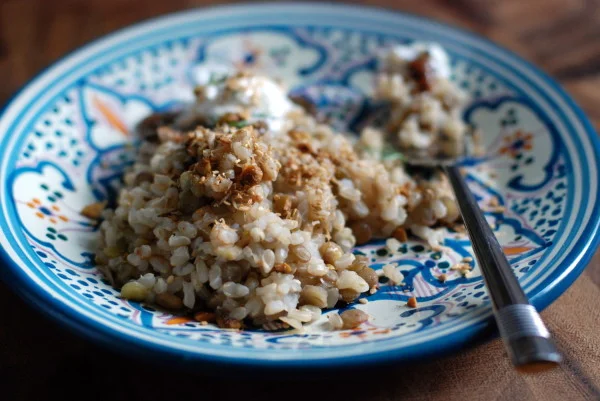
1-DSC_1165-600x401.jpg

And looking through photos for this post, I realized that I managed to make a rather astonishing amount of food while the kitchen project was underway. I owe you homemade chilaquiles (with homemade tortilla chips that are easy, really!), a walnut cake, and the best chocolate tart I've ever made, scouts' honor. Let's get to it.

Lentils and Rice with Dukkah and Tamarind Sauce
Adapted from a couple recipes on Food52
Serves 4 as a main, 6 as a side

For the rice and lentils:
1 1/2 cups (scant 10 oz.) brown rice
1 cup (7 oz.) green lentils

For the sauce:
2 tablespoons coconut oil (or substitute vegetable oil or ghee)
1 tablespoon nigella seeds
1/4 cup tamarind puree
3 teaspoons brown sugar
1/2 teaspoon salt

For the dukkah:
3 tablespoons coriander seeds
1 tablespoon cumin seeds
1/2 cup shelled pistachio nuts
1/4 cup sesame seeds
3 tablespoons unsweetened shredded coconut
1 teaspoon sea salt
1/2 teaspoon freshly cracked black pepper

For serving:
Yogurt
Chopped cilantro, fennel fronds, minced chives, or another green herb

Make rice and lentils: Fill a large pot with water, add a big pinch of salt, and bring to a boil over high heat. Add rice, and cook for 35-40 minutes, until rice is cooked through but retains its bite. 10 minutes into the cooking time, add lentils; the two should be done at about the same time. Drain and set aside.

Make the dukkah: Toast coriander and cumin seeds in a small skillet over medium heat until fragrant, about 2 minutes. Allow spices to cool completely before transferring to a spice grinder or mortar and pestle and grinding. Transfer ground spices to a mixing bowl.

Meanwhile, roast nuts in the same small skillet until golden, about 5 minutes. Transfer to a cutting board and finely chop. Transfer to mixing bowl. Add sesame seeds to the skillet and toast until golden brown, about 2 minutes, then transfer to mixing bowl. Finally, toast coconut in the skillet, stirring constantly until golden, about 2 minutes. Add to mixing bowl. Add salt and pepper, and adjust spices/s&p as needed.

Make sauce: In the same skillet, heat oil over medium heat. Add nigella seeds and cook for about 1 minute; they might sputter a bit, so be careful. Remove from heat. Add tamarind puree and brown sugar (again, might sputter), stirring to combine. Add salt and combine. Taste and adjust salt/sugar as needed.

To serve: Scoop a portion of rice and lentils onto a plate. Drizzle with a spoonful of tamarind sauce, sprinkle with dukkah, and top with a dollop of yogurt and a pinch of herbs.
In gluten-free, main dishes, vegan, vegetarian, healthy
5 Comments

Tuscan Kale and Chickpea Soup

October 20, 2014 Rivka
1-DSC_0694.jpg

I have a (very cynical) theory that for every 10 vegetarian soup recipes out there, 9 of them had authors who sneaked in some chicken stock when no one was looking. I often read these recipes incredulously: you're telling me your meatless soup is deep and complex, and yet it contains no miso, no tomato paste, no porcini mushrooms, no smoked anchovies - no umami whatsoever. Heck, it doesn't even have much in the way of spices. This all seems mostly impossible.

But as I'm not coming to find, there are magical exceptions to this rule. There are owners of a certain restaurant in Brooklyn by the name of Franny's, which I have love-love-loved for a very long time, who make pretty much everything turn to gold. They are experts at pasta and pizza; masters of crostini and of fritti, those fried bites that start a meal. Well, no surprise: it turns out, they're pros at soup, too.

Making a vegetarian soup taste complex and flavorful absolutely requires attention to detail and process; this soup has steps. But, as usual, I did find a couple of shortcuts that'll make this soup use fewer pots and take less time. That said, as written, this probably isn't an ideal choice for a make-and-eat weeknight supper situation. I made a double recipe last weekend, and it lasted us much of the week. Fortunately, this is a soup that improves over time. I also suspect that it'd freeze beautifully, and I'm making a third batch this, the whole of which I'll be freezing for some very theoretical time down the road when time is more of the essence.

1-DSC_0703.jpg

Speaking of said time: lots of you have emailed and commented to check in on preggo and bebe. Thank you so, so much. It's the home stretch around here. The babe is in position and ready to go. We've managed to not find out the sex (though this morning's appointment nearly spoiled that - be careful!), and I'm really glad we kept it under wraps; I think it's changed the nature of our anticipation. I thought this stage would be full of wondering and theorizing about what the kid will be like; instead, since that's a total mystery, I've been thinking a lot more about how we'll be as parents. I'm happy not to know more yet; I'm happy to be patient. (I'm also happy to be enjoying a not-at-all small number of peaceful restaurant meals with the lady and with friends; if only I could log them for later.)

The other good news about this phase, at least for my meat-loving wife, is that I've been clearing out the freezer of space-hoggers like spare ribs. In honor of our anniversary, I stovetop-smoked them for about an hour, then let them melt away in a low oven . The whole process was way easier than it sounds. Tutorials here and here, recipe inspiration here, if you're interested. We served them with some very good BBQ baked beans, which I'll tell you about one of these days.

Thinking more about those ribs, I'm happy to have the dregs of my last batch of this soup in the fridge. It'll make a healthy, filling supper.

Good to counteract those apple cider doughnuts I made this weekend, which I'll tell you about later this week. Till then -

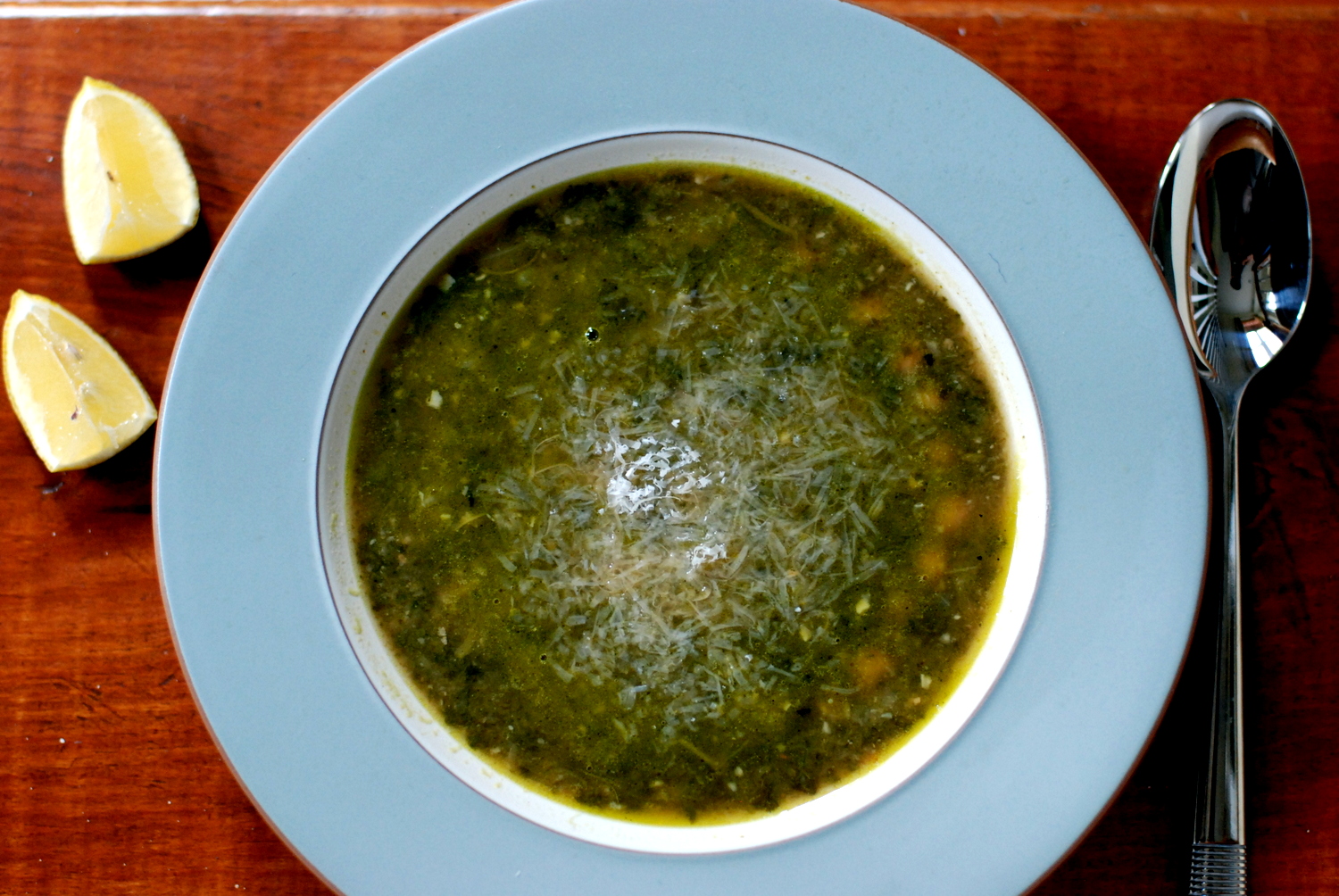
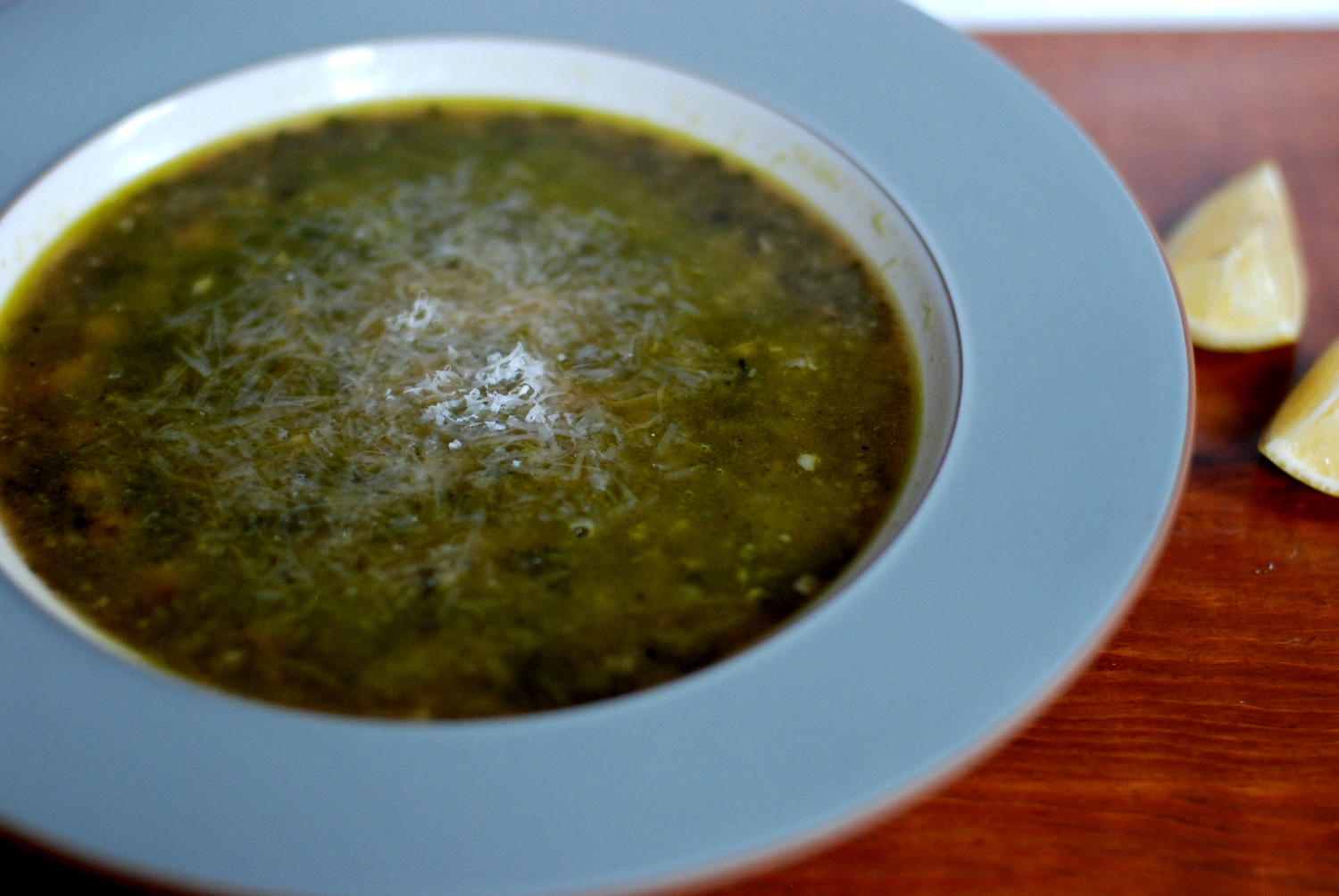
Franny's Kale Chickpea SoupAdapted from Franny's: Simple Seasonal Italian Serves 8

On my shortcuts: I skipped the cheesecloth sachet, of course. Instead, I diced the onion small enough that it disintegrated into the soup; I cut the carrot and celery just in half, for easy removal; and the rosemary sprig was easy enough to find and remove. You're also supposed to put 3 garlic cloves in the sachet, but since garlic is such a prominent flavor in the soup anyway, I didn't see the harm in leaving them in there. I'm pretty sure 2 of the 3 found their way into the blender with the portion that got pureed, and I ended up with one of them in my bowl, all smooth and melty, which was delightful. I also sauteed the rest of the garlic in a pan big enough to accommodate the kale, saving one pan in the process. I'm sure you're wondering whether you can make this with canned chickpeas, and while I'm sure you can, I'm also sure the cooking time helps marry the flavors and textures of this soup. Still, I know time is of the essence. If you try it with canned chickpeas, will you report back?

One more note: this soup is pretty perfect as is, but I did just want to note that it works well with greens other than kale. I haven't tried it with collards and probably wouldn't start there, since they can taste a bit chalky after a long liquidy cook. That said, beet greens, in particular, are fantastic in this soup. So if you have a small bunch of kale and a big pile of greens from those beets, don't hesitate to make this.

And one tiny other thing: 1 cup of olive oil. A lot, yes, but not the 1 1/2 cups originally called for, and also not really that much, at 2 tablespoons per serving. Disagree? Think about the fact that most cookie recipes call for 2 sticks butter. That's a cup right there. I've already cut the amount of olive oil by 1/3 - don't skimp further. If anything, be more generous if you feel so inclined.

2 cups dried chickpeas
1 carrot, peeled and cut in half
1 celery stalk, cleaned and cut in half
1 onion, halved (or diced, if you don't want to fish it out with the carrot and celery; see note above)
11 garlic cloves, peeled
5 strips lemon peel
1 sprig rosemary
1 tablespoon kosher salt, more to taste
3 1/2 quarts water
1 cup extra-virgin olive oil, divided; more for drizzling
1/4 teaspoon chili flakes
2 big bunches Tuscan kale or beet greens Freshly cracked black pepper Lemon wedges, for serving
Grated Parmigiano-Reggiano cheese, for serving

Put the chickpeas in a medium bowl, cover with at least an inch of water, and let soak overnight.

In a large pot, combine carrot, celery, onion, 3 garlic cloves, lemon peel, rosemary, 1/2 cup olive oil, 1 tablespoon salt, and the 3 quarts water. Bring to a boil over high heat,  then reduce the heat to medium-low and simmer until the chickpeas are tender, about 1 hour (more if chickpeas are old). Taste at the end of cooking, and add more salt as needed.

Meanwhile, finely chop or (faster!) crush the remaining 8 garlic cloves. Remove the center ribs from the kale and coarsely chop the leaves (you should have about 16 cups, but if not, no stress). Set up your blender and have the blender canister at the ready.

In a large skillet, heat 1/4 cup olive oil over medium heat. Add the garlic and chili flakes and cook until the garlic is fragrant but not golden, about 1 minute. Transfer to the blender canister (it's okay if some is left in the pan). Immediately add 1/3 of the kale, toss to combine, and cook, tossing occasionally, until tender, about 3 minutes. Transfer cooked kale straight into the blender. Add 2 tablespoons of olive oil and another 1/3 of the kale, and cook in a similar manner, transferring to the blender when cooked. Repeat with the last 2 tablespoons olive oil and the last batch of kale.

When the chickpeas are cooked, fish out the carrot, celery, rosemary, and onion if not diced. Then scoop 2 cups of them and their liquid into the blender with the kale, and puree until smooth. Add this puree back to the pot with the rest of the chickpeas, and cook over medium-high heat until hot.

Serve with grated Parmigiano-Reggiano, a drizzle of olive oil, and lemon wedges on the side.

In appetizers, comfort food, gluten-free, soup, vegan, vegetarian, healthy
Comment

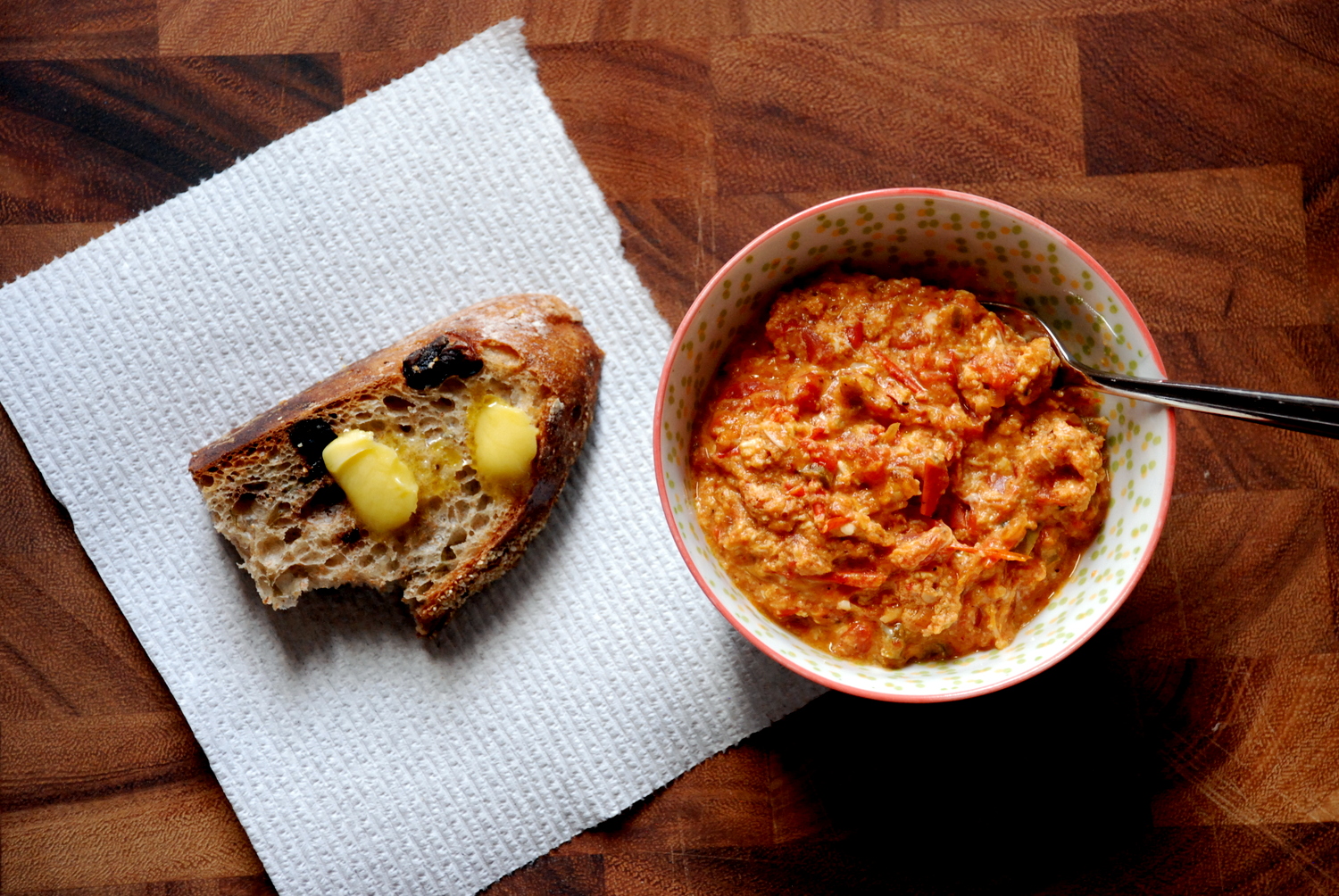
Menemen - Turkish Eggs with Tomatoes and Peppers

October 14, 2014 Rivka
1-DSC_0308.jpg

It must have been 2005 when I first fell for shakshuka, the Israeli dish of eggs fry-poached in a spicy, oniony tomato sauce. For a few years, I obsessively sought it out at restaurants; eventually, I taught myself to make it at home. There are a few places - like the kitschily named but legit Dr. Shakshuka, in Tel Aviv - that make it consistently well: their whites are always set, their yolks perfectly runny, every time. Back when I lived in Jerusalem, there was a little cafe near my apartment that I loved, but that had a problem with runny whites in their shakshuka. It was either that or a hard yolk, and I wanted neither - so I learned to ask for my eggs "mikushkashot" - scrambled. They happily obliged, and I wound up with soft-scrambled eggs in that same punchy sauce. Don't tell anyone, but I've always liked my invented version better.

At the time, I thought shakshuka was something unique that you could only find in Israel. I should have known better: nearly every wonderful "Israeli" food, from falafel to shawarma to hummus to labneh, was cribbed from another Middle Eastern culture. Shakshuka is no exception; it's originally from North Africa, or so I understand from Google. And now, of course, it's on trendy menus all over the country. Shakshuka has hit the big time.

1-DSC_0301.jpg

Israel isn't the only copycat. It seems every culture has its own name and nuanced method for cooking eggs in tomatoes. There's the classic Eggs in Purgatory (...is it a classic? I did a bit of poking for historical origins of the dish, and aside from finding several mentions of "Catholic" and "uovo in purgatorio," I came up short), and some folks have added more chile and renamed the dish Eggs in Hell. But the version I've come to love more recently is called Menemen, hailing from Turkey, which is basically the hacked-up version of shakshuka I've been ordering and making all along. Apparently, I didn't invent it after all. But all the good cooks steal ideas from each other, so the copycat badge is one I'm proud to wear.

Like shakshuka, menemen is a dish you'll like more if you make it your own. My brother and the internet have taught me that some like their menemen chunky - with defined pieces of egg, tomato, and pepper - and others like the dish reduced to almost a custard, where everything sort of blends together. I'm not quite at the point where I can control exactly how it comes out, but I tend to make it - and like it - somewhere between the two extremes.

According to my bro, the best menemen has a good mix of tomato and pepper, and plenty of egg - which, in Turkey, doesn't always happen; eggs are more expensive than vegetables. His favorite menemen also keeps the tomatoes on the slightly liquidy side, which I also enjoy (though it makes cooking the eggs a bit more challenging). And - shock! - he likes his menemen with beyaz peynir, which is like a mild feta, or tulum, a grassy Turkish goat's milk cheese. And plenty of pul biber, a Turkish condiment of chile and salt.

1-DSC_0304.jpg

So that's the fully-loaded version. But I tend to keep things pretty simple: onion, tomato, pepper, some chile, eggs. A hunk of good bread to sop everything up. That's a happy morning in my book.

I broke the news to my brother that I'd be posting about menemen, and he said he'd try to get me a menemen set the next time he goes to Turkey. Who knew there were menemen sets? Turns out, because you're supposed to serve it in the same dish in which you cook it, there are beautiful stove-safe bowls - made of hand-formed metal - specifically for menemen. I'd love to get my hands on one of those eventually, but for now, a good old skillet and bowl do the trick.

What's your favorite way to eat eggs and tomatoes? You know you have one - now share it.

Menemen - Turkish Eggs in Tomatoes and Peppers Serves 2

Like all egg dishes, menemen is deeply personal. I like my peppers to retain some crunch; I prefer my tomatoes a little runny, even though it makes cooking the eggs harder; and I like my eggs less custardy, with some defined curds. With both personal preferences and stoves so idiosyncratic, it seemed silly to offer cooking times. I've done it anyway, but more important are the signs that my menemen is ready for the next step. Those trump cooking times here. If you want your peppers/tomatoes/eggs firmer or softer, then by all means. Make this dish your own.

2 tablespoons olive oil
1/2 a small onion, diced
2 long green (non-spicy) peppers, seeded and chopped (or substitute a bell pepper)
2 large tomatoes, chopped
2 eggs
salt z
1/2 teaspoon of your best semi-spicy red pepper flakes - ideally Turkish or Aleppo pepper
cheese, olives, more pepper, parsley, or whatever else you'd like to incorporate (optional)
crusty bread (less optional)

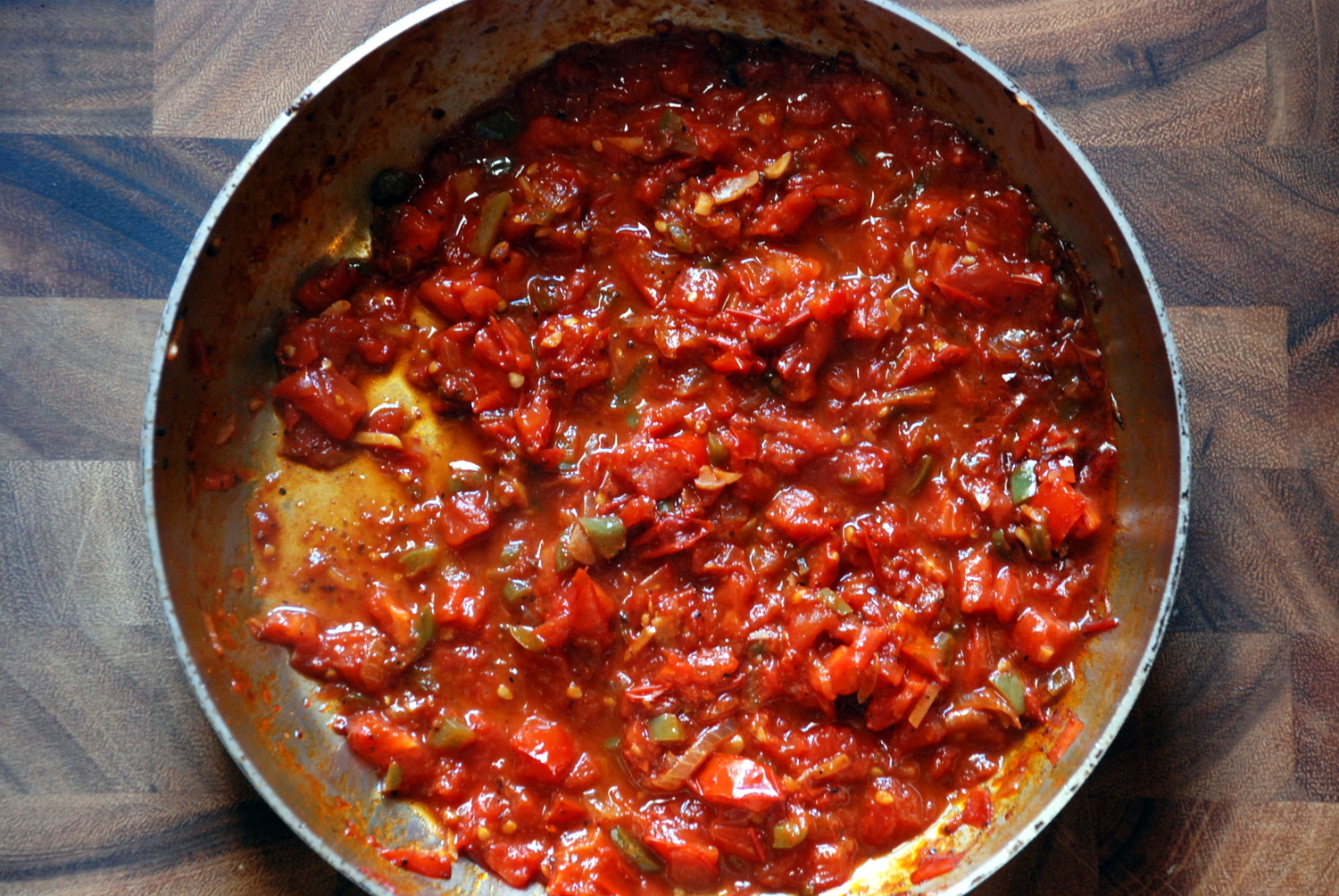
Add the olive oil to a large frying pan (stainless steel, cast iron, and non-stick all work) and set over medium heat. Add the onion and peppers with a pinch of salt. Give a few tosses, and cook until onions take on light color and everything smells fragrant but peppers are still somewhat firm, about 3 minutes.

Add tomatoes, another pinch of salt, and the pepper. Give a good stir, and let them cook until much, but not all, of their liquid has evaporated and they look saucy, about 4 minutes more.

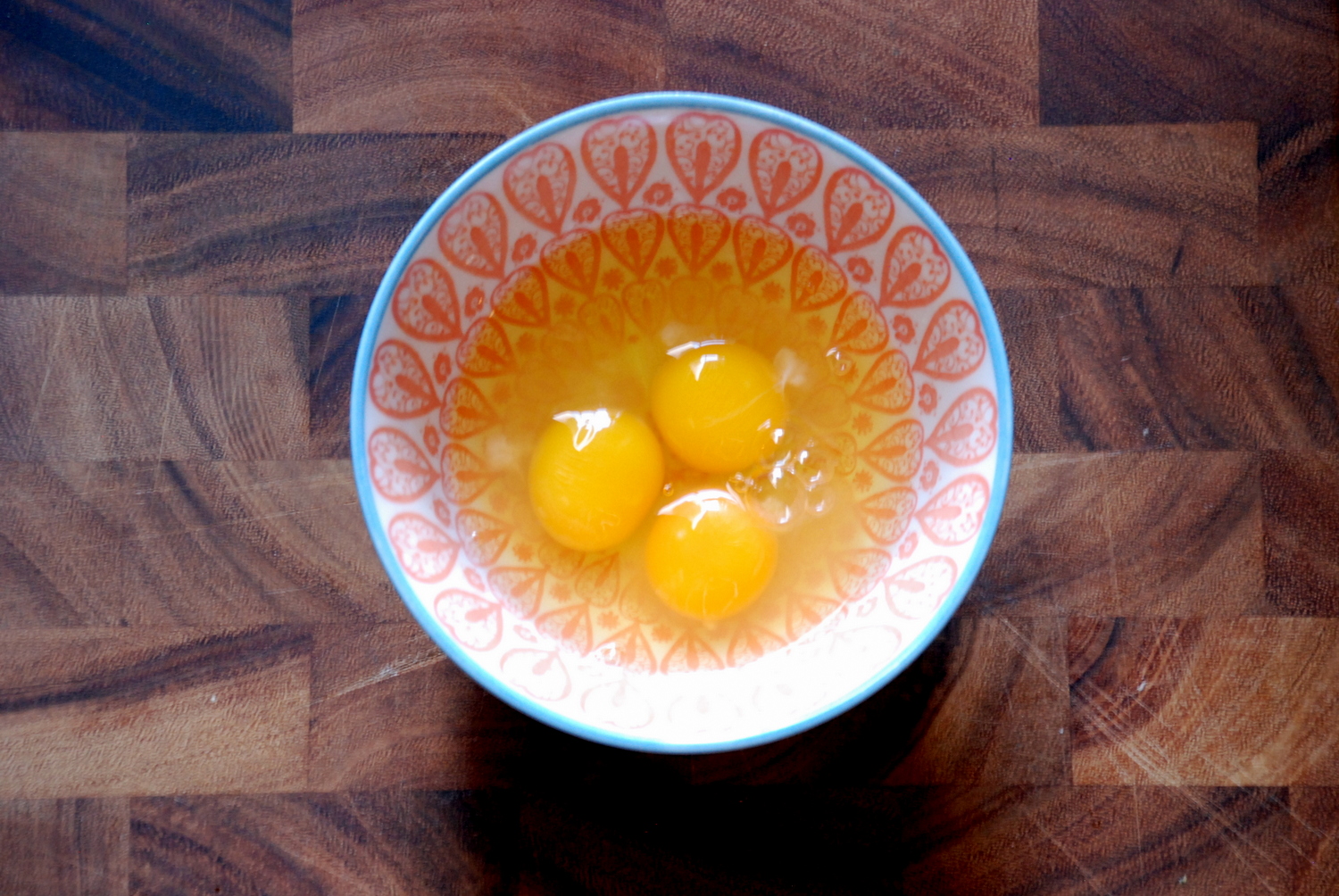
Lightly beat eggs with a pinch of salt in a small bowl. When tomato mixture is ready, add eggs all at once, and use a wooden or silicone spatula to gently fold them into the tomato mixture. Because I like curds in my menemen, I take care to fold them only occasionally; if you prefer a more uniform dish, you can stir it slowly but continuously. Either way, you're looking for the whites to almost cook through. They should be basically opaque when you plate the menemen, as they'll continue cooking for a few seconds off the heat, but not much. If you prefer very runny eggs (and the uncooked whites don't bother you), you can add the eggs, stir a few times to incorporate, and transfer the menemen to bowls almost immediately. Your choice.

Serve menemen with any of your preferred fix-ins, and crusty bread on the side.

In breakfast and brunch, gluten-free, vegetarian, easy, healthy
-1 Comments

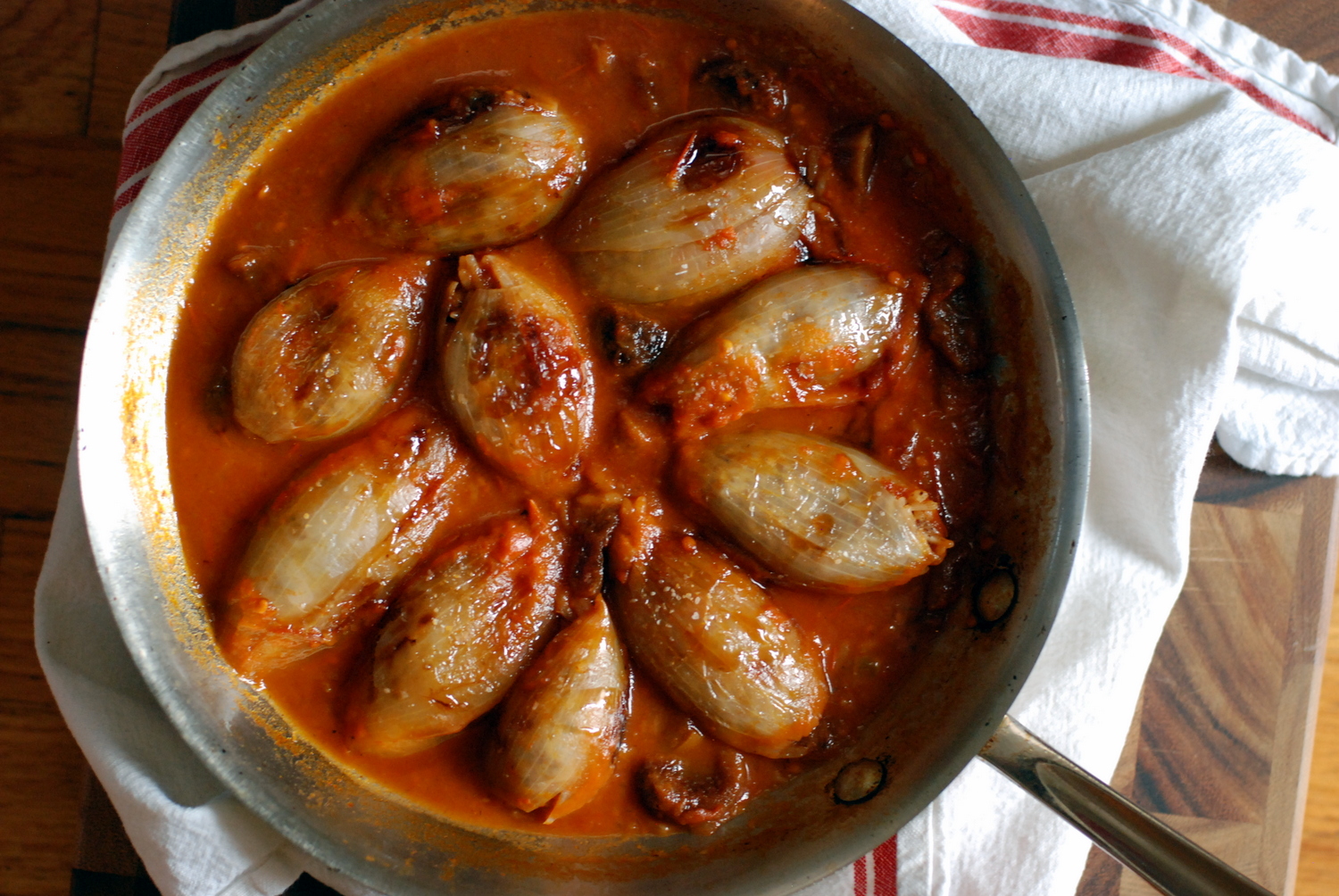
Persian Stuffed Onions + Rosh Hashana Menus

September 17, 2014 Rivka
1-DSC_0816.jpg

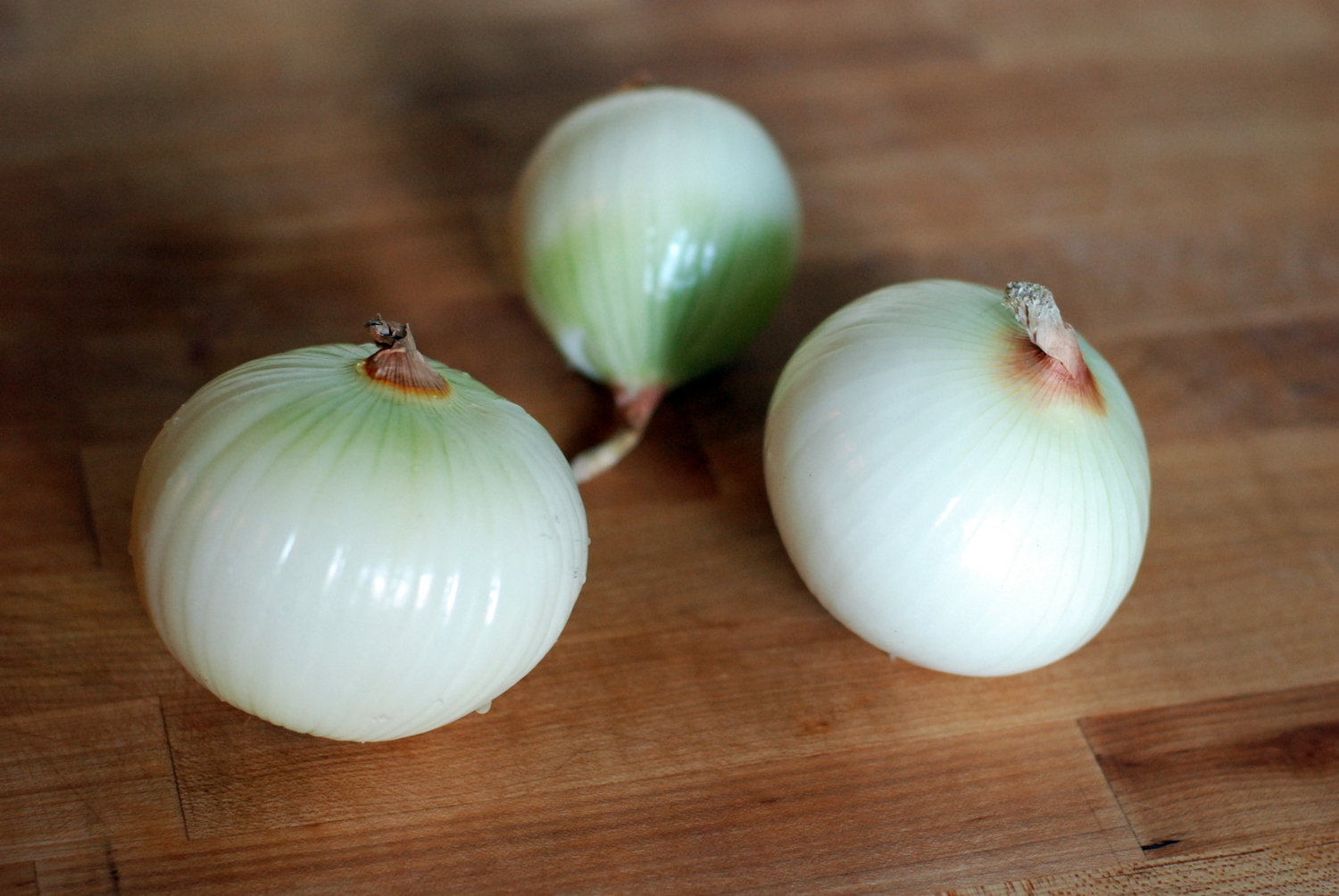
This recipe isn't exactly my culinary Mount Everest. It's more like, say, pilates: the thing I know I'd like if I did it but can't quite get it up to try. Let's break it down: there's the separating of onions into layers, which looks at the outset like a royal pain. There's the filling, which involves meat and lots of spices and raw rice, which - would it really cook in the sauce? I couldn't be sure. And of course, there's that sauce, which calls for tamarind puree, which I don't always have just lying around the house. In sum, enough reasons to look longingly at a picture of the finished product, then turn the page -- again, and again, and again.

Perhaps we should chalk it up to the refreshed ambition that comes with the turn of a new year. Or perhaps, a more likely story, I'm looking down the road a couple months and seeing little other than nursing, and diaper changing, and maybe fingerscrossedplease some sleeping, but not a lot of cooking. Whatever the impetus, I had been convinced. If ever there were a time to see whether Persian stuffed onions are worth the fuss, it was now.

1-DSC_0749.jpg
1-DSC_0760.jpg

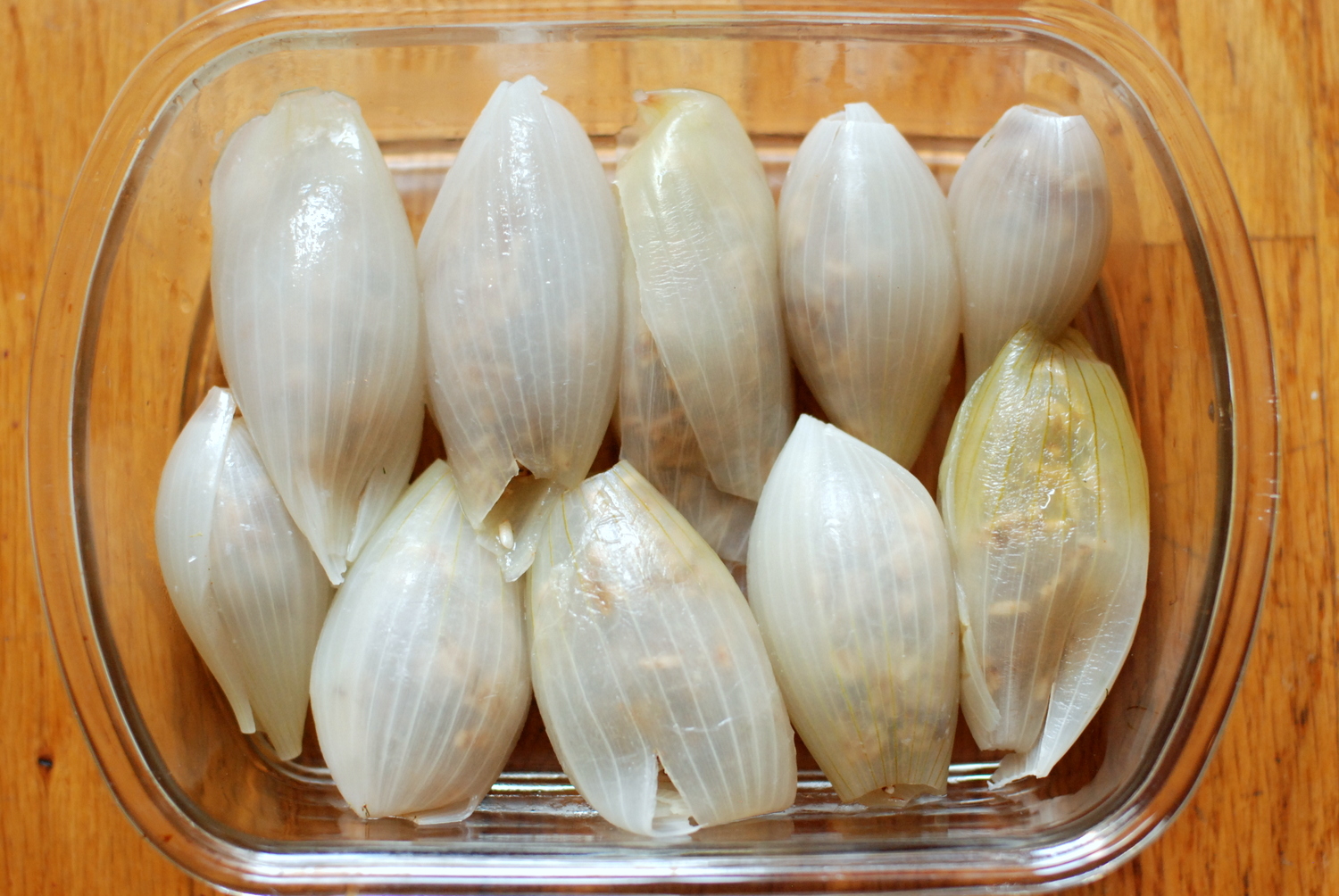
And you know what? They really are worth the fuss. First of all, they're not such a fuss. The onions, once boiled, are soft enough to separate easily. If you tear one of the layers (who me?), it doesn't matter in the least. The filling, which always looked like a pain, is actually quite the opposite: turns out, you don't need to cook it before stuffing the onions; it just cooks in the broth. (Lesson: snap judgment < actually reading the recipe.) And best of all, you can freeze the onions stuffed and uncooked, then bake them off at a later date. I'll be making a massive batch of these to stow away for the road ahead.

1-DSC_0782.jpg
1-DSC_0796.jpg
1-DSC_0805.jpg

Rosh Hashana Menu Planning: I've always flirted with Persian flavors for Rosh Hashana. For a few years running, I've served a main course of brisket with tamarind, and I almost always have some sort of sweet-sour vegetable to serve alongside. But this year, instead of just nodding toward the East, I'm building the entire menu around it.

The sweet and sour flavors of Persian cooking have always drawn me in. That they're so friendly to pomegranates, squash, and other fall produce only makes my job easier. So a couple weeks back, I started digging through The Food of Life, my guide to Persian cuisine, in search of ideas. I've settled (at least for now) on the following menu for dinner:

  • Deb's Fig and Olive Oil Challah
  • Persian Sumac Soup with Chickpea Dumplings (see Joan Nathan write all about those chickpea dumplings here)
  • Greens with Apples, Black Lentils, Celery Root, Walnuts, and Mustard Vinaigrette (a riff on this and this)
  • Tamarind Brisket (this year with lots of wine in the broth, because why not?)
  • Persian Stuffed Onions
  • Green Beans and Beets with Orange Segments and Sumac Vinaigrette
  • Apples and Honey Cake
  • A sorbet (either apple-bourbon, maple-almond, or a riff on one of these)

What are you making? I'd love to see your favorite recipes and menu ideas below - let's get the juices flowing.

Meanwhile, happy cooking, and happy new year. I hope the coming months are full of new adventures for all of us.

Persian Sweet and Sour Stuffed Onions Inspired by recipes in The Food of Life and Aromas of Aleppo Serves 4 as a main, 6 as a side dish

I'll be making two versions of these for our Rosh Hashana dinner: one vegetarian, one with ground lamb. I've given instructions for both versions below. One important note: the ratios here are hard to nail precisely, because every onion is different, and I don't know how many layers your onions will have. You are very likely to find yourself with either extra onion layers or extra filling after making this recipe. Don't sweat it. If you've got extra onion layers, dice them and add them to the sauce. If you have extra rice, cook it in a bit of broth and eat as a chef's snack, or freeze it for another time. Lastly, because the quantities vary so much, you may want to double the recipe, just to be safe. Leftovers freeze very well uncooked, and can be baked off and eaten at a later date.

For the vegetarian version:
3 large or 4 medium yellow onions
1 1/2 cups long-grain rice
1/2 cup golden raisins, chopped
1 tablespoon dried dill
1 teaspoon dried mint
1 teaspoon cinnamon
1/2 teaspoon ground cumin
1/2 teaspoon ground cardamom
1/4 teaspoon ground cloves
1 teaspoon salt
2 teaspoon pomegranate molasses
2 teaspoons tomato paste

For the meat filling: All of the above, but use only 1 cup of rice 1/2 pound ground lamb (or beef)

For the sauce:
2-3 tablespoons olive oil
1 1/2 cups tomato puree
2 cups vegetable or chicken broth
2 tablespoons tamarind puree or 2 teaspoons pomegranate molasses
2 teaspoons brown sugar
1/2 teaspoon cinnamon
1/4 cup dried apricots, coarsely chopped
1/2 teaspoon salt

Prepare the onions: Bring a large pot of water to a boil over high heat. Meanwhile, use a paring knife to trim the very tip off of the non-root ends of the onions, and to scrape away the dry outer layers from the onions. Any layer that is even partially dried should be removed. Take care not to stab the onions' flesh, and leave the root end of the onions intact.

Add the onions to the boiling water, and simmer for 20 minutes (25 minutes for larger onions) until flesh is very soft. Strain onions and set aside to cool. (To accelerate cooling process, transfer onions to an ice bath to cool.)

Prepare the filling: Soak rice in cold water for 30 minutes. Strain rice, then combine all ingredients - including raw ground meat, if using - in a large bowl. Use a fork or your fingers to ensure that everything is evenly distributed.

Stuff the onions: Fill a medium bowl halfway with water. I find it easiest to store the onion layers in water while working, so they don't dry out. Set up a plate, tray, or other container to hold your filled onions.

Take an onion in your hand, with the ends at top and bottom. Use the paring knife to slice a deep slit from end to end, cutting through about three layers of onion. The carefully remove the layers of onion, using your fingers to separate each layer. If a layer rips, don't sweat it - you can always patch over it once stuffed. Transfer onion layers to the bowl of water. If you can remove more sizable layers from the core of the onion, slice deeper with the knife and remove more layers. If not, set the core aside. Repeat with remaining onions.

Take an onion layer in your palm, fill it with a heaping tablespoon of filling, and wrap the layer around itself, loosely enclosing the filling. You want to leave room for the rice to expand, so don't wrap the layers too tightly. Transfer the filled onion layer to your plate or tray, and continue filling remaining layers of onions, lining them up on the tray as you go.

Freezing the onions: At this stage, you can wrap the filled onions tightly and freeze them for a few months. Thaw completely in the refrigerator before proceeding.

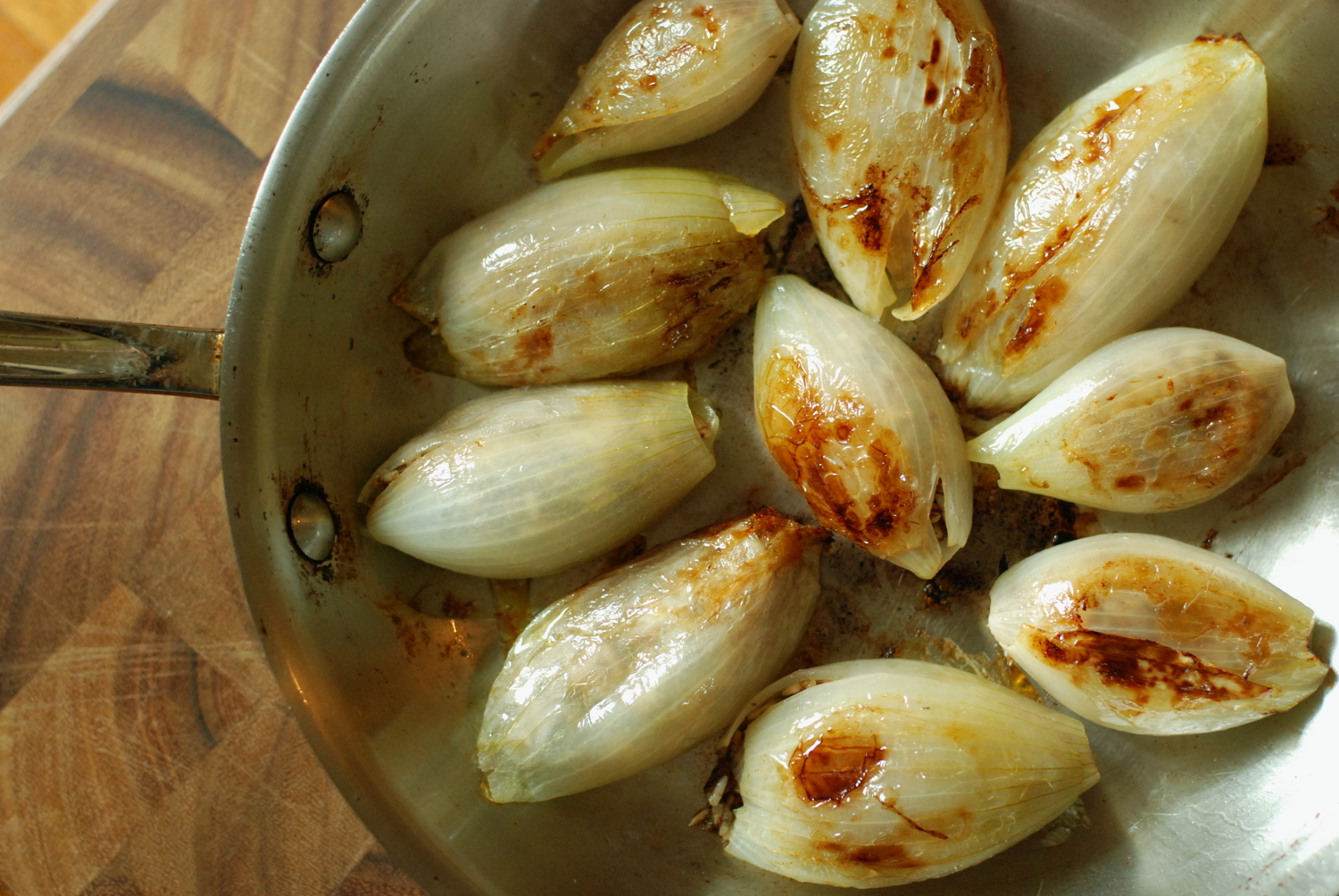
Cook the onions: Depending on the size of your pan, you may need to brown the onions in batches. If using a large roaster, all onions should fit in one batch. If using a sauce pan, brown the onions in 2-3 batches, using one tablespoon of the olive oil for each batch.

Pour olive oil into a large deep sauce pan or ovenproof roaster, and set over medium heat. When oil shimmers, carefully transfer as many stuffed onions as will fit in the bottom of the pan. Cook for 3-5 minutes, until golden, then turn and cook another 3-5 minutes on the other side. If using a sauce pan, transfer browned onions back onto your tray, and repeat with remaining onions until all onions have been browned.

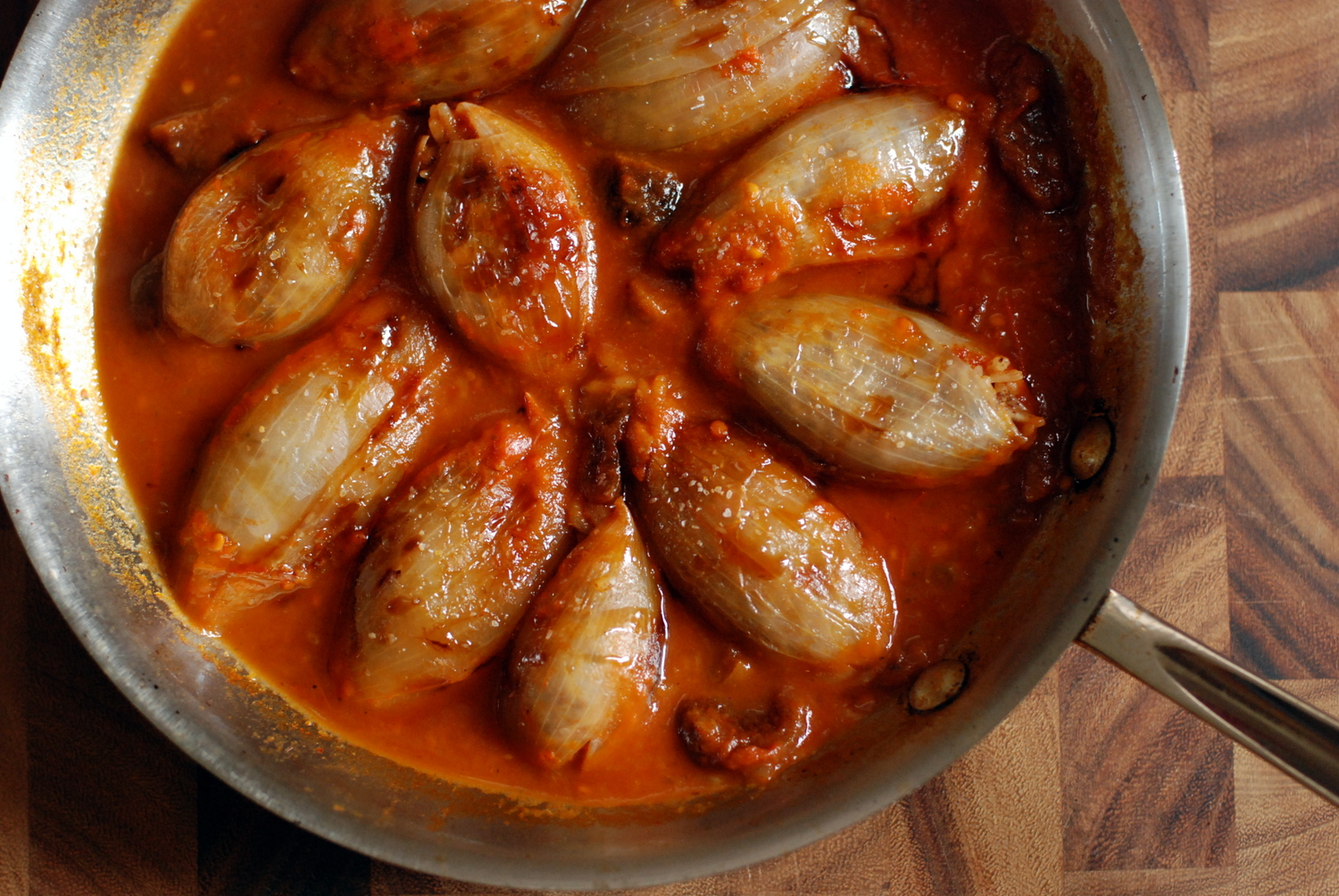
Once all onions have been browned, make your sauce in the bottom of the same pan - no need to remove the onions; they'll be cooking in the sauce. Add all the sauce ingredients, shake the pan a bit to distribute the ingredients, give a little stir around the onions to help blend the sauce, and add any onions from the tray back into the pan. Cover with a lid or tin foil, and simmer over medium-low heat for 20 minutes, until broth has thickened and filling has fully cooked. Check at the halfway point: if your stove is very powerful, your liquid may evaporate more quickly, in which case you may need to add a few tablespoons of water to keep things moving. Feel free to add as much water as you need to keep the broth from sticking.

After 20 minutes of simmering, slice into an onion layer to ensure that everything looks fully cooked; if not, add another few tablespoons of water, shake to distribute, and cook another 5-10 minutes.

Serve hot, with sauce ladled over onions.

In gluten-free, menus, sides, vegetarian
-1 Comments
Older Posts →
No results found

Subscribe by email:

  • books (1)
  • crisps and crumbles (1)
  • frozen (1)
  • toys (2)
  • gifts (3)
  • egg whites (5)
  • fried (5)
  • how to use--- (6)
  • drinks (10)
  • menus (11)
  • travel (11)
  • fish (12)
  • kosher for passover (14)
  • thanksgiving (14)
  • vegan (20)
  • snacks (21)
  • techniques (21)
  • soup (26)
  • bread (28)
  • pies and tarts (28)
  • cake (33)
  • events (34)
  • condiments (36)
  • various and sundry (39)
  • uncategorized (42)
  • cookies and bars (46)
  • weekday lunch (47)
  • appetizers (48)
  • salad (51)
  • gluten-free (56)
  • comfort food (61)
  • breakfast and brunch (77)
  • sides (81)
  • dessert (90)
  • main dishes (100)
  • healthy (139)
  • easy (155)
  • vegetarian (180)

| LATEST |

Featured
Blue Chair Fruit's Black Raspberry Jam

One Saturday night a few weeks ago, friends tipped us off that Butler's Orchard had snap peas and blueberries and black raspberries all ready to go at once. Needless to say, we canceled all other plans for the next day, and by 8:30 am Sunday morning, we were off to the races. 

Blueberries are awesome to pick with an 18-month old. They free from the bush easily, they're plentiful at toddler height, and us oldies can reach the higher ones and save our backs while the kid gets the low-hanging fruit. We came home with 5 pounds of blueberries, 5 pounds of black raspberries, and stains just about everywhere.

Read more →
Thai Grapefruit Salad

If you've seen me in the past few weeks and expressed even vague interest in Asian food and/or cooking, I've probably bored you to tears gushing on about the best cookbook of the year (IMHO), 101 Easy Asian Recipes. The title is both accurate and a bit tongue-in-cheek, since it makes the book sound like something fusion-y and inauthentic and terrible, when in fact, it inauthentic, and unabashedly so, and wonderful. The back of the book has big speech bubbles boasting "100% inauthentic" and "very good" and "easy, really." It's fab.

The book comes from Peter Meehan, who has worked with David Chang (Momofuku) and Danny Bowein (Mission Chinese) for years, co-authored the Momofuku cookbook, and now edits Lucky Peach magazine. He's clearly a meticulous guy who gets how Asian food works -- the balance of flavors, the precision with cooking times, etc. But this book takes a step away from the "this has 500 ingredients/steps, but it's worth it"-style of recipes, opting instead for formulas that follow two important ground rules: no deep-frying, and no recipes within recipes. The rationale: Asian food isn't just for Sunday projects, it's for weeknight dinner with kids. Good bless you, Peter Meehan. 

Read more →
Mango Sticky Rice
Mango Sticky Rice

've had this Thai glutinous rice sitting in the bottom of my cupboard for months, but never quite worked up the guts to make it into something until, a few  weeks ago, the waiter at our little Laotian spot in the neighborhood told me that sticky rice may be the easiest thing on their menu to make at home. That doesn't necessarily say much, considering the menu includes items like crispy rice salad (involving rice that's cooked, mixed with other stuff, formed into balls, deep-fried, broken into pieces, and tossed with a gazillion other ingredients, which I know only because I've made it and whoa, pain in the butt doesn't even start). Still: "easier" was motivation enough not to let that rice sit untouched.

Read more →
Winter 2016: Odds and Ends

Not a full post today, but a bunch of odds and ends that I've been meaning to share.

Marmalading: That's what kept me out of trouble and away from insanity during our two-ish weeks of hibernation under an impenetrable and, apparently, unplowable 30 inches of snow. (Attention DC officials: occasionally, it snows here. Surprise! Buy another plow or two.) Fortunately, my fridge was chock-full of citrus you've never heard us, because Cathy went to Texas for a marathon series of cooking classes, and her trip coincided with Central Market's wonderful Citrus Festival, and she is a goddess and a wonderful friend and a crazy lover of citrus like yours truly. (I paid her in Barcelonian anchovies, yes). For most of last weekend, our home smelled like a heavenly mix of chartreuse hot cocoa (thank you Pam!) and boiling citrus peel. Not shabby. Not shabby at all.

Read more →
Povitica: The Best Babka Ever

It's snowing! It's snowing! THE APOCALYPSE IS COMING! I hope you bought flour and sugar. I hope you happen to have walnuts in the house. Yes? Wonderful.

Meet my latest, love, the Povitica. It comes from my other latest love, the Great British Baking Show. If I may, for just a moment, evangelize on its (the show's) behalf, it is the sweetest, coziest little food show on television. Contestants do their preparation in advance, and come to weekly competition with dog-eared copies of recipes they’ve developed. If someone runs behind, others pitch in to help out. Even the hosts of the show sometimes provide assistance. There’s a lot of smiling and hugging, absolutely no product placement, and so much Englishness, you won’t know what to do with yourself. It's Victorian sponge for miles.

Don't let the coziness fool you: each episode brings a "bake" more ambitious than the last.  There are hot-water pastries and raised yeasted loaves, tiered pies and sculptured cakes. There are desserts you’ve never heard of, from Germany and Poland and France and Croatia, which if you saw in a cookbook might give you pause: lots of ingredients, pages of instruction, no sense of what the thing is supposed to look like if baked correctly. But when a bunch of (okay, very accomplished) home bakers give these recipes a go, under the pressure of a short timeline a televised competition, you watch them, and you think, yeah, maybe I could do that. One minute I’m watching the show, then next, I’m all I must have this in my oven now. That is why last week I up and baked a dobos torte, just because. And then this week, I got baking shpilkes  again, so I went totally mad and baked my beloved povitica.

Read more →
Persimmon Walnut Bread

This is a happy-accident story, but it doesn't start that way. This past fall, I was determined to make hachiya persimmons into smooth, spiced butter. But each time I tried, I created something so ruined, so mouth-dryingly inedible, that I had to dump the entire thing. I did this too many times. cough three.

Fuyu persimmons are sweet and crunchy. They can be eaten as you would an apple. Hachiya persimmons are not as friendly. If you buy them hard, you must wait to eat them, or you will take a bite and your entire mouth will turn dry and chalky, like what tannins in wine do to your mouth but unpleasant, a thousand times unpleasant. To avoid this, you must tend to your hachiyas: put them in a paper bag, set them somewhere warm but not too warm, encourage them to ripen but protect them dutifully against spoilage. Hachiyas can be eaten when they are soft all over, and plump like a balloon. At that point, their astringency goes away, leaving behind soft, floral-flavored flesh that's wonderful as is, or in dozens of baked goods.

The catch, though, is that if even one bit of the persimmon hasn't reached that perfect stage of ripeness, its astringency will infiltrate and ruin whatever you're making with it. This is especially true in the case of butter, where the persimmons are cooked together and then pureed. And so it was for me, time after time, I found persimmons, coddled them to ripeness, cooked them, blended them, tasted them, cursed, and tossed the mixture into the trash. So wasteful, so frustrating. There must be a better way.

Read more →
Sprout Chaat Salad + New Site!

I want desperately to tell you all about this chaat-style salad I've been making almost daily, but it's probably rude to offer guests something to eat without first saying hi, so: 

Hi! I've got a new home.

Not Derby Pie is still there - go see for yourself - but it was time for a fresh start. I never really had the technical wherewithal to manage my own website. I faked it pretty well for 8 (!) years, but with every automatic Wordpress update, my site would break a little bit more – the header, gone! the comments, gone! etc – and late last year, I finally decided I needed a full reboot.  So, here we are: From now on, I'll be sharing new recipes over here, at rivkafriedman.net. 

I used Squarespace to build this site, and I hope you love its clean interface as much as I do. The search function is simpler, the design is 100% mobile-friendly, and I've managed to haul all of my old posts over to this new home, with only minor glitches in spacing and captions and whatnot. I'm 90% of the way there. The biggest issue is that ingredient lists in recipes transfer as a block, not a list. You may see some other minor formatting issues for a little while longer. If a recipe looks particularly garbled, you can always find it back on NDP.

New year, new start. I'm so excited to finally share this with you.

Now then, onto business. 2016's first sprouts are ready for a salad.

Read more →
Maple Walnut Squares

I know it's almost Christmas, but I'm about one month behind (on everything) and right now, I need to commit a tiny act of Thanksgiving blasphemy. I tell you this: the best dessert I ate on Thanksgiving was not pie.

By 7 pm the evening of the holiday, our house was full of neighbors who had decided to stay local. Our table was overflowing with pies, many of which our friends had brought: a glistening, lattice-topped sour cherry pie; several bourbon/brandy-filled pumpkin pies; a gorgeous rendition of Deb's chocolate tart with gingersnap crust (a slice of which I carefully set aside for myself, which my unsuspecting and always-cleaning lady accidentally threw away, *sob*) and many more. I tried too many; I loved them all. But I think my favorite bite of all was a slice of these maple walnut squares.

Read more →
How to Give Thanks
How to Give Thanks
Read more →
Croissants (really, I made croissants) + other croissant-ish things
Read more →

| hEALTHY |

Featured
Sprout Chaat Salad + New Site!

I want desperately to tell you all about this chaat-style salad I've been making almost daily, but it's probably rude to offer guests something to eat without first saying hi, so: 

Hi! I've got a new home.

Not Derby Pie is still there - go see for yourself - but it was time for a fresh start. I never really had the technical wherewithal to manage my own website. I faked it pretty well for 8 (!) years, but with every automatic Wordpress update, my site would break a little bit more – the header, gone! the comments, gone! etc – and late last year, I finally decided I needed a full reboot.  So, here we are: From now on, I'll be sharing new recipes over here, at rivkafriedman.net. 

I used Squarespace to build this site, and I hope you love its clean interface as much as I do. The search function is simpler, the design is 100% mobile-friendly, and I've managed to haul all of my old posts over to this new home, with only minor glitches in spacing and captions and whatnot. I'm 90% of the way there. The biggest issue is that ingredient lists in recipes transfer as a block, not a list. You may see some other minor formatting issues for a little while longer. If a recipe looks particularly garbled, you can always find it back on NDP.

New year, new start. I'm so excited to finally share this with you.

Now then, onto business. 2016's first sprouts are ready for a salad.

Read more →
Fennel frond pesto + what to do with those pesky stalks
Read more →
Asparagus Toasts with Pistachios and Mint
Read more →
Eggplant-Walnut Pâté + Passover Ideas
Read more →
1-DSC_0861-600x401.jpg
Best Mushroom Pizza (or any white pie, really)
Read more →
Lentils and Rice with Tamarind Sauce and Dukkah
Read more →
Big Kale Salad with Pomegranate and Feta
Read more →
Punchy Crunchy Ginger Salad
Read more →

| BreakfAST |

Featured
Povitica: The Best Babka Ever

It's snowing! It's snowing! THE APOCALYPSE IS COMING! I hope you bought flour and sugar. I hope you happen to have walnuts in the house. Yes? Wonderful.

Meet my latest, love, the Povitica. It comes from my other latest love, the Great British Baking Show. If I may, for just a moment, evangelize on its (the show's) behalf, it is the sweetest, coziest little food show on television. Contestants do their preparation in advance, and come to weekly competition with dog-eared copies of recipes they’ve developed. If someone runs behind, others pitch in to help out. Even the hosts of the show sometimes provide assistance. There’s a lot of smiling and hugging, absolutely no product placement, and so much Englishness, you won’t know what to do with yourself. It's Victorian sponge for miles.

Don't let the coziness fool you: each episode brings a "bake" more ambitious than the last.  There are hot-water pastries and raised yeasted loaves, tiered pies and sculptured cakes. There are desserts you’ve never heard of, from Germany and Poland and France and Croatia, which if you saw in a cookbook might give you pause: lots of ingredients, pages of instruction, no sense of what the thing is supposed to look like if baked correctly. But when a bunch of (okay, very accomplished) home bakers give these recipes a go, under the pressure of a short timeline a televised competition, you watch them, and you think, yeah, maybe I could do that. One minute I’m watching the show, then next, I’m all I must have this in my oven now. That is why last week I up and baked a dobos torte, just because. And then this week, I got baking shpilkes  again, so I went totally mad and baked my beloved povitica.

Read more →
Croissants (really, I made croissants) + other croissant-ish things
Read more →
Mushroom and Kale Breakfast Strata
Read more →
Barley Porridge with Orange and Black Sesame
Read more →
Ramps 'n' Eggs Biscuit Sandwiches
Read more →
Asparagus Toasts with Pistachios and Mint
Read more →
Apple-Cheddar Scones with Sage
Read more →
Menemen - Turkish Eggs with Tomatoes and Peppers
Read more →
You must select a collection to display.

© 2016 Rivka Friedman. All Rights Reserved.