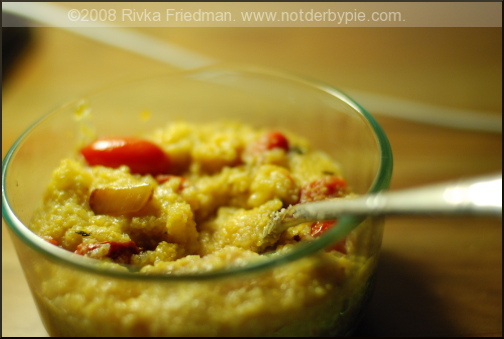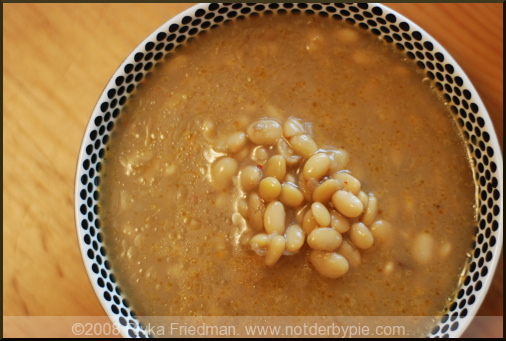
Beans in Broth with Caramelized Sweet Potato

beansbroth Have I told you about Rancho Gordo? Having read too many articles about the joys of dried beans, I teamed up with my officemate and we ordered a shipment. Now, under my counter, I've got a healthy supply of them, including rio zape, tepari, mayocoba, garbanzo, and borlotti.

I've always loved beans. (It's tough not to when you grow up in a vegetarian house.) And I won't lie: nothing beats the convenience of canned beans. If you won't take it from me, take it from Adam: I couldn't agree more that in a pinch, canned kidney bean chili or canned garbanzo bean hummus tastes just great. But canned beans are on the mushy side, and they taste like salt. If I can spare the time and manage the advance prep, it's wonderful to bite into toothsome beans for dinner -- and nothing beats controlling your own seasoning.

Like I said, dried beans can't be made in a flash. They need to be soaked overnight, rinsed, and then simmered for at least a couple hours to achieve optimum texture. If you can manage the time, though, you'll see that dried beans have better texture and distinctive flavor, even when prepared uber-simply. Last night's dinner is a case in point.

Yesterday was a super cold day; I knew I'd want something warm and comforting for dinner, but I didn't want to use any meat products, so my frozen beef-broth cubes were out of the question. I'd put some beans in soaking water that morning, so that was a start. My normal inclination would be to dump the kitchen sink in a pot and hope it turned out well, but I've been thinking a lot about the value of restraint when seasoning food. Sometimes, the simplest dishes are the tastiest. How would my beans taste if instead of seasoning them with beef broth and 20 spices, I used water and 5? I decided that now was the time to try a minimalist bean dish.

On my way home, I did a quick mental-survey of my kitchen and remembered a lonely sweet potato in the bowl on the dining room table. As soon as I got home, I turned the oven to 350, wrapped the sweet potato (skin on) in old foil and tossed it in. I'd leave it there until the beans were done; by then, it'd be nice and caramelized, with a custard-like texture.

Meanwhile, I took 1 cup of soaked tepari beans (small, like cannellini) out of the fridge, drained them, and rinsed them a couple times. In a medium pot, I sauteed 2 chopped shallots in 2 Tbsp. of olive oil. To that, I added 1/2 tsp. coriander seeds, 1/2 tsp. smoked paprika, 1/2 tsp. aleppo pepper (chili flakes would work), a pinch of saffron, and 1 bay leaf. I stirred all this around for a couple minutes, then added the beans, stirred to coat with the seasoning, and added 3 cups of water. I turned the heat down to medium-low, and left the beans to simmer, covered, for about 2 hours, adding more water as necessary. In two hours' time, the spices mingled, and the beans released some of their own flavor as well. There was plenty of extra liquid, which formed a lovely pot liquor scented with coriander, smoked paprika, and, well...beans. I poured some into a bowl, added half of the sweet potato with its wonderful caramel-brown skin, got myself a spoon, curled up on the couch, and went to heaven. Amazing.

Beans in Broth with Caramelized Sweet Potato

(As I said, this recipe is simple, but truly amazing. So amazing, in fact, that I failed to take a picture of the finished dish. You'll have to let your imagination kick in here.)

1 sweet potato 1 cup tepari or other small white beans 2 shallots, chopped 1/2 tsp. aleppo pepper 1/2 tsp. smoked paprika 1/2 tsp. coriander seeds pinch saffron threads 1 bay leaf 3 cups water

Wrap sweet potato, skin-on, in foil and toss in the oven. Turn on to 350 or 400 degrees (we're flexible), and just let it rip. Give it at least an hour; the longer, the better. I left mine in for about 2 hours and 15 minutes, and it was as soft as custard.

Pre-soak beans overnight or for at least 3 hours in water that covers them by at least an inch. Drain and rinse; set aside.

In medium pot, saute 2 chopped shallots in 2 Tbsp. of olive oil. Add 1/2 tsp. coriander seeds, 1/2 tsp. smoked paprika, 1/2 tsp. aleppo pepper (chili flakes would work), and 1 bay leaf. Stir to incorporate, then add the beans, stirred to coat with the seasoning, and add 3 cups of water. Turn the heat down to medium-low, and leave the beans to simmer, covered, for about 2 hours, adding more water as necessary.

When beans are fork-tender but not mushy, pour a serving into a bowl with some of the bean broth, and add half the cooked sweet potato. If desired, top with grated parmesan cheese (though I didn't).

"Too rich and dark" chocolate pudding

chocpudding1 A while back, I made some chipotle chocolate pudding parfaits. Humbly speaking, they were pretty darn awesome. At least, I thought so. D? Not so much. She prefers snack packs, I guess. But I don't give up so easily. There's no way those gelatinous, tasteless pudding packs can beat homemade chocolate pudding. Armed with my best chocolate (callebaut 70%), organic whole milk, and a little bit of love, I set out to make chocolate pudding that D might like.

"It's too dark and rich," she said. Really, I can't win around here.

Too dark and rich? What does that even mean? No such thing. This chocolate pudding is dead easy, practically foolproof (see my note in the recipe about avoiding lumps) and relatively healthy, compared to butter-filled sweets. It calls for whole milk, but it'll work with any kind, even skim. And if you don't love your puddin' super-sweet, omit 2 Tbsp of the sugar. Anyway you make it, this pudding is a fantastic dessert/snack. I don't bother to scoop it into ramekins: I just cool the whole thing in the fridge, and occasionally dip a spoon in when I'm craving something sweet after dinner.

chocpudding2

While I'd really like to get D off the snack packs, I guess the fact that she doesn't like my pudding just means there's more for me.

Silky Chocolate Pudding Adapted from John Scharffenberger, via Smitten Kitchen Serves 6

Note: I think I figured out a way to avoid lumps from forming. Instead of adding the milk all at once, add a little bit of it first -- enough to make a very thin paste. Stir with a whisk to break up all the little lumps, and when it's completely emulsified, add the rest of the milk.

1/4 cup cornstarch 1/2 cup sugar 1/8 teaspoon salt 3 cups whole milk 6 ounces 62% semisweet chocolate, coarsely chopped (I used good quality chocolate in block form, and just chopped it up; use 70% bittersweet if you want more of a dark chocolate kick) 1 teaspoon pure vanilla extract (2 Tbsp. rum, optional) (1/2 tsp. chipotle, optional)

1. Combine the cornstarch, sugar and salt in the top of a double boiler. Slowly whisk in the milk, scraping the bottom and sides with a heatproof spatula to incorporate the dry ingredients. Place over gently simmering water and stir occasionally, scraping the bottom and sides with a whisk. After 15 to 20 minutes, when the mixture begins to thicken and coats the back of the spoon, add the chocolate. Continue stirring for about 2 to 4 minutes, or until the pudding is smooth and thickened. Remove from the heat and stir in the vanilla.

2. Strain through a fine-mesh strainer (or skip this step if you’re a slacker like me who is absolutely certain that there is nary a lump her puddin’) into a serving bowl or into a large measuring cup with a spout and pour into individual serving dishes.

3. If you like pudding skin, pull plastic wrap over the top of the serving dish(es) before refrigerating. If you dislike pudding skin, place plastic wrap on top of the pudding and smooth it gently against the surface before refrigerating. Refrigerate for at least 30 minutes and up to 3 days.

Polenta with Tomatoes, Shallots, and Goat Cheese

polenta1 Forget Rachael Ray, with her hoarse voice and her annoying little mannerisms. I'll show you a 30 minute meal -- better yet, a 15-minute meal -- that'll have you at the table before you can say "EVOO". It's called polenta, and it's really flippin' easy. You can actually make it more quickly than I can write this post. And while I've included the recipe for polenta with tomatoes, shallots, and goat cheese, you can easily make it with something else. As always, I've listed several variations.
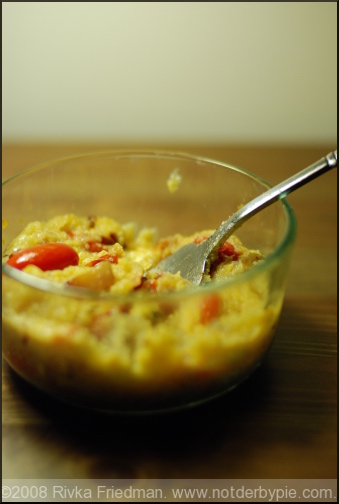
Polenta is basically poor man's food: it's simple, it's cheap, it's sustaining, and it's dead-easy to make. All you need is cornmeal, salt, and water -- ohh, and a fair amount of muscle for all the stirring you'll be doing.

The method is simple: heat the water til warm, add polenta. Stir til your hand wants to fall off, then a little more. For soft polenta, you'll be stirring about 7ish minutes, maybe 8. It's done when it's just past al dente and well-emulsified. For a firmer polenta, you're done when the polenta pulls away from the sides of the pot, about 10 minutes.

polenta2

Here are some flavor variations:

- Pears, Gorgonzola, a squeeze of honey and some pecans or walnuts - Feta cheese, basil, and tomatoes - Red peppers and pesto - Cheddar cheese (I like white) and apple slices quick-sauteed in a tab of butter - salt and pepper (polenta is awesome on its own) - Mushrooms, parsley, and parmesan (my all-time favorite)

Before I give you today's recipe, I need to give a (long overdue!) shoutout to one of my favorite new bloggers on the scene. Not a food blogger -- thought her posts will totally make your mouth water -- my dear friend Sarah has recently moved back east from the great city of Seattle with some serious talent under her arm and more than a few tricks up her sleeve. She's got a fantastic blog devoted to spoken word poetry, and she will KNOCK YOUR SOCKS OFF with her poems, for serious. I dare you to check out this blog, and you'll see exactly what I'm talking about. Even the title is so frickin' great: Remember When I Had a Blog. Do yourself a favor: add Remember When to your list of reads and prepare to be blown away!

Also, a just-added shoutout to awesome friend-of-friend Ashley, who's recently started a super cool business called Green Eyed Monster. She sells canvas tote bags that are friendly both to your shoulder and to the environment, and they have awesome logos -- you MUST check them out!

Now, the recipe you've been waiting for:

Polenta with Tomatoes, Shallots, and Goat Cheese

2 cups water 1 cup milk 1 cup yellow polenta (cornmeal) 2 shallots, chopped 2 Tbsp. olive oil 1 cup grape tomatoes, halved 1/4 cup of goat cheese, crumbled into bits 2 tablespoons unsalted butter 1/4 cup freshly grated Parmiggiano-Reggiano cheese

In a small sauce pan, heat olive oil over medium heat. Add shallots, and saute until translucent, about 3 minutes. Add tomatoes, and cook until they look a bit bloated and have begun to soften. Add herbs, if desired -- basil, thyme, parsley, or marjoram would all be lovely. Saute two minutes more, then remove from heat.

Meanwhile, in a medium pot, heat salt, milk and water until hot but not boiling. Add polenta in a steady stream, stirring vigorously to avoid lumps. When all the polenta is added, bring heat up to a boil, then reduce to a simmer and continue stirring constantly for about 7 minutes, until creamy looking. Turn off heat, add butter, and stir to incorporate. Stir in tomato-shallot mixture and goat cheese; stir gently to combine. Serve with freshly-grated Parmiggiano-Reggiano cheese.

Apricot-Stuffed French Toast

stuffed-french-toast-1 The third installment of "what's for [catered] brunch?" begins with a tip on cooking for a crowd. When cooking for a crowd -- especially if it's folks you don't know personally -- I always try to size up the guests during the menu-planning stage, so that I can be sure I'm cooking dishes that'll go over well, even if I don't care much for them. When Rocco DiSpirito was on Top Chef a couple weeks back, he announced (inappropriately, if you ask me) that he loves bacon; every chef but one presented a bacon dish. The chef that didn't actually made something that sounded pretty tasty, but he lost because Rocco likes bacon. Also: my friend Julia regularly cooks chicken when she hosts lunch, even though she's veg, because her guests like chicken and she aims to please. It makes sense: cook for the crowd, not necessarily for yourself.

stuffedfrenchtoast2

While I don't always follow this rule, I tend to stick with it when I don't know the people I'm cooking for, as with the catered brunch from a few weeks back. And since I know that most people love creamy, gooey things, I opted for a (relatively) easy stuffed french toast recipe from Martha. It's basically thick slices of french toast that are stuffed with a mixture of apricot jam and cream cheese. Not my cup of tea, nor my mom's, but boy was it the crowd favorite. As usual, we made some key adjustments after tasting the filling, because we found the combo of cream cheese and apricot jam somewhat flat and lacking in character. A generous confetti of lemon zest and a fair sprinkle of lemon juice made all the difference. We made enough that there were three for each person; five courses notwithstanding, people did the job and polished off nearly all the french toast. Watching the guests rave, my mom and I took one of the end pieces, put it on a plate, sliced two little bites off, and each tried it. We looked at each other, bobbed our heads in agreement that it tasted as we expected, and then laughed as we acknowledged that neither of us particularly liked it. But hey, the guests were happy. More than happy.

stuffed-french-toast-4

Assuming you've got guests coming for the holidays -- or that you'll be a guest in someone's home and would like to cook brekkie one morning as a thank you to your hosts -- this is a true crowd-pleaser of a recipe. It doesn't take all too long to prepare, and it can sit happily in a low oven until it's time to eat. If the goal is happy customers, this recipe's the ticket.

stuffed-french-toast-3

PS...Donate and bid for Menu For Hope! Here's the link.

Apricot-Stuffed French Toast adapted from Martha Stewart serves 4

• 1 loaf challah, cut into eight 1-inch-thick slices • 3 tablespoons or more apricot jam or "just apricots" preserves (less sugar, more tang) • 1/4 cup (2 ounces) reduced-fat cream cheese, room temperature • 2 large eggs • 1/2 cup low-fat (1 percent) milk • 1/4 teaspoon ground cinnamon • zest of one lemon • 2 tsps. lemon juice • 1 to 2 tablespoons unsalted butter • Pure maple syrup, for serving (optional)

Directions 1. Using a paring knife, cut a horizontal slit in each bread slice to form a pocket. In a bowl, mix jam and cream cheese with a fork or hand blender. Add lemon juice and zest. Spoon 1 tablespoon mixture into each pocket. 2. In a shallow bowl, whisk together eggs, milk, and cinnamon until combined. In a large nonstick skillet, melt 1 tablespoon butter over medium-low heat. Lay half the bread slices in egg mixture, letting them soak 5 seconds on each side. 3. Place slices in skillet; cook until golden brown, 3 to 4 minutes per side. Repeat with remaining bread, adding more butter to skillet if needed. If desired, serve French toast with syrup (which we did, and we heated the syrup for maximum yum factor). We also topped the platter with a sprinkle of powdered sugar, which made for a lovely presentation.

Told you we only had a bite...