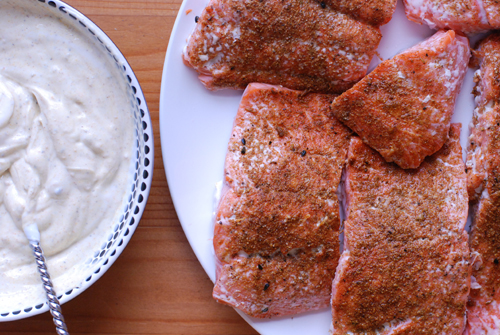
Moroccan Salmon with Curried Yogurt

Though it doesn't appear very often on this site, fish -- salmon in particular -- is a staple in the NDP kitchen. I like it because it's a substantial cornerstone of a meal without being as heavy as meat often is. I frequently host lunch on Saturdays, and I almost always cook for these lunches in advance; salmon can be served cold with a dipping sauce, obviating the need to carefully par-bake it before reheating the next day to serve. Also, it's delicious.

Last year, I frequently cooked fish "en papillote," each filet wrapped with care in its own little parcel of parchment paper. It's a very healthful way of cooking fish, in its own juices and little else. Sometimes I'd add slivers of thai bird chillies or slices of peach, but the method was always the same. This year, I'm planning to broil my fish more often. That little spot at the bottom of my oven doesn't get enough airtime, and considering its ability to make sugar into caramel and turn anything that beautiful shade of brown, it really should.

The method here couldn't be simpler. Clean the salmon and slice into individual servings (or don't, if you prefer the drama of bring a long side of salmon to the table). Season generously with salt and just about anything else. My favorite of late is Ras El Hanout, a Moroccan spice blend of nutmeg, mace, cloves, black pepper, saffron, and more (recipe below), that's mellow but still intensely flavorful. Salmon has plenty of natural fat, so drizzling oil over the fillets is optional. Either way, tuck it under the broiler for about 15 minutes, until it's just cooked through.

When it comes to serving the salmon, serve warm or chilled, and offer plenty of lemon slices. I also served a super-easy curried yogurt that comes together in a jiffy. I used a spice blend called Hawaij, a Yemenite blend of cumin, tumeric, cloves, black pepper, and more. I've included the recipe below, but you could also use a curry powder or a different spice blend.

Moroccan Salmon with Curried Yogurt serves 4

For the Ras El Hanout:

2 teaspoons ground nutmeg 1 teaspoon salt 1 teaspoon ground ginger 3/4 teaspoon ground black pepper 1/2 teaspoon ground mace 1/2 teaspoon ground allspice 1/4 teaspoon ground cinnamon 1/4 teaspoon crushed saffron threads

Blend in spice blender. Best if used within a week.

For the Salmon:

Preheat the broiler. Slice salmon into individual portions, if desired, and transfer to broiler-safe baking sheet or 9x13 pan. Season generously with salt and about 5 tablespoons of a dry spice mixture. Drizzle lightly with olive oil or dot with butter, if desired. Place salmon underneath broiler about 7 minutes, until top is browned. Transfer to oven and lower heat to 400; bake another 7-9 minutes, until salmon is fully cooked.

For the Hawaij:

6 1/2 tablespoons black peppercorns 1/4 cup cumin seed 2 1/2 tablespoons coriander seeds 1 1/2 tablespoons green cardamom pods 1 1/2 teaspoons whole cloves 3 1/2 tablespoons ground turmeric

Blend. Add two tablespoons to 1 cup yogurt and stir to combine.

Lynne Rossetto Kasper's Thai Cabbage Salad with Cashews and Chili-Coconut Dressing

Not everyday is as productive as last Friday. In about 2 hours, I made a fantastic salad, discovered a new cooking technique, and finally learned how to achieve that elusive sweet-salty-tangy-spicy balance in a Thai vinaigrette. It's all thanks to Lynn Rossetto Kasper. As if I'm surprised.

I am a huge fan of Lynn Rossetto Kasper. I'm a loyal listener to her "The Splendid Table" podcast, and I absolutely loved her pithy and clever "How to Eat Supper" podcasts, which she co-hosted with TST producer Sally Swift (until recently, when they suddenly stopped coming out...) So I'm sort of embarrassed to admit that it took me until last week to sign up for Lynn's "Weeknight Kitchen" newsletter. Now maybe it's too soon to pass judgement, seeing as I've only gotten two issues. But this is Lynn Rossetto Kasper. Every recipe is a run-to-your-kitchen recipe. As expected, just one day after the email landed in my inbox, I was at the counter, surrounded by heaps of green cabbage.

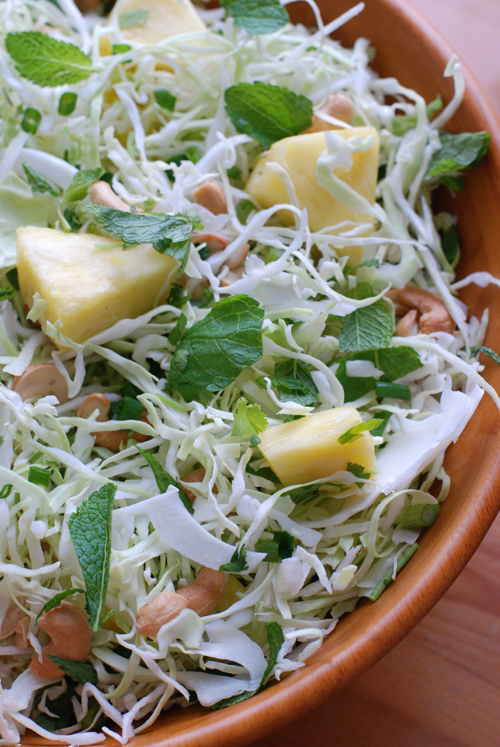
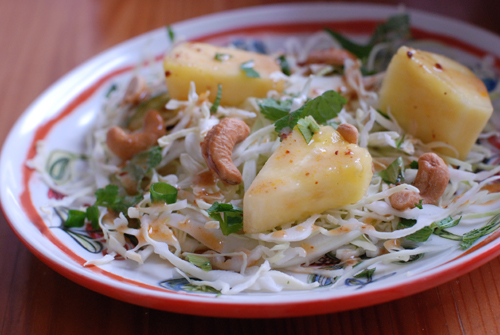
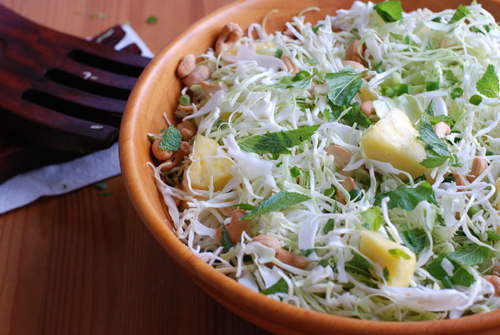
The recipe in last week's edition was for a Thai cabbage salad with tofu, cashews, and pineapple. D was quick to point out that I cut my pineapple slices so large as to intimidate my guests (sorry, ya'll! Hope the yellow didn't scare you away) so in the future, I'll make my pineapple more....welcoming. But aside from that, I found this salad delightful. It's got really well-layered flavor: the bitter freshness of cabbage, the tangy sweetness of pineapple, a generous handful of cashews, scallions and herbs, and a biting vinaigrette rounded out with fish sauce (one of Lynn's favorite ingredients: it's got tons of umami, or glutamate, which helps give that extra something to...well, almost anything.)

I threw together a small plate of this salad before serving it to make sure that the flavors were balanced. One bite led to two, then three, and before I knew it, my plate was clean. Yep, flavors were balanced alright. I've had the salad for two lunches and a dinner, and a wee bit of it is with me at jury duty today. Now go pick yourself up and make it.

Also, now that I have your attention, apologies for the shameless self-promotion, but if I can't do it here, where can I? I'm super excited to announce that I'm featured in this week's Washingtonian Blogger Beat! Check it out!

Thai Cabbage Salad with Cashews and Chili-Coconut Dressing

This dressing is truly amazing. Heating the chili in the oil really opens up the flavors (the new technique I learned), and the fish sauce is really key in rounding out this dressing: if you've never used it before, don't be afraid! It can smell funky, but the flavor is very subtle. Not one of the guests to whom I served this salad thought there was fish sauce in the dressing. Also of note: this sauce goes way beyond cabbage salad: Cook some tofu and vegetables, add this sauce, and you've got thai curry.

For the Roasted Chile-Coconut Dressing: 1/2 cup expeller-pressed canola oil (or other oil, such as safflower or grapeseed 4 generous teaspoons coarse ground Aleppo chile (I use Penzey's, which Lynn recommends), or other flavorful medium-hot to hot ground chile 4 large garlic cloves, chopped fine 1-1/3 cups coconut milk (canned is fine) 2 to 2-1/2 tablespoons Asian fish sauce 4 tablespoons sugar 1/4 to 1/3 teaspoon salt Juice of 1 to 1-1/2 large limes

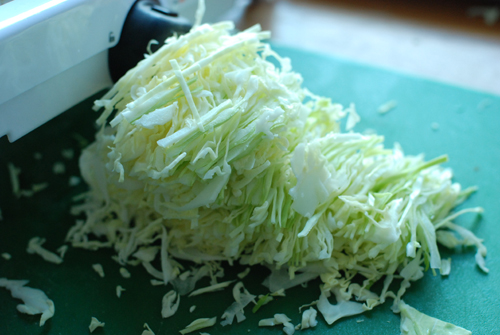
For the Salad: 3 large handfuls mixed greens 8 leaves of Napa or regular cabbage, cut crosswise into thin slivers. (If using regular cabbage, as I did slice as thinly as possible; use a mandoline if you have one) 4 whole scallions, thin sliced 1-1/2 cups bite-sized pieces pineapple, fresh, or canned in pineapple juice and drained 1/2 cup salted broken cashews, or peanuts (I like them toasted) 1-1/2 to 2 cups diced firm tofu, cooked and diced tempeh, chicken, or seafood 1/2 light-packed cup fresh mint, coriander (cilantro) or basil leaves, torn (I used mint and cilantro) Salt and fresh ground black pepper

1. Make the dressing by combining in a 12-inch straight sided sauté pan the oil, chile and garlic. Heat slowly over medium so flavors will open up but nothing will burn (about 2 minutes). Stir with a wood spatula until the garlic begins to sizzle (don't let it brown).

2. Quickly add the coconut milk and boil, stirring, for 30 seconds, or until it's a deep red-gold. Stir in the fish sauce (start with the smallest amount), sugar and salt and boil 30 seconds, or until thickened with glossy bubbles and the sauce is the color of caramel.

3. Immediately scrape all the sauce into a bowl to stop the cooking. (Sauce could be refrigerated for several days). Rinse and dry the pan and keep it handy for reheating the sauce.

4. Make the salad by blending the greens and cabbage together and dividing between 4 dinner plates. Divide the remaining ingredients between each serving, scattering them over the greens. Season the salads with salt and pepper.

5. Warm the dressing in the pan until it comes to a bubble and drizzle it over each serving. Then squeeze generous amounts of fresh lime over the salads and serve.

Syllabub

To Amanda Hesser's list of foods whose names alone command that you make them, I add this quirky dessert. Syllabub! Every time in the past two weeks I've called it by name, it's been met with total crack-up laughter. Don't you want to make it too, just to be able to say you whipped something up and it's called Syllabub? Ha.

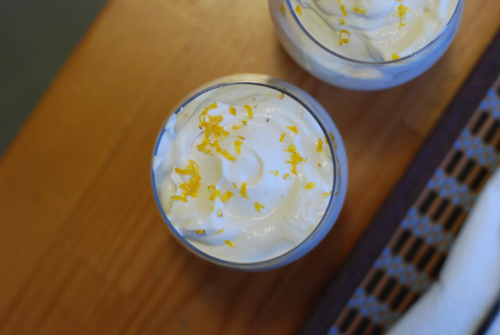
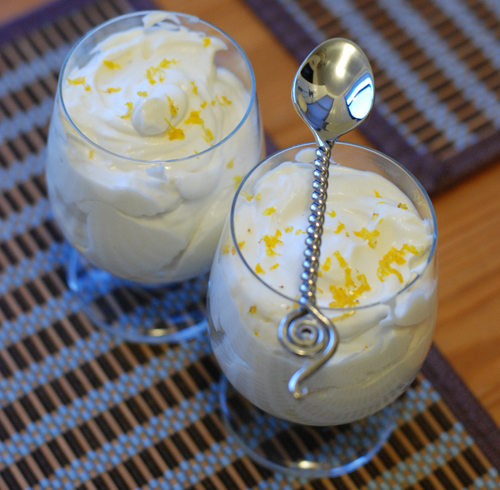
Now that I've made it, I can tell you the name shouldn't be your only motivation for giving Syllabub a whirl. I came across the recipe in an old issue of Saveur (1996, maybe?) that I was reading last weekend at a friend's lake house in Wisconsin. The picture caught my eye: a big, heavy-bottomed glass was filled to the brim with what looked like vanilla custard, topped with a bit of lemon zest and a sprig of rosemary. Intrigued, I read the piece: turns out, syllabub is basically whipping cream combined with sherry and some flavorings. Something about the alcohol or the acid of the lemon juice (or maybe both) thicken the cream without much whipping -- it's very bizarre! -- so very little, if any, work is necessary.

There's a great little anecdote in the Saveur piece about how people used to milk their cows into a bowl with some wine in it, which had the fascinating effect of thickening the cream on top while letting the whey sink to the bottom. I don't have any cows to milk, but I knew instantly that I had to make this dessert -- if only to see cream whip itself.

The result is both fascinating, and quite tasty. The sherry is joined by lemon zest, sugar, a bit of cognac, and a whisper of vanilla; they mingle overnight (or for five minutes, if you're me), and cream is added. Et voila, the perfect end to your meal. I could see layering some berries or berry sauce in between layers of the syllabub, as the cream on its own is quite rich. In terms of alcohol, don't feel bound to use sherry; I also used brandy (not just the 2 tablespoons called for, but in place of the sherry as well) and, while the final product is definitely different, it's equally tasty.

Syllabub adapted from Saveur

1⁄3 cup superfine sugar 1⁄4 cup oloroso or other sherry 2 tbsp. cognac or other brandy 2 tbsp. fresh lemon juice Zest of 1 lemon, reserve a small amount for garnish 1 3⁄4 cups plus 2 tbsp. cold heavy cream (preferably unhomogenized) Pinch of freshly grated nutmeg 4 sprigs of rosemary 1. Put sugar, sherry, cognac, lemon juice, and zest into a large bowl. Stir well, then cover and let sit out at room temperature overnight to allow the flavors to meld. 2. Add heavy cream and a pinch of nutmeg (just "a suspicion", says Day-Lewis) to the sherry mixture and whip with a whisk until soft peaks form. Spoon into 4 glasses and garnish each with a bit of lemon zest and a sprig of rosemary.

Graham Crackers

D's stepmom, Terri, has an absolute weakness for graham crackers. She says they're the one thing she absolutely can't keep in the house, because once she opens the package, she'll eat every last one. I learned this on our recent trip to Israel, and was pleased to be able to reply that in my bag, I just so happened to have two homemade graham crackers that I'd packed as a plane snack. Naturally, her eyes bulged. I bounded up the stairs and grabbed them immediately.

It had all started innocently enough: having given in several times the previous week to sugary, buttery shortbread and chocolate chip cookies and really so much more, I was determined to bake a snack that would satisfy my sweet tooth without pushing me over the edge. That whole "new year, new habits" thing has nothing to do with it, promise.

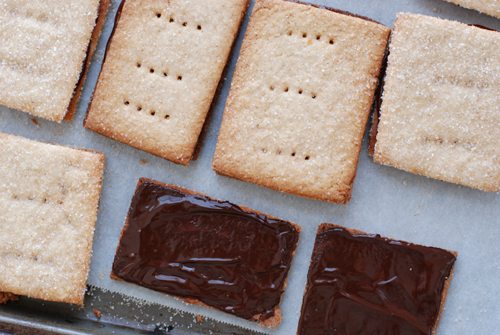
Graham crackers were the perfect choice. (They're called crackers -- how bad could they be?) I made a batch a couple days before we left; I gave a few away as holiday presents, and the rest I played around with. Some got a one-sided dunking in chocolate, others became sandwiches.

The cookies were just perfect. They were addictively crunchy, and the addition of whole wheat flour gave them a rustic, graham-y quality. And don't forget the generous dusting of cinnamon sugar to finish them off.

Now Terri wasn't all that enthused by the graham crackers, because the particular pair I'd brought were sandwiching a thick layer of intensely brown caramel, which overpowered the rather subtle flavor of the graham crackers. I liked 'em just fine, but I probably won't make them again. Graham crackers are meant to be simple, the kind of thing you munch alongside a steaming cup of tea. They satisfy a sweet craving just perfectly, no caramel or chocolate needed.

Graham Crackers adapted ever so slightly from The Washington Post

For the graham crackers

9 tablespoons plus 1 teaspoon unsalted butter, at room temperature 3/4 cup plus 1 tablespoon sugar 3/4 cup plus 1 tablespoon flour, plus more for rolling 1 1/3 cups whole-wheat flour 4 teaspoons baking powder 3/4 teaspoon salt 6 tablespoons whole or low-fat buttermilk or milk

For the topping (optional)

1 cup sugar 1 tablespoon ground cinnamon

Combine the butter and sugar in the bowl of a stand mixer or hand-held electric mixer. Beat on medium speed until light.

Combine the flours, baking powder and salt on a sheet of parchment paper or wax paper.

Reduce the speed to low; add the flour mixture, then the buttermilk, in several increments, ending with the flour; beat to form a soft dough. Divide the mixture in half, then wrap each portion in plastic wrap. Refrigerate for 1 hour or until well chilled.

For the topping (if using): Combine the sugar and cinnamon in a bowl.

Position oven racks in the upper and lower thirds of the oven; preheat to 325 degrees. Line 2 rimmed baking sheets with parchment paper.

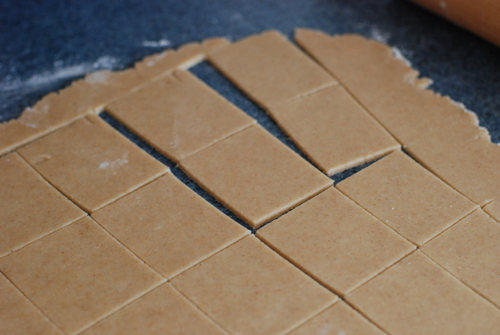
Lightly flour a work surface. Working with 1/2 portion at a time (keeping the others chilled), lightly flour the top of the dough. Roll out to a rectangle with a thickness of slightly less than 1/4 inch. Use cookie cutters to cut into shapes, or use a sharp knife and a ruler to cut the dough into 2-by-3-inch rectangles. Alternatively, use a scalloped cutter to give your cookies a wavy edge. (I did this on batch number 2.) Prick each cookie two or three times with a fork, and place the unbaked crackers on the baking sheets, spaced 1/4 inch apart. Sprinkle evenly with the topping, if using.

Bake for 6 to 8 minutes, then rotate the baking sheets top to bottom and front to back. Bake for 6 to 9 minutes, until golden brown and baked through. Let cool on the baking sheets before serving or storing.