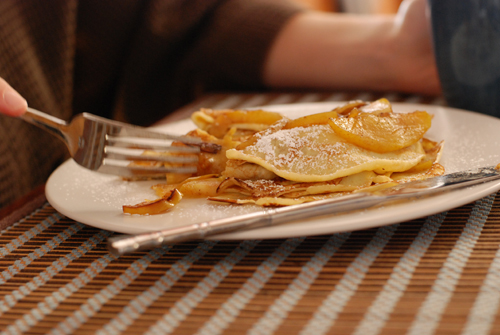
Caramelized Apple Crepes

As I write this, the view outside my window is largely white. It's been snowing for 29 straight hours here in DC, and over 30 inches have piled up on the ground. The sky is blue for the first time in two days, and people are just starting to move about outside, however cautiously. But not me. I was out last night for dinner, and out again early this morning; twice is enough for the time being. I've got oxtail stew cooling in the fridge, my sixth straight loaf of weekly no-knead bread undergoing its first rise, and raspberry streusel coffee cake on the counter. Yep -- I've been cooking up quite a storm in here. But I'll have to tell you about those another time. Right now, I can't get my mind off caramelized apple crepes.
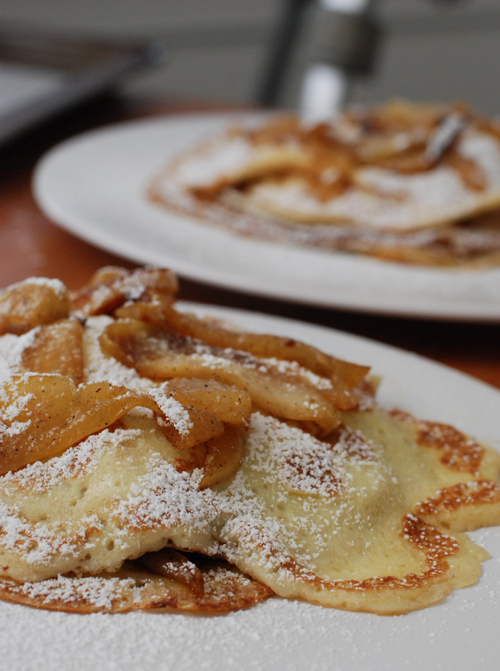
I first made these crepes the morning D and I left for Israel, and I've been dreaming about them ever since. It's well known in these parts that I have a bit of a romance with luxurious breakfasts. From blueberry hotcakes to Dutch babies to stuffed french toast and more, I'm crazy about the kind of edible Sunday morning projects that remind you, no -- you're not at work today. I've often overlooked crepes as an at-home breakfast option, but I won't be doing that anymore.

I first made these crepes the day D and I left for Israel. I knew I wanted to use up some a couple of older apples, and I had just enough milk for a crepe batter. Inspired by the "perfect pancakes" posted by sweet enough on Food52, I decided to caramelized the apples in some butter and maple syrup, then layer them between thin, floppy, crispy-edged crepes. The result? Well, it's probably obvious: delicious as all hell.
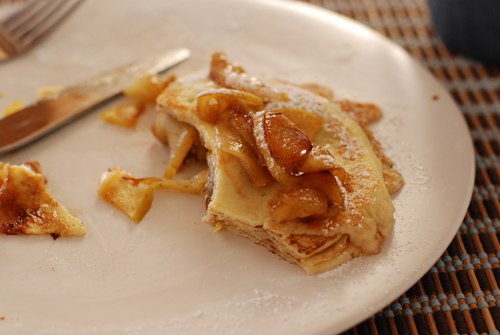
If you don't have apples, feel free to substitute pears or some other fruit. Just make sure to adjust the quantity of sugar if the fruit you use is sweet (as with pears). And maybe toss in some lemon juice along with the zest.

Caramelized Apple Crepes serves 4-5 inspired by Food52 and Alton Brown

For the apples: 2 tablespoons butter 2 tablespoons maple syrup 2-3 apples, cored, peeled, and thinly sliced

For the crepes: 2 large eggs 3/4 cup milk 1/2 cup water 1 cup flour 3 tablespoons melted butter Butter, for coating the pan

Preheat oven to 200 degrees and put a rimmed baking sheet on an oven rack.

Heat pan over medium heat and add butter. When it starts to bubble, add apples and cook until softened. Add maple syrup and cook 3-5 minutes, until fully soft and coated in butter and syrup. (Yum.)

Meanwhile, blend all ingredients for crepes in blender until well mixed. Heat small non-stick pan (or crepe pan, if you have one) and add just enough butter to coat. Using a small ladle, spoon about 1 oz of batter into pan and swirl to spread evenly. Cook about 30 seconds, then flip and cook about 10-20 seconds more. Transfer finished crepes to baking sheet in oven. Continue until batter has been used up.

To serve layer crepes with apples and top with a sprinkling of powdered sugar and a drizzle of maple syrup.
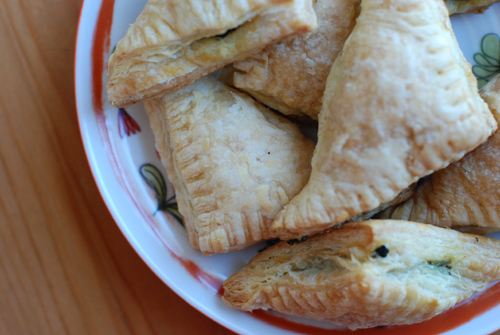
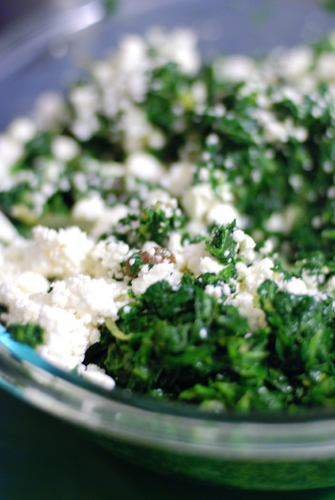
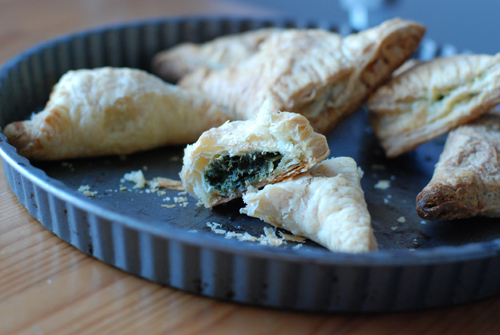
Spinach Bourekas

At some point last year, I fell off the puff pastry cliff. It all started with this onion-date tart, one of the best and easiest recipes I've ever written. I made it once, twice, three times, and more; I couldn't stop. I'd tweak a thing or two every time: I'd add mushrooms, swap the goat cheese for feta, add some roasted red peppers, etc. The tart never failed to please, so I just didn't stop making it.

From there, I branched out to other similar tarts, like this one with zucchini and olives. Why hadn't I thought of this sooner? Why had it taken so long to realize that when you pile delicious stuff on a buttery piece of dough and bake it off, the results are...delicious?

Just when I thought I'd had my revelation, D had had just about enough. She finally confessed that she hated all these tarts -- these big pieces of flaky dough meant to pose as entrees -- and that if I could stop making them, forever, that'dbegreatthanks. I was bummed: had I reached the end of puff pastry heaven so quickly? Without it, what else would I make? There was NOTHING else to make! Nothing but puff pastry! AACK!

Needless to say, I moved on. I made other delicious things like baked pastas and quiches and even the occasional (gasp!) meat dish. I moved on so well, in fact, that I actually forgot about puff pastry entirely. That is, until my friend Jeremy asked me to make some bourekas for a potluck he and his wife Beth hosted this weekend.

Given that I lived in Israel for two years, where bourekas could easily make a run against falafel, hummus, and schnitzel for the country's national dish, it's hard to believe that they haven't come up on NDP before today. I guess I don't make them as often as I'd have thought. But they're really very easy to make, they keep well and reheat like a charm, and they're as appropriate for a fancy meal as they are in a ziplock baggie.

Using the recipe below, I made about 50 bourekas before running out of puff pastry. I sandwiched the leftover filling between layers of filo dough for an easy mid-week pie that was a close relative of spanikopita.

Spinach Bourekas adapted from Ina Garten's spanikopita recipe makes about 50, plus extra filling

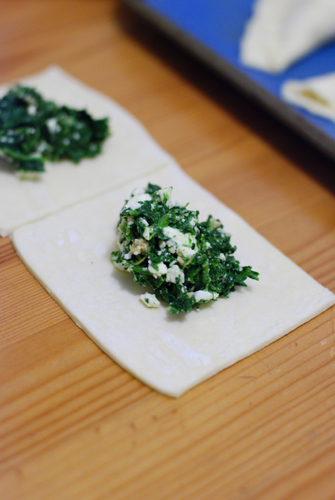
1/4 cup good olive oil 1 cup chopped yellow onion 3 scallions, white and green parts, chopped 2 (10-oz) packages frozen chopped spinach, defrosted 4 eggs, lightly beaten 3 tablespoons parmesan cheese 3 tablespoons plain dry bread crumbs 1 teaspoon freshly-grated nutmeg 2 teaspoons salt 1 teaspoon black pepper 2 cups diced feta cheese 3 tablespoons toasted pine nuts 3 tablespoons golden raisins 1 small wedge lemon 3 packages (6 sheets) puff pastry, defrosted

Preheat the oven to 375 degrees

Heat olive oil over medium heat in a large saute pan. Add onion and cook for 5 minutes, until soft but not browned. Add scallions and cook two more minutes, until wilted. Meanwhile, squeeze the water out of the chopped spinach and transfer to a large bowl.

Add cooked onions and scallions to spinach and stir to combine. Mix in eggs, parmesan, bread crumbs, nutmeg, salt, pepper, and raisins. Squeeze in lemon juice; gently fold in feta and pine nuts.

Sprinkle working surface with flour. Place one sheet of puff pastry on suface and roll it out to about 1/8-inch thick, rotating it 90 degrees after each roll to ensure that dough grows evenly and doesn't stick. Use more flour as necessary. Once dough is proper size, cut the dough into three lengthwise and three horizontally, dividing the dough into nine equally-sized squares.

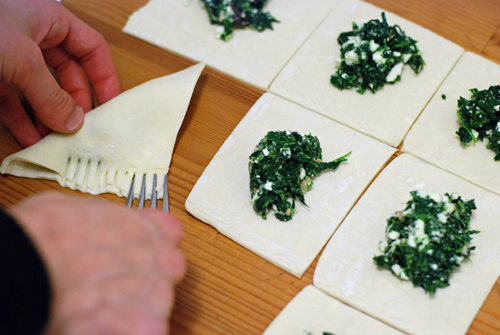
Place two tablespoons filling into the middle of each square. Dip your finger in a bit of water and run it along the edges of the square, then bring one corner its opposite corner and seal to make a triangle. Use the tines of a fork to make a decorative edge and ensure that bourekas stay shut.

Place bourekas on parchment or silpat-lined baking sheet and bake about 25 minutes, until golden on top. Serve warm or at room temperature.

Bursting Hot Tomatoes with Cheesy Breadcrumbs

There's a little game I play as fall wanes into winter. It's about tomatoes. In summer, when tomatoes are at their peak, I want nothing but to eat them -- lots of them, all the time -- in preparations as simple as can be. Don't make me pasta with tomato sauce when bursting, juicy, raw tomatoes can be had in abundance; slice up a couple, drizzle a little olive oil on top, share a pinch of salt, and I'll be on my way, thank you.

The fall tomatoes in these parts aren't half-bad, either. Some farmers -- Toigo, notably -- do a great job with the late-season fruit. But December and January (and beyond) are murky tomato territory, where the red ones are all found beneath the fluorescent lighting of your nearest grocery store, and the farmers market tomatoes tend to be green, for frying or pickling only.

Now before you let anyone tell you that supermarket tomatoes are good for nothing, I've got to chime in. I'll agree wholeheartedly that January beefsteak tomatoes are about as mealy and flavorless as they come. However, the grocery store's cherry tomatoes are passable when you really, really need them. Furthermore, there are ways to enhance supermarket tomatoes to the point that they're not just edible, they're actually kinda tasty. This is one of those ways.

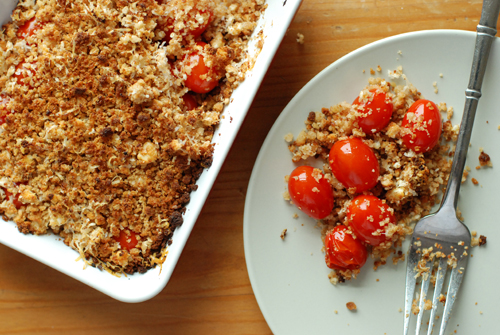
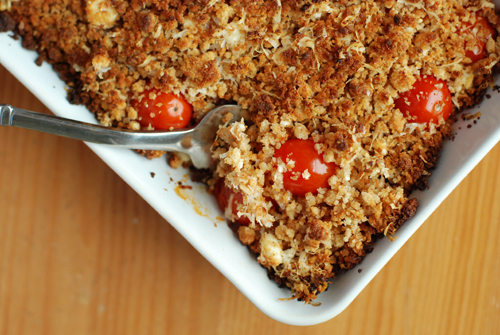
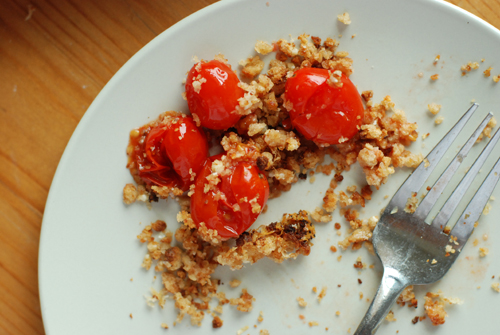
That quality that we all love about good raw tomatoes -- that so-juicy-it'll-burst thing -- can be mimicked by heating subpar tomatoes. This concentrates intensifies their flavor, and also stretches the tomato skin taut, so that when you bite into one, the innards burst in your mouth. Top said heated cherry tomatoes with a thick blanket of feta and parmesan-spiked homemade breadcrumbs, and you're on your way to heaven. Given that the tomatoes aren't the best, you should compensate by using high-quality ingredients for the rest of the dish. I use homemade breadcrumbs, really good butter, and parmigiano reggiano cheese.

I can imagine this going wonderfully with a steak dinner; alternatively, pair it with a salad, a frittata, or roasted vegetables for a light supper.

Bursting Hot Tomatoes with Cheesy Breadcrumbs

serves 2

1 pint cherry tomatoes, best you can find but supermarket will do 1 cup homemade breadcrumbs 1 tablespoon butter 1/8 cup crumbled feta cheese 1/8 cup grated parmesan cheese black pepper

Preheat oven to 400 degrees. Spread the tomatoes in a single layer in an ovenproof casserole.

In a small saucepan over medium heat, melt butter. Add breadcrumbs; toss to coat evenly, then continue to cook until golden, about 5 minutes.

Transfer breadcrumbs to a small bowl; mix in feta, parmesan, and several grinds of black pepper. Spread evenly over tomatoes. Bake until breadcrumbs are well browned, about 15 minutes. Serve immediately.

Down and Dirty Pasta e Cecci

Anything that has the words "down and dirty" in the title is something I will, sooner or later, make. "Down and dirty" suggests a rough-and-tumble version of the refined original, something you're more likely to eat on your front stoop than in a dining room. When I hear down and dirty, I see myself in cutoff jean shorts and one of those ribbed white tank tops, sitting outside on a balmy summer day. There are mosquitos in the air, bangs in my face. I'm eating from a clay bowl I threw in the pottery studio down the street. When lunchtime rolls around, I notice some chickpeas in the cabinet, so I decide to throw them in with some chili, anchovies, and pasta, and call it lunch. Down and dirty lunch, that is.

Surely you can understand how, when I saw a recipe for "down and dirty pasta e cecci" on Food52's website (via Jennifer Steinhauser of NYT, via her friend fisheri -- that's his username, not his real name -- oh, the confusion!), I simply had to make it. Mind you, I didn't even know what "cecci" were. I don't speak Italian. But down and dirty pasta is something that best be coming out of my kitchen, like, pronto.

I read the recipe around 8am. Turns out cecci are chickpeas. Great! I love chickpeas. At 8:03, I was in the kitchen, a pot of water boiling on the stove, rummaging through my cabinets for a (suddenly precious) can of chickpeas. With good anchovies in the fridge and a can of tomatoes by my side, I was moments away from having a tupperware of down and dirty pasta and cecci for lunch. Chickpeas were found, I got down and dirty in the kitchen, the rest is down and dirty history.

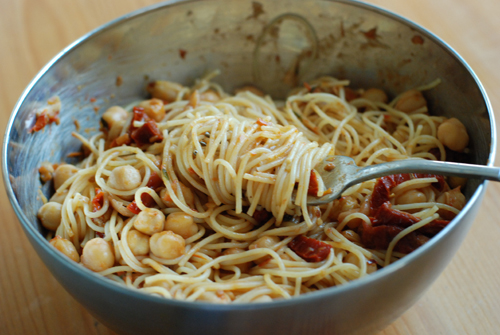
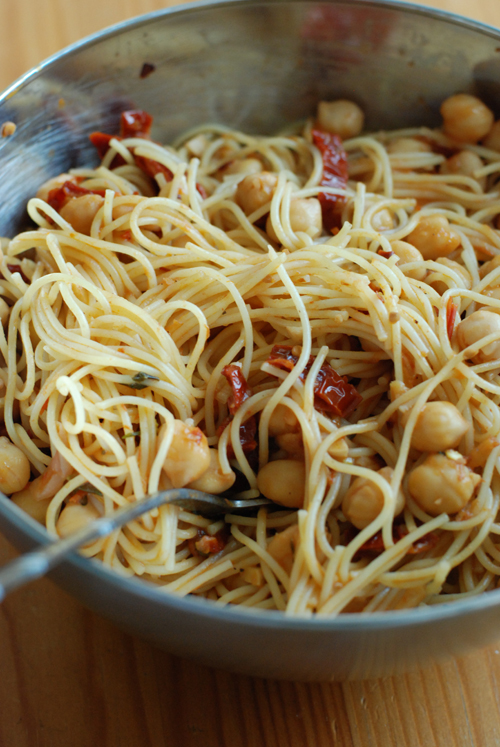
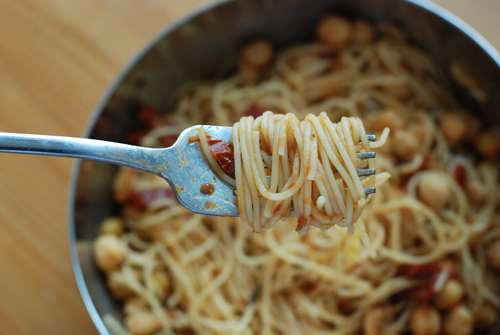
As Jennifer rightly points out, this is the kind of recipe that lends itself to adjustments -- both intentional and entirely accidental ones. Fisheri calls for fresh tomatoes, but I assure you if he'd written the recipe during an East Coast winter, he'd have called for canned. I actually cheated and used half canned tomatoes, half sundried tomatoes that I reconstituted in a bit of boiling water. Come summer, I'll try this with fresh ones, but not these days. I have a unconquerable weakness for spice, so I've added chili flakes both times I've made this recipe, and highly recommend them. Fisheri called for farfalle or another small pasta, but I broke all the rules and used spaghetti. Know what? It was still delicious. In terms of the liquid used, I've tried it with chicken broth and water; both are fine, broth is is better. If you use water, be sure to really load up that bowl with cheese. As for the rosemary: it's delicious, but so was a sprig of thyme that I accidentally used instead. Any which way you make it, dinner (or lunch) just doesn't get much easier.

Also, now that I have your attention, apologies for the shameless self-promotion, but if I can't do it here, where can I? I'm super excited to announce that I'm featured in this week's Washingtonian Blogger Beat! Check it out!

Down and Dirty Pasta e Cecci From Food52, via Jennifer Steinhauser, via her friend Fisheri

2 cloves garlic 4 filets anchovies 3 sprigs rosemary 3 tablespoons olive oil chili flakes to taste 1 can chickpeas, drained 4 ripe plum tomatoes (or 4 canned tomatoes, strained if desired; or a mix of canned and sundried, reconstituted; you get the drift: anything goes.) 1/2 pound small pasta like farfalle (I used spaghetti) 4 cups chicken broth or water heaps of grated parmesan salt and pepper

Dice garlic, roughly chop anchovies, and cut up tomatoes.

If using water instead of broth, bring water to a boil in small pot.

In a large pot over medium heat, saute the garlic, anchovies, and two sprigs of rosemary in olive oil until anchovies melt into the oil. Add chili flakes, if using.

Add chopped tomatoes. Saute 10-15 minutes, until tomatoes are cooked through. Taste, and salt if needed.

Turn heat to medium-high and add chickpeas, along with a few cups of boiling water or chicken broth. Ad last sprig of rosemary and bring the whole thing to a gentle boil.

Add pasta. If liquid doesn't cover pasta, add enough that it's just covered. Reduce heat to simmer and cook for one minute less than the pasta package recommends. You want the pasta to be cooking in what will become its sauce, so add liquid only if necessary; you don't want the sauce to be too thin.

When the pasta is done, spoon it into bowls, grind in some pepper, and top with as much parmesan cheese as your heart desires. Add a glug of olive oil, if you like. Dig in.